

360
M. Antoniou et al.
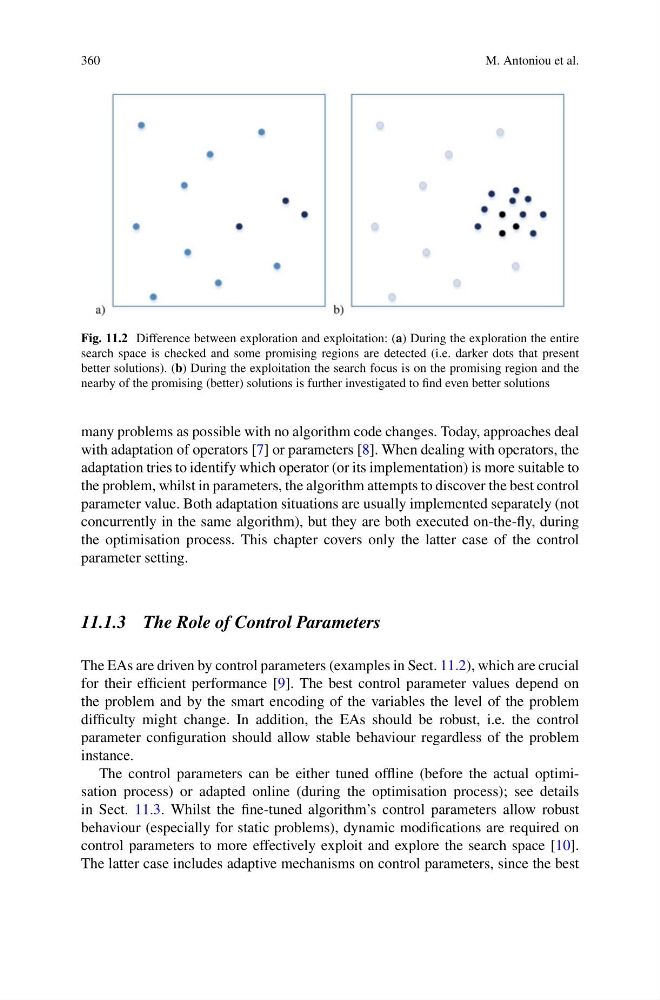
Fig. 11.2 Difference between exploration and exploitation: (a) During the exploration the entire
search space is checked and some promising regions are detected (i.e. darker dots that present
better solutions). (b) During the exploitation the search focus is on the promising region and the
nearby of the promising (better) solutions is further investigated to find even better solutions
many problems as possible with no algorithm code changes. Today, approaches deal
with adaptation of operators [7] or parameters [8]. When dealing with operators, the
adaptation tries to identify which operator (or its implementation) is more suitable to
the problem, whilst in parameters, the algorithm attempts to discover the best control
parameter value. Both adaptation situations are usually implemented separately (not
concurrently in the same algorithm), but they are both executed on-the-fly, during
the optimisation process. This chapter covers only the latter case of the control
parameter setting.
11.1.3 The Role of Control Parameters
The EAs are driven by control parameters (examples in Sect. 11.2), which are crucial
for their efficient performance [9]. The best control parameter values depend on
the problem and by the smart encoding of the variables the level of the problem
difficulty might change. In addition, the EAs should be robust, i.e. the control
parameter configuration should allow stable behaviour regardless of the problem
instance.
The control parameters can be either tuned offline (before the actual optimisation process) or adapted online (during the optimisation process); see details
in Sect. 11.3. Whilst the fine-tuned algorithm’s control parameters allow robust
behaviour (especially for static problems), dynamic modifications are required on
control parameters to more effectively exploit and explore the search space [10].
The latter case includes adaptive mechanisms on control parameters, since the best
M. Antoniou et al.
Fig. 11.2 Difference between exploration and exploitation: (a) During the exploration the entire
search space is checked and some promising regions are detected (i.e. darker dots that present
better solutions). (b) During the exploitation the search focus is on the promising region and the
nearby of the promising (better) solutions is further investigated to find even better solutions
many problems as possible with no algorithm code changes. Today, approaches deal
with adaptation of operators [7] or parameters [8]. When dealing with operators, the
adaptation tries to identify which operator (or its implementation) is more suitable to
the problem, whilst in parameters, the algorithm attempts to discover the best control
parameter value. Both adaptation situations are usually implemented separately (not
concurrently in the same algorithm), but they are both executed on-the-fly, during
the optimisation process. This chapter covers only the latter case of the control
parameter setting.
11.1.3 The Role of Control Parameters
The EAs are driven by control parameters (examples in Sect. 11.2), which are crucial
for their efficient performance [9]. The best control parameter values depend on
the problem and by the smart encoding of the variables the level of the problem
difficulty might change. In addition, the EAs should be robust, i.e. the control
parameter configuration should allow stable behaviour regardless of the problem
instance.
The control parameters can be either tuned offline (before the actual optimisation process) or adapted online (during the optimisation process); see details
in Sect. 11.3. Whilst the fine-tuned algorithm’s control parameters allow robust
behaviour (especially for static problems), dynamic modifications are required on
control parameters to more effectively exploit and explore the search space [10].
The latter case includes adaptive mechanisms on control parameters, since the best