

10 Sequential Parameter Optimization for Mixed-Discrete Problems
337
variables on the output. One example of sensitivity analysis applied to aircraft
design is given in [48].
A classic method for screening and sensitivity analysis using experimental
designs is the modeling and analysis of regression models [14]. Common examples
are the analysis of p-values in linear regression, mean decrease impurity in random
forests [12] and the theta values of Kriging models [19].
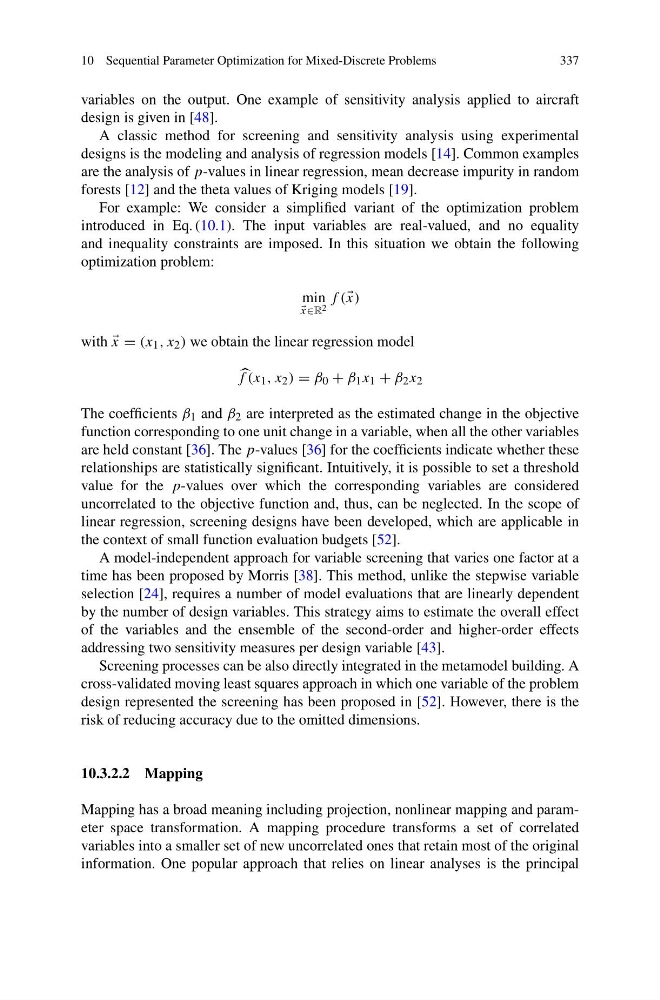
For example: We consider a simplified variant of the optimization problem
introduced in Eq. (10.1). The input variables are real-valued, and no equality
and inequality constraints are imposed. In this situation we obtain the following
optimization problem:
min
x∈R 2
f ( x)
with
x = (x 1 , x 2 ) we obtain the linear regression model
f (x 1 , x 2 ) = β 0 + β 1 x 1 + β 2 x 2
The coefficients β 1 and β 2 are interpreted as the estimated change in the objective
function corresponding to one unit change in a variable, when all the other variables
are held constant [36]. The p-values [36] for the coefficients indicate whether these
relationships are statistically significant. Intuitively, it is possible to set a threshold
value for the p-values over which the corresponding variables are considered
uncorrelated to the objective function and, thus, can be neglected. In the scope of
linear regression, screening designs have been developed, which are applicable in
the context of small function evaluation budgets [52].
A model-independent approach for variable screening that varies one factor at a
time has been proposed by Morris [38]. This method, unlike the stepwise variable
selection [24], requires a number of model evaluations that are linearly dependent
by the number of design variables. This strategy aims to estimate the overall effect
of the variables and the ensemble of the second-order and higher-order effects
addressing two sensitivity measures per design variable [43].
Screening processes can be also directly integrated in the metamodel building. A
cross-validated moving least squares approach in which one variable of the problem
design represented the screening has been proposed in [52]. However, there is the
risk of reducing accuracy due to the omitted dimensions.
10.3.2.2 Mapping
Mapping has a broad meaning including projection, nonlinear mapping and parameter space transformation. A mapping procedure transforms a set of correlated
variables into a smaller set of new uncorrelated ones that retain most of the original
information. One popular approach that relies on linear analyses is the principal
337
variables on the output. One example of sensitivity analysis applied to aircraft
design is given in [48].
A classic method for screening and sensitivity analysis using experimental
designs is the modeling and analysis of regression models [14]. Common examples
are the analysis of p-values in linear regression, mean decrease impurity in random
forests [12] and the theta values of Kriging models [19].
For example: We consider a simplified variant of the optimization problem
introduced in Eq. (10.1). The input variables are real-valued, and no equality
and inequality constraints are imposed. In this situation we obtain the following
optimization problem:
min
x∈R 2
f ( x)
with
x = (x 1 , x 2 ) we obtain the linear regression model
f (x 1 , x 2 ) = β 0 + β 1 x 1 + β 2 x 2
The coefficients β 1 and β 2 are interpreted as the estimated change in the objective
function corresponding to one unit change in a variable, when all the other variables
are held constant [36]. The p-values [36] for the coefficients indicate whether these
relationships are statistically significant. Intuitively, it is possible to set a threshold
value for the p-values over which the corresponding variables are considered
uncorrelated to the objective function and, thus, can be neglected. In the scope of
linear regression, screening designs have been developed, which are applicable in
the context of small function evaluation budgets [52].
A model-independent approach for variable screening that varies one factor at a
time has been proposed by Morris [38]. This method, unlike the stepwise variable
selection [24], requires a number of model evaluations that are linearly dependent
by the number of design variables. This strategy aims to estimate the overall effect
of the variables and the ensemble of the second-order and higher-order effects
addressing two sensitivity measures per design variable [43].
Screening processes can be also directly integrated in the metamodel building. A
cross-validated moving least squares approach in which one variable of the problem
design represented the screening has been proposed in [52]. However, there is the
risk of reducing accuracy due to the omitted dimensions.
10.3.2.2 Mapping
Mapping has a broad meaning including projection, nonlinear mapping and parameter space transformation. A mapping procedure transforms a set of correlated
variables into a smaller set of new uncorrelated ones that retain most of the original
information. One popular approach that relies on linear analyses is the principal