

334
L. Gentile et al.
numerical analysis. This causes significant costs with respect to time or resources.
Surrogate model-based optimization (SMBO) aims to handle the complex variable
structures and the limited budget simultaneously. Sequential parameter optimization
(SPO) pursues the identification of global optima, making advantage of a budget
allocation process that maximizes the information gaining in promising regions.
This chapter aims to show an efficient method to face mixed-discrete optimization
problems utilizing SPO. Particularly, the chapter is structured as follows: Sect. 10.2
introduces the problem definition, Sect. 10.3 describes the challenges that are
common in this problem domain, Sect. 10.4 contains a thorough description of
SPO, and finally an application of SPO on real-world discrete-mixed optimization
problem is presented in Sect. 10.5.
10.2 Problem Definition
Optimization can be seen as the process of searching for the best candidate solution
in the search space, which maximizes or minimizes an objective function. Without
loss of generality, we refer to optimization as a minimization process. In this
chapter, we will focus on describing problems including real-valued variables,
ordinal integers, and categorical (uncountable) variables.
Let f : R n r × Z n z × D n d → R denote the objective function to be optimized,
g j : R n r × Z n z × D n d → R, 1 ≤ j ≤ n g the inequality constraints and h k :
R n r × Z n z × D n d → R, 1 ≤ k ≤ n h the equality constraints.
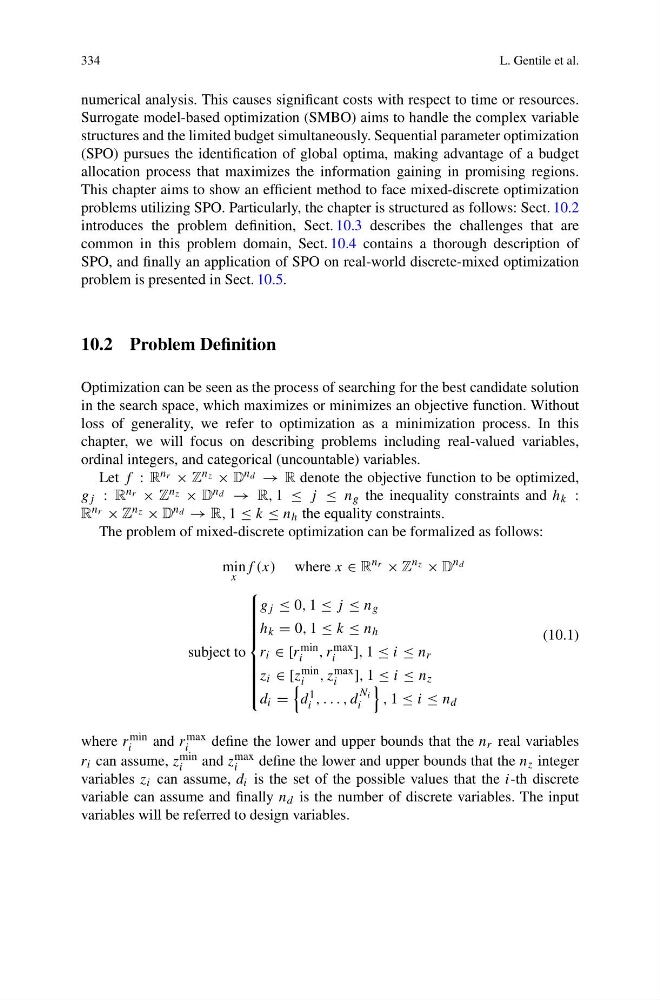
The problem of mixed-discrete optimization can be formalized as follows:
min
x
f (x) where x ∈ R
n r × Z
n z × D
n d
subject to
⎧
⎪ ⎪ ⎪ ⎪ ⎪ ⎪ ⎪ ⎨
⎪ ⎪ ⎪ ⎪ ⎪ ⎪ ⎪ ⎩
g j ≤ 0, 1 ≤ j ≤ n g
h k = 0, 1 ≤ k ≤ n h
r i ∈ [r min
i , r max
i
], 1 ≤ i ≤ n r
z i ∈ [z min
i , z max
i ], 1 ≤ i ≤ n z
d i =
d 1
i , . . . , d
N i
i
, 1 ≤ i ≤ n d
(10.1)
where r min
i
and r max
i
define the lower and upper bounds that the n r real variables
r i can assume, z min
i
and z max
i
define the lower and upper bounds that the n z integer
variables z i can assume, d i is the set of the possible values that the i-th discrete
variable can assume and finally n d is the number of discrete variables. The input
variables will be referred to design variables.
L. Gentile et al.
numerical analysis. This causes significant costs with respect to time or resources.
Surrogate model-based optimization (SMBO) aims to handle the complex variable
structures and the limited budget simultaneously. Sequential parameter optimization
(SPO) pursues the identification of global optima, making advantage of a budget
allocation process that maximizes the information gaining in promising regions.
This chapter aims to show an efficient method to face mixed-discrete optimization
problems utilizing SPO. Particularly, the chapter is structured as follows: Sect. 10.2
introduces the problem definition, Sect. 10.3 describes the challenges that are
common in this problem domain, Sect. 10.4 contains a thorough description of
SPO, and finally an application of SPO on real-world discrete-mixed optimization
problem is presented in Sect. 10.5.
10.2 Problem Definition
Optimization can be seen as the process of searching for the best candidate solution
in the search space, which maximizes or minimizes an objective function. Without
loss of generality, we refer to optimization as a minimization process. In this
chapter, we will focus on describing problems including real-valued variables,
ordinal integers, and categorical (uncountable) variables.
Let f : R n r × Z n z × D n d → R denote the objective function to be optimized,
g j : R n r × Z n z × D n d → R, 1 ≤ j ≤ n g the inequality constraints and h k :
R n r × Z n z × D n d → R, 1 ≤ k ≤ n h the equality constraints.
The problem of mixed-discrete optimization can be formalized as follows:
min
x
f (x) where x ∈ R
n r × Z
n z × D
n d
subject to
⎧
⎪ ⎪ ⎪ ⎪ ⎪ ⎪ ⎪ ⎨
⎪ ⎪ ⎪ ⎪ ⎪ ⎪ ⎪ ⎩
g j ≤ 0, 1 ≤ j ≤ n g
h k = 0, 1 ≤ k ≤ n h
r i ∈ [r min
i , r max
i
], 1 ≤ i ≤ n r
z i ∈ [z min
i , z max
i ], 1 ≤ i ≤ n z
d i =
d 1
i , . . . , d
N i
i
, 1 ≤ i ≤ n d
(10.1)
where r min
i
and r max
i
define the lower and upper bounds that the n r real variables
r i can assume, z min
i
and z max
i
define the lower and upper bounds that the n z integer
variables z i can assume, d i is the set of the possible values that the i-th discrete
variable can assume and finally n d is the number of discrete variables. The input
variables will be referred to design variables.