

326
M. Antoniou and P. Korošec
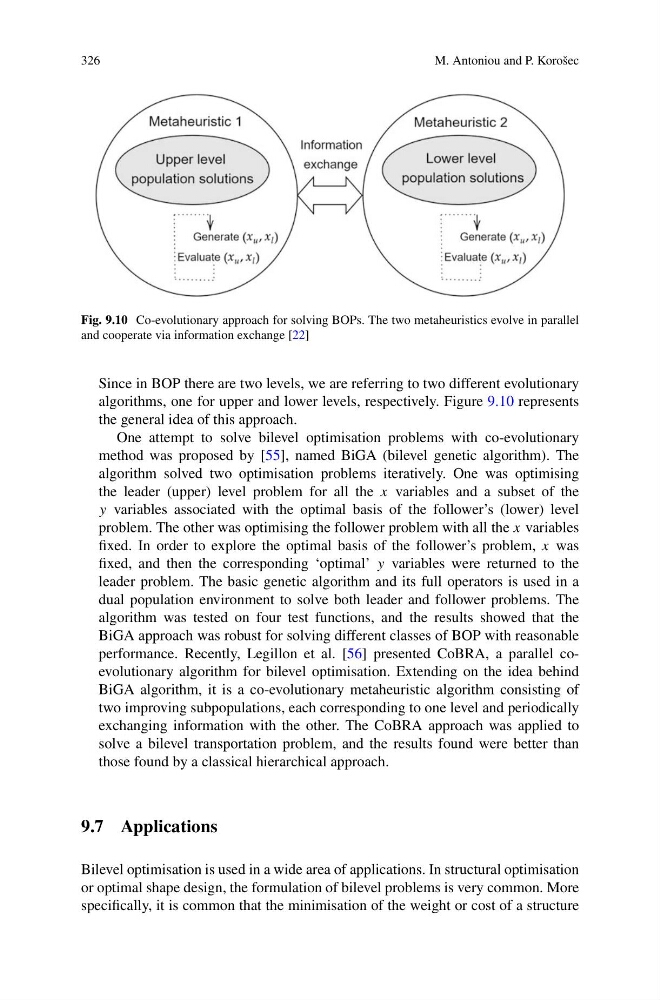
Fig. 9.10 Co-evolutionary approach for solving BOPs. The two metaheuristics evolve in parallel
and cooperate via information exchange [22]
Since in BOP there are two levels, we are referring to two different evolutionary
algorithms, one for upper and lower levels, respectively. Figure 9.10 represents
the general idea of this approach.
One attempt to solve bilevel optimisation problems with co-evolutionary
method was proposed by [55], named BiGA (bilevel genetic algorithm). The
algorithm solved two optimisation problems iteratively. One was optimising
the leader (upper) level problem for all the x variables and a subset of the
y variables associated with the optimal basis of the follower’s (lower) level
problem. The other was optimising the follower problem with all the x variables
fixed. In order to explore the optimal basis of the follower’s problem, x was
fixed, and then the corresponding ‘optimal’ y variables were returned to the
leader problem. The basic genetic algorithm and its full operators is used in a
dual population environment to solve both leader and follower problems. The
algorithm was tested on four test functions, and the results showed that the
BiGA approach was robust for solving different classes of BOP with reasonable
performance. Recently, Legillon et al. [56] presented CoBRA, a parallel coevolutionary algorithm for bilevel optimisation. Extending on the idea behind
BiGA algorithm, it is a co-evolutionary metaheuristic algorithm consisting of
two improving subpopulations, each corresponding to one level and periodically
exchanging information with the other. The CoBRA approach was applied to
solve a bilevel transportation problem, and the results found were better than
those found by a classical hierarchical approach.
9.7 Applications
Bilevel optimisation is used in a wide area of applications. In structural optimisation
or optimal shape design, the formulation of bilevel problems is very common. More
specifically, it is common that the minimisation of the weight or cost of a structure
M. Antoniou and P. Korošec
Fig. 9.10 Co-evolutionary approach for solving BOPs. The two metaheuristics evolve in parallel
and cooperate via information exchange [22]
Since in BOP there are two levels, we are referring to two different evolutionary
algorithms, one for upper and lower levels, respectively. Figure 9.10 represents
the general idea of this approach.
One attempt to solve bilevel optimisation problems with co-evolutionary
method was proposed by [55], named BiGA (bilevel genetic algorithm). The
algorithm solved two optimisation problems iteratively. One was optimising
the leader (upper) level problem for all the x variables and a subset of the
y variables associated with the optimal basis of the follower’s (lower) level
problem. The other was optimising the follower problem with all the x variables
fixed. In order to explore the optimal basis of the follower’s problem, x was
fixed, and then the corresponding ‘optimal’ y variables were returned to the
leader problem. The basic genetic algorithm and its full operators is used in a
dual population environment to solve both leader and follower problems. The
algorithm was tested on four test functions, and the results showed that the
BiGA approach was robust for solving different classes of BOP with reasonable
performance. Recently, Legillon et al. [56] presented CoBRA, a parallel coevolutionary algorithm for bilevel optimisation. Extending on the idea behind
BiGA algorithm, it is a co-evolutionary metaheuristic algorithm consisting of
two improving subpopulations, each corresponding to one level and periodically
exchanging information with the other. The CoBRA approach was applied to
solve a bilevel transportation problem, and the results found were better than
those found by a classical hierarchical approach.
9.7 Applications
Bilevel optimisation is used in a wide area of applications. In structural optimisation
or optimal shape design, the formulation of bilevel problems is very common. More
specifically, it is common that the minimisation of the weight or cost of a structure