

322
M. Antoniou and P. Korošec
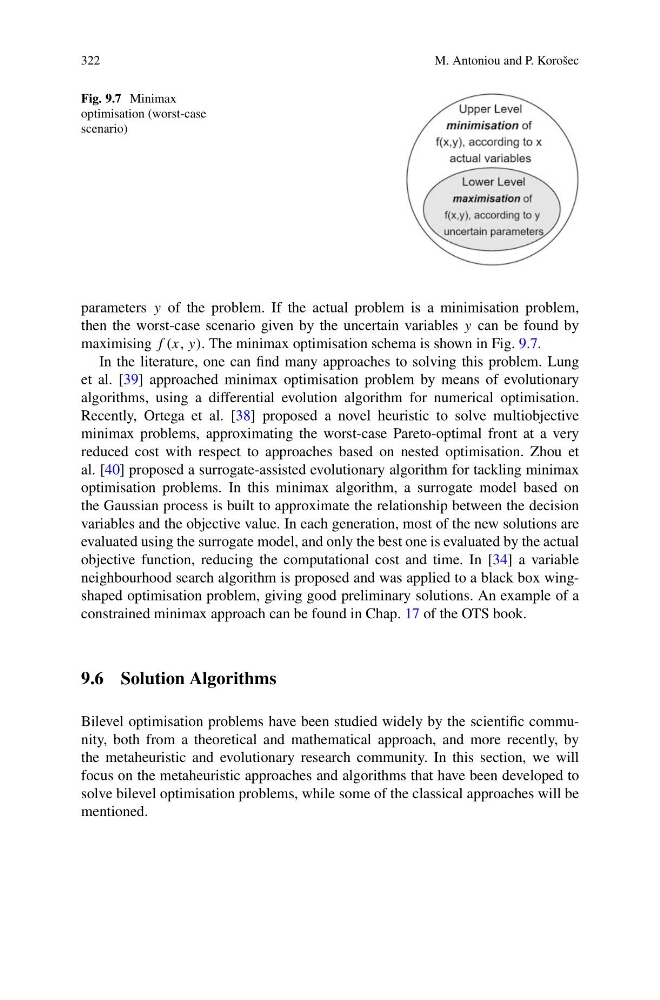
Fig. 9.7 Minimax
optimisation (worst-case
scenario)
parameters y of the problem. If the actual problem is a minimisation problem,
then the worst-case scenario given by the uncertain variables y can be found by
maximising f (x, y). The minimax optimisation schema is shown in Fig. 9.7.
In the literature, one can find many approaches to solving this problem. Lung
et al. [39] approached minimax optimisation problem by means of evolutionary
algorithms, using a differential evolution algorithm for numerical optimisation.
Recently, Ortega et al. [38] proposed a novel heuristic to solve multiobjective
minimax problems, approximating the worst-case Pareto-optimal front at a very
reduced cost with respect to approaches based on nested optimisation. Zhou et
al. [40] proposed a surrogate-assisted evolutionary algorithm for tackling minimax
optimisation problems. In this minimax algorithm, a surrogate model based on
the Gaussian process is built to approximate the relationship between the decision
variables and the objective value. In each generation, most of the new solutions are
evaluated using the surrogate model, and only the best one is evaluated by the actual
objective function, reducing the computational cost and time. In [34] a variable
neighbourhood search algorithm is proposed and was applied to a black box wingshaped optimisation problem, giving good preliminary solutions. An example of a
constrained minimax approach can be found in Chap. 17 of the OTS book.
9.6 Solution Algorithms
Bilevel optimisation problems have been studied widely by the scientific community, both from a theoretical and mathematical approach, and more recently, by
the metaheuristic and evolutionary research community. In this section, we will
focus on the metaheuristic approaches and algorithms that have been developed to
solve bilevel optimisation problems, while some of the classical approaches will be
mentioned.
M. Antoniou and P. Korošec
Fig. 9.7 Minimax
optimisation (worst-case
scenario)
parameters y of the problem. If the actual problem is a minimisation problem,
then the worst-case scenario given by the uncertain variables y can be found by
maximising f (x, y). The minimax optimisation schema is shown in Fig. 9.7.
In the literature, one can find many approaches to solving this problem. Lung
et al. [39] approached minimax optimisation problem by means of evolutionary
algorithms, using a differential evolution algorithm for numerical optimisation.
Recently, Ortega et al. [38] proposed a novel heuristic to solve multiobjective
minimax problems, approximating the worst-case Pareto-optimal front at a very
reduced cost with respect to approaches based on nested optimisation. Zhou et
al. [40] proposed a surrogate-assisted evolutionary algorithm for tackling minimax
optimisation problems. In this minimax algorithm, a surrogate model based on
the Gaussian process is built to approximate the relationship between the decision
variables and the objective value. In each generation, most of the new solutions are
evaluated using the surrogate model, and only the best one is evaluated by the actual
objective function, reducing the computational cost and time. In [34] a variable
neighbourhood search algorithm is proposed and was applied to a black box wingshaped optimisation problem, giving good preliminary solutions. An example of a
constrained minimax approach can be found in Chap. 17 of the OTS book.
9.6 Solution Algorithms
Bilevel optimisation problems have been studied widely by the scientific community, both from a theoretical and mathematical approach, and more recently, by
the metaheuristic and evolutionary research community. In this section, we will
focus on the metaheuristic approaches and algorithms that have been developed to
solve bilevel optimisation problems, while some of the classical approaches will be
mentioned.