

310
M. Antoniou and P. Korošec
the rest of the chapter, as we believe that this is the best way for an introduction to
multilevel optimisation problems.
9.3 Bilevel Optimisation Problem
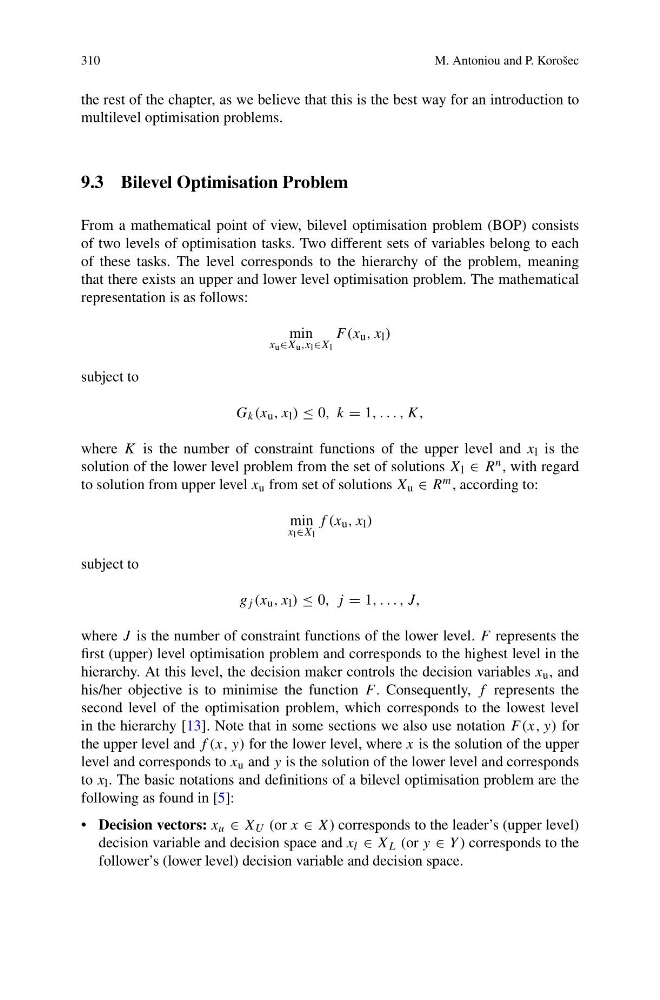
From a mathematical point of view, bilevel optimisation problem (BOP) consists
of two levels of optimisation tasks. Two different sets of variables belong to each
of these tasks. The level corresponds to the hierarchy of the problem, meaning
that there exists an upper and lower level optimisation problem. The mathematical
representation is as follows:
min
x u ∈X u ,x l ∈X l
F (x u , x l )
subject to
G k (x u , x l ) ≤ 0, k = 1, . . . , K,
where K is the number of constraint functions of the upper level and x l is the
solution of the lower level problem from the set of solutions X l ∈ R n , with regard
to solution from upper level x u from set of solutions X u ∈ R m , according to:
min
x l ∈X l
f (x u , x l )
subject to
g j (x u , x l ) ≤ 0, j = 1, . . . , J,
where J is the number of constraint functions of the lower level. F represents the
first (upper) level optimisation problem and corresponds to the highest level in the
hierarchy. At this level, the decision maker controls the decision variables x u , and
his/her objective is to minimise the function F . Consequently, f represents the
second level of the optimisation problem, which corresponds to the lowest level
in the hierarchy [13]. Note that in some sections we also use notation F (x, y) for
the upper level and f (x, y) for the lower level, where x is the solution of the upper
level and corresponds to x u and y is the solution of the lower level and corresponds
to x l . The basic notations and definitions of a bilevel optimisation problem are the
following as found in [5]:
• Decision vectors: x u ∈ X U (or x ∈ X) corresponds to the leader’s (upper level)
decision variable and decision space and x l ∈ X L (or y ∈ Y ) corresponds to the
follower’s (lower level) decision variable and decision space.
M. Antoniou and P. Korošec
the rest of the chapter, as we believe that this is the best way for an introduction to
multilevel optimisation problems.
9.3 Bilevel Optimisation Problem
From a mathematical point of view, bilevel optimisation problem (BOP) consists
of two levels of optimisation tasks. Two different sets of variables belong to each
of these tasks. The level corresponds to the hierarchy of the problem, meaning
that there exists an upper and lower level optimisation problem. The mathematical
representation is as follows:
min
x u ∈X u ,x l ∈X l
F (x u , x l )
subject to
G k (x u , x l ) ≤ 0, k = 1, . . . , K,
where K is the number of constraint functions of the upper level and x l is the
solution of the lower level problem from the set of solutions X l ∈ R n , with regard
to solution from upper level x u from set of solutions X u ∈ R m , according to:
min
x l ∈X l
f (x u , x l )
subject to
g j (x u , x l ) ≤ 0, j = 1, . . . , J,
where J is the number of constraint functions of the lower level. F represents the
first (upper) level optimisation problem and corresponds to the highest level in the
hierarchy. At this level, the decision maker controls the decision variables x u , and
his/her objective is to minimise the function F . Consequently, f represents the
second level of the optimisation problem, which corresponds to the lowest level
in the hierarchy [13]. Note that in some sections we also use notation F (x, y) for
the upper level and f (x, y) for the lower level, where x is the solution of the upper
level and corresponds to x u and y is the solution of the lower level and corresponds
to x l . The basic notations and definitions of a bilevel optimisation problem are the
following as found in [5]:
• Decision vectors: x u ∈ X U (or x ∈ X) corresponds to the leader’s (upper level)
decision variable and decision space and x l ∈ X L (or y ∈ Y ) corresponds to the
follower’s (lower level) decision variable and decision space.