

278
D. Irawan and B. Naujoks
Analogously, in optimization, the method is the same; however, instead of letters,
we have objectives, and the number of objectives is always the same for all designs.
The objectives must be ordered by importance.
Aggregation Method
Another way to deal with the ambiguity of optimality in many-objective problems
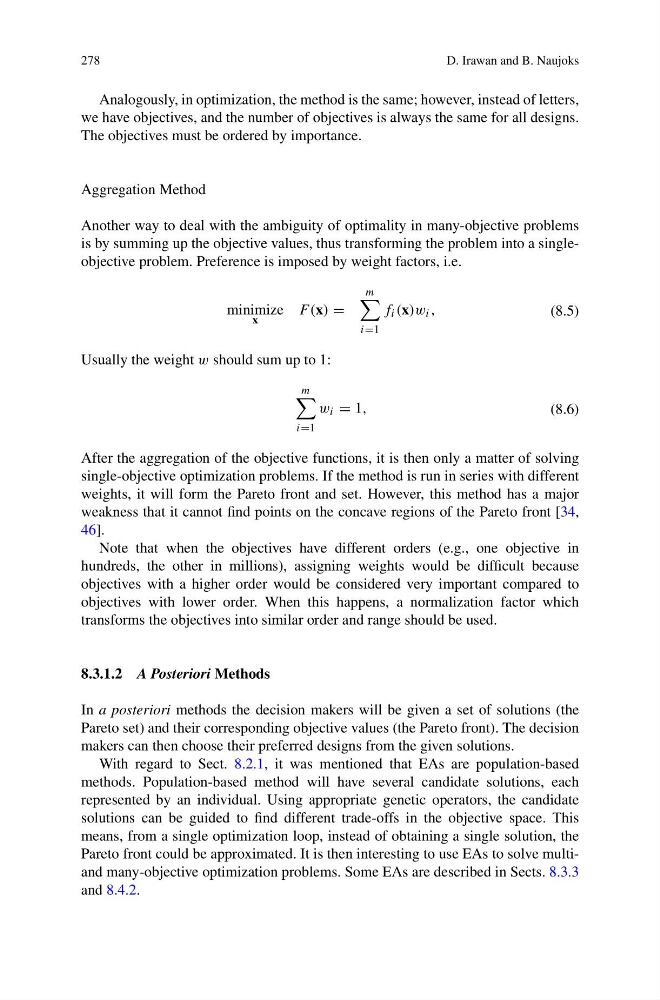
is by summing up the objective values, thus transforming the problem into a singleobjective problem. Preference is imposed by weight factors, i.e.
minimize
x
F (x) =
m
i=1
f i (x)w i ,
(8.5)
Usually the weight w should sum up to 1:
m
i=1
w i = 1,
(8.6)
After the aggregation of the objective functions, it is then only a matter of solving
single-objective optimization problems. If the method is run in series with different
weights, it will form the Pareto front and set. However, this method has a major
weakness that it cannot find points on the concave regions of the Pareto front [34,
46].
Note that when the objectives have different orders (e.g., one objective in
hundreds, the other in millions), assigning weights would be difficult because
objectives with a higher order would be considered very important compared to
objectives with lower order. When this happens, a normalization factor which
transforms the objectives into similar order and range should be used.
8.3.1.2 A Posteriori Methods
In a posteriori methods the decision makers will be given a set of solutions (the
Pareto set) and their corresponding objective values (the Pareto front). The decision
makers can then choose their preferred designs from the given solutions.
With regard to Sect. 8.2.1, it was mentioned that EAs are population-based
methods. Population-based method will have several candidate solutions, each
represented by an individual. Using appropriate genetic operators, the candidate
solutions can be guided to find different trade-offs in the objective space. This
means, from a single optimization loop, instead of obtaining a single solution, the
Pareto front could be approximated. It is then interesting to use EAs to solve multiand many-objective optimization problems. Some EAs are described in Sects. 8.3.3
and 8.4.2.
D. Irawan and B. Naujoks
Analogously, in optimization, the method is the same; however, instead of letters,
we have objectives, and the number of objectives is always the same for all designs.
The objectives must be ordered by importance.
Aggregation Method
Another way to deal with the ambiguity of optimality in many-objective problems
is by summing up the objective values, thus transforming the problem into a singleobjective problem. Preference is imposed by weight factors, i.e.
minimize
x
F (x) =
m
i=1
f i (x)w i ,
(8.5)
Usually the weight w should sum up to 1:
m
i=1
w i = 1,
(8.6)
After the aggregation of the objective functions, it is then only a matter of solving
single-objective optimization problems. If the method is run in series with different
weights, it will form the Pareto front and set. However, this method has a major
weakness that it cannot find points on the concave regions of the Pareto front [34,
46].
Note that when the objectives have different orders (e.g., one objective in
hundreds, the other in millions), assigning weights would be difficult because
objectives with a higher order would be considered very important compared to
objectives with lower order. When this happens, a normalization factor which
transforms the objectives into similar order and range should be used.
8.3.1.2 A Posteriori Methods
In a posteriori methods the decision makers will be given a set of solutions (the
Pareto set) and their corresponding objective values (the Pareto front). The decision
makers can then choose their preferred designs from the given solutions.
With regard to Sect. 8.2.1, it was mentioned that EAs are population-based
methods. Population-based method will have several candidate solutions, each
represented by an individual. Using appropriate genetic operators, the candidate
solutions can be guided to find different trade-offs in the objective space. This
means, from a single optimization loop, instead of obtaining a single solution, the
Pareto front could be approximated. It is then interesting to use EAs to solve multiand many-objective optimization problems. Some EAs are described in Sects. 8.3.3
and 8.4.2.