

8 An Introduction to Many-Objective Evolutionary Optimization
275
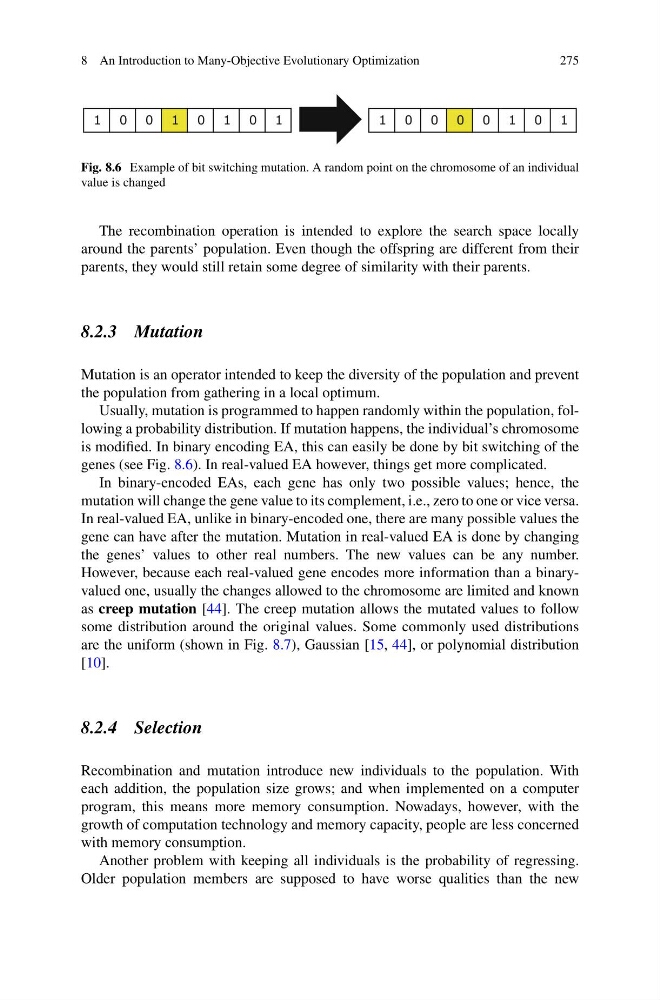
Fig. 8.6 Example of bit switching mutation. A random point on the chromosome of an individual
value is changed
The recombination operation is intended to explore the search space locally
around the parents’ population. Even though the offspring are different from their
parents, they would still retain some degree of similarity with their parents.
8.2.3 Mutation
Mutation is an operator intended to keep the diversity of the population and prevent
the population from gathering in a local optimum.
Usually, mutation is programmed to happen randomly within the population, following a probability distribution. If mutation happens, the individual’s chromosome
is modified. In binary encoding EA, this can easily be done by bit switching of the
genes (see Fig. 8.6). In real-valued EA however, things get more complicated.
In binary-encoded EAs, each gene has only two possible values; hence, the
mutation will change the gene value to its complement, i.e., zero to one or vice versa.
In real-valued EA, unlike in binary-encoded one, there are many possible values the
gene can have after the mutation. Mutation in real-valued EA is done by changing
the genes’ values to other real numbers. The new values can be any number.
However, because each real-valued gene encodes more information than a binaryvalued one, usually the changes allowed to the chromosome are limited and known
as creep mutation [44]. The creep mutation allows the mutated values to follow
some distribution around the original values. Some commonly used distributions
are the uniform (shown in Fig. 8.7), Gaussian [15, 44], or polynomial distribution
[10].
8.2.4 Selection
Recombination and mutation introduce new individuals to the population. With
each addition, the population size grows; and when implemented on a computer
program, this means more memory consumption. Nowadays, however, with the
growth of computation technology and memory capacity, people are less concerned
with memory consumption.
Another problem with keeping all individuals is the probability of regressing.
Older population members are supposed to have worse qualities than the new
275
Fig. 8.6 Example of bit switching mutation. A random point on the chromosome of an individual
value is changed
The recombination operation is intended to explore the search space locally
around the parents’ population. Even though the offspring are different from their
parents, they would still retain some degree of similarity with their parents.
8.2.3 Mutation
Mutation is an operator intended to keep the diversity of the population and prevent
the population from gathering in a local optimum.
Usually, mutation is programmed to happen randomly within the population, following a probability distribution. If mutation happens, the individual’s chromosome
is modified. In binary encoding EA, this can easily be done by bit switching of the
genes (see Fig. 8.6). In real-valued EA however, things get more complicated.
In binary-encoded EAs, each gene has only two possible values; hence, the
mutation will change the gene value to its complement, i.e., zero to one or vice versa.
In real-valued EA, unlike in binary-encoded one, there are many possible values the
gene can have after the mutation. Mutation in real-valued EA is done by changing
the genes’ values to other real numbers. The new values can be any number.
However, because each real-valued gene encodes more information than a binaryvalued one, usually the changes allowed to the chromosome are limited and known
as creep mutation [44]. The creep mutation allows the mutated values to follow
some distribution around the original values. Some commonly used distributions
are the uniform (shown in Fig. 8.7), Gaussian [15, 44], or polynomial distribution
[10].
8.2.4 Selection
Recombination and mutation introduce new individuals to the population. With
each addition, the population size grows; and when implemented on a computer
program, this means more memory consumption. Nowadays, however, with the
growth of computation technology and memory capacity, people are less concerned
with memory consumption.
Another problem with keeping all individuals is the probability of regressing.
Older population members are supposed to have worse qualities than the new