

240
A. Riccardi et al.
The need of self-adapting techniques especially for these two parameters
has been widely recognised in the literature. In [36] the authors introduced a
fuzzy adaptive differential evolution algorithm using fuzzy logic controllers to
adapt the parameters for the mutation and crossover operators. The self-adaptive
DE (SADE), described in [37], incorporates a mechanism that self-adapts both
the parameters CR and F and the trial vector generation strategy. In [38] an
adaptation strategy is proposed for parameter F , while CR is kept constant. In
[39] both control parameters are added to each individual of the population and
evolve with it. An alternative approach for the on-line adaptation of both CR and
F parameters and embedded into the general framework of IDEA is proposed
in [40]. The proposed approach uses the Parzen kernel method to build a joint
probabilistic representation of the most promising region of the bivariate CR −F
space. The resulting probability density function (PDF) is updated during the
optimisation process on the basis of obtained results. A further development of
AIDEA is multi-population adaptive inflationary differential evolution algorithm
(MP-AIDEA) [41] where multiple populations are initialised in the search space
and exchange information during the optimisation process.
• Particle swarm optimisation (PSO) [42]: it is a population-based stochastic
optimisation technique developed by Eberhart and Kennedy in 1995 [43],
inspired by the social behaviour of bird flocking or fish schooling. In PSO, the
potential solutions, called particles, fly through the problem space by following
the current optimum particles. Each particle keeps track of its coordinates in the
problem space, which are associated with the best solution it has achieved so far.
The particle swarm optimisation concept consists of, at each iteration, changing
the velocity of each particle i according to a close-loop control mechanism.
7.2.3 Multi-Objective Optimisation
The problem of optimising concurrently two or more objective functions falls
into the category of multi-objective optimisation problems. In contrary to singleobjective optimisation, the purpose is not to find a unique global optimal solution
but rather a set of solutions representing the compromise (trade-offs) between the
different objectives.
Also in multi-objective optimisation, as in single-objective, it is possible to
distinguish between local and global solutions: they will be referred as global
frontier and local frontier.
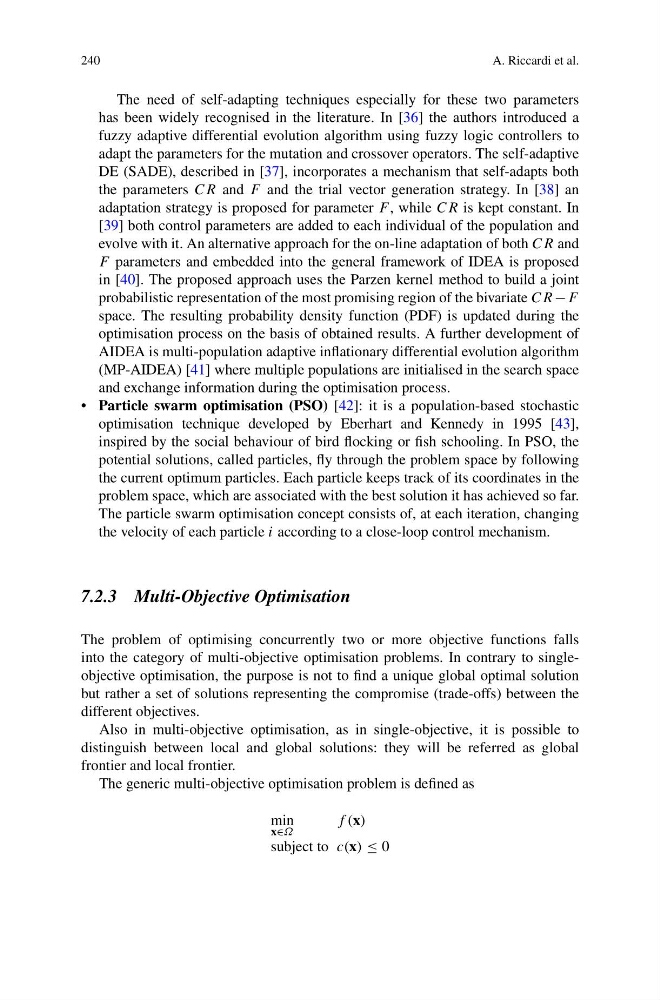
The generic multi-objective optimisation problem is defined as
min
x∈Ω
f (x)
subject to c(x) ≤ 0
A. Riccardi et al.
The need of self-adapting techniques especially for these two parameters
has been widely recognised in the literature. In [36] the authors introduced a
fuzzy adaptive differential evolution algorithm using fuzzy logic controllers to
adapt the parameters for the mutation and crossover operators. The self-adaptive
DE (SADE), described in [37], incorporates a mechanism that self-adapts both
the parameters CR and F and the trial vector generation strategy. In [38] an
adaptation strategy is proposed for parameter F , while CR is kept constant. In
[39] both control parameters are added to each individual of the population and
evolve with it. An alternative approach for the on-line adaptation of both CR and
F parameters and embedded into the general framework of IDEA is proposed
in [40]. The proposed approach uses the Parzen kernel method to build a joint
probabilistic representation of the most promising region of the bivariate CR −F
space. The resulting probability density function (PDF) is updated during the
optimisation process on the basis of obtained results. A further development of
AIDEA is multi-population adaptive inflationary differential evolution algorithm
(MP-AIDEA) [41] where multiple populations are initialised in the search space
and exchange information during the optimisation process.
• Particle swarm optimisation (PSO) [42]: it is a population-based stochastic
optimisation technique developed by Eberhart and Kennedy in 1995 [43],
inspired by the social behaviour of bird flocking or fish schooling. In PSO, the
potential solutions, called particles, fly through the problem space by following
the current optimum particles. Each particle keeps track of its coordinates in the
problem space, which are associated with the best solution it has achieved so far.
The particle swarm optimisation concept consists of, at each iteration, changing
the velocity of each particle i according to a close-loop control mechanism.
7.2.3 Multi-Objective Optimisation
The problem of optimising concurrently two or more objective functions falls
into the category of multi-objective optimisation problems. In contrary to singleobjective optimisation, the purpose is not to find a unique global optimal solution
but rather a set of solutions representing the compromise (trade-offs) between the
different objectives.
Also in multi-objective optimisation, as in single-objective, it is possible to
distinguish between local and global solutions: they will be referred as global
frontier and local frontier.
The generic multi-objective optimisation problem is defined as
min
x∈Ω
f (x)
subject to c(x) ≤ 0