

234
A. Riccardi et al.
A trust region constraint can be added to the algorithm to control the length of the
step, and a quasi-Newton approximation of the Hessian can be used instead of the
second derivatives of the Lagrangian.
7.2.2 Global Optimisation
The effectiveness of the traditional local optimisation techniques on multimodal
objective functions strongly depends on the initial guess solution given to a method.
If a previous knowledge of the problem is available, the designer can provide a
good initial guess to the algorithm to ensure convergence to the global optimum.
Otherwise the algorithm will mostly fail in the global search, getting trapped in one
of the multiple local minima.
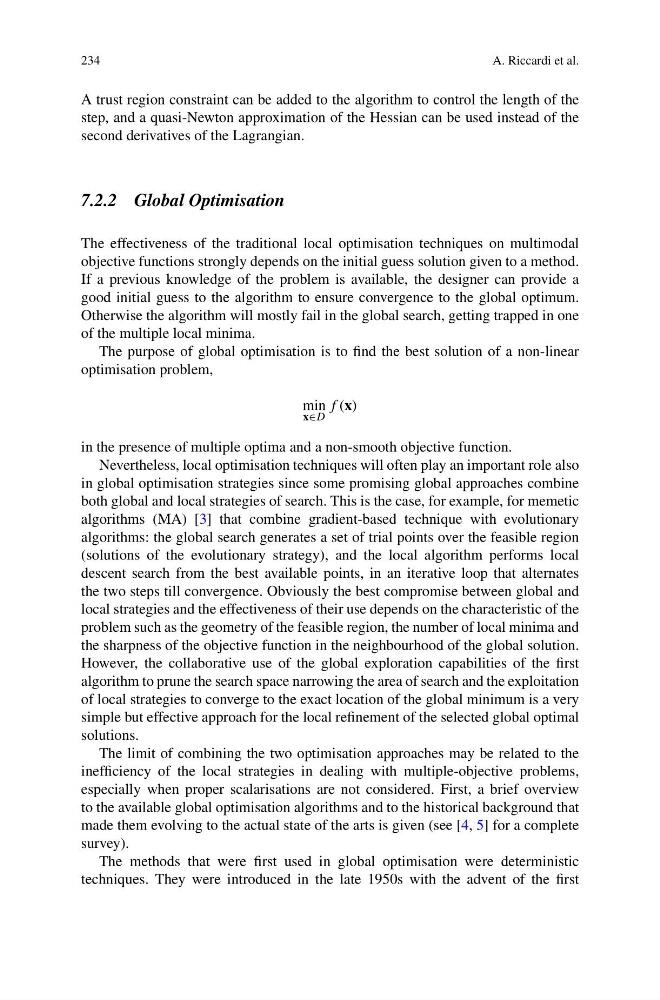
The purpose of global optimisation is to find the best solution of a non-linear
optimisation problem,
min
x∈D
f (x)
in the presence of multiple optima and a non-smooth objective function.
Nevertheless, local optimisation techniques will often play an important role also
in global optimisation strategies since some promising global approaches combine
both global and local strategies of search. This is the case, for example, for memetic
algorithms (MA) [3] that combine gradient-based technique with evolutionary
algorithms: the global search generates a set of trial points over the feasible region
(solutions of the evolutionary strategy), and the local algorithm performs local
descent search from the best available points, in an iterative loop that alternates
the two steps till convergence. Obviously the best compromise between global and
local strategies and the effectiveness of their use depends on the characteristic of the
problem such as the geometry of the feasible region, the number of local minima and
the sharpness of the objective function in the neighbourhood of the global solution.
However, the collaborative use of the global exploration capabilities of the first
algorithm to prune the search space narrowing the area of search and the exploitation
of local strategies to converge to the exact location of the global minimum is a very
simple but effective approach for the local refinement of the selected global optimal
solutions.
The limit of combining the two optimisation approaches may be related to the
inefficiency of the local strategies in dealing with multiple-objective problems,
especially when proper scalarisations are not considered. First, a brief overview
to the available global optimisation algorithms and to the historical background that
made them evolving to the actual state of the arts is given (see [4, 5] for a complete
survey).
The methods that were first used in global optimisation were deterministic
techniques. They were introduced in the late 1950s with the advent of the first
A. Riccardi et al.
A trust region constraint can be added to the algorithm to control the length of the
step, and a quasi-Newton approximation of the Hessian can be used instead of the
second derivatives of the Lagrangian.
7.2.2 Global Optimisation
The effectiveness of the traditional local optimisation techniques on multimodal
objective functions strongly depends on the initial guess solution given to a method.
If a previous knowledge of the problem is available, the designer can provide a
good initial guess to the algorithm to ensure convergence to the global optimum.
Otherwise the algorithm will mostly fail in the global search, getting trapped in one
of the multiple local minima.
The purpose of global optimisation is to find the best solution of a non-linear
optimisation problem,
min
x∈D
f (x)
in the presence of multiple optima and a non-smooth objective function.
Nevertheless, local optimisation techniques will often play an important role also
in global optimisation strategies since some promising global approaches combine
both global and local strategies of search. This is the case, for example, for memetic
algorithms (MA) [3] that combine gradient-based technique with evolutionary
algorithms: the global search generates a set of trial points over the feasible region
(solutions of the evolutionary strategy), and the local algorithm performs local
descent search from the best available points, in an iterative loop that alternates
the two steps till convergence. Obviously the best compromise between global and
local strategies and the effectiveness of their use depends on the characteristic of the
problem such as the geometry of the feasible region, the number of local minima and
the sharpness of the objective function in the neighbourhood of the global solution.
However, the collaborative use of the global exploration capabilities of the first
algorithm to prune the search space narrowing the area of search and the exploitation
of local strategies to converge to the exact location of the global minimum is a very
simple but effective approach for the local refinement of the selected global optimal
solutions.
The limit of combining the two optimisation approaches may be related to the
inefficiency of the local strategies in dealing with multiple-objective problems,
especially when proper scalarisations are not considered. First, a brief overview
to the available global optimisation algorithms and to the historical background that
made them evolving to the actual state of the arts is given (see [4, 5] for a complete
survey).
The methods that were first used in global optimisation were deterministic
techniques. They were introduced in the late 1950s with the advent of the first