

174
T. Krak
Qf
(x) := inf
Q∈Q
Qf
(x) .
(5.9)
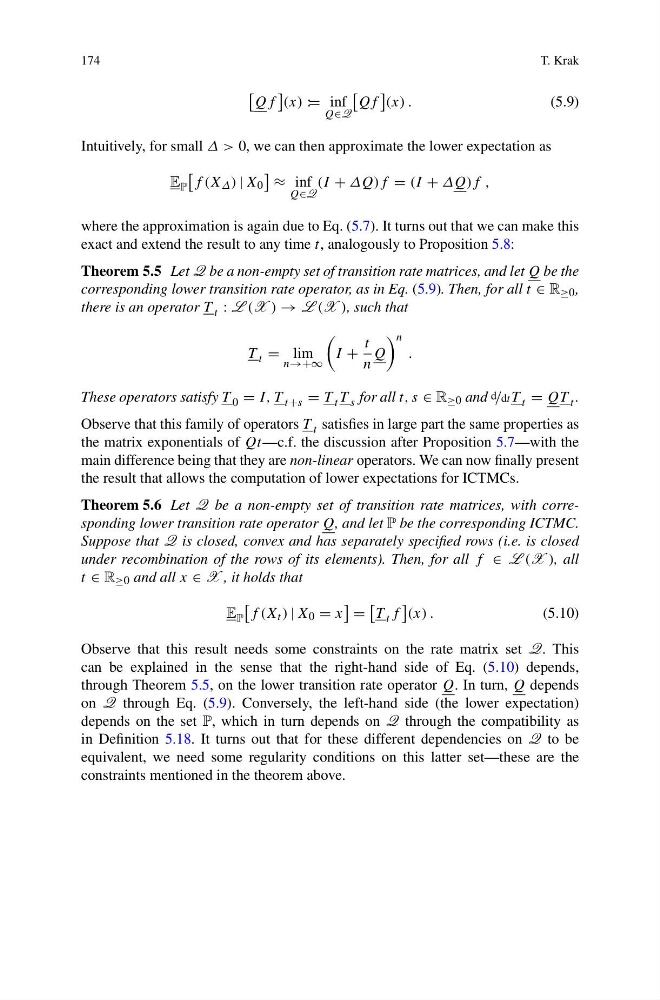
Intuitively, for small Δ > 0, we can then approximate the lower expectation as
E P
f (X Δ ) | X 0
≈ inf
Q∈Q
(I + ΔQ)f = (I + ΔQ)f ,
where the approximation is again due to Eq. (5.7). It turns out that we can make this
exact and extend the result to any time t, analogously to Proposition 5.8:
Theorem 5.5 Let Q be a non-empty set of transition rate matrices, and let Q be the
corresponding lower transition rate operator, as in Eq. (5.9). Then, for all t ∈ R ≥0 ,
there is an operator T t : L (X ) → L (X ), such that
T t = lim
n→+∞
I +
t
n
Q
n
.
These operators satisfy T 0 = I , T t+s = T t T s for all t, s ∈ R ≥0 and d /dtT t = QT t .
Observe that this family of operators T t satisfies in large part the same properties as
the matrix exponentials of Qt—c.f. the discussion after Proposition 5.7—with the
main difference being that they are non-linear operators. We can now finally present
the result that allows the computation of lower expectations for ICTMCs.
Theorem 5.6 Let Q be a non-empty set of transition rate matrices, with corresponding lower transition rate operator Q, and let P be the corresponding ICTMC.
Suppose that Q is closed, convex and has separately specified rows (i.e. is closed
under recombination of the rows of its elements). Then, for all f ∈ L (X ), all
t ∈ R ≥0 and all x ∈ X , it holds that
E P
f (X t ) | X 0 = x
=
T t f
(x) .
(5.10)
Observe that this result needs some constraints on the rate matrix set Q. This
can be explained in the sense that the right-hand side of Eq. (5.10) depends,
through Theorem 5.5, on the lower transition rate operator Q. In turn, Q depends
on Q through Eq. (5.9). Conversely, the left-hand side (the lower expectation)
depends on the set P, which in turn depends on Q through the compatibility as
in Definition 5.18. It turns out that for these different dependencies on Q to be
equivalent, we need some regularity conditions on this latter set—these are the
constraints mentioned in the theorem above.
T. Krak
Qf
(x) := inf
Q∈Q
Qf
(x) .
(5.9)
Intuitively, for small Δ > 0, we can then approximate the lower expectation as
E P
f (X Δ ) | X 0
≈ inf
Q∈Q
(I + ΔQ)f = (I + ΔQ)f ,
where the approximation is again due to Eq. (5.7). It turns out that we can make this
exact and extend the result to any time t, analogously to Proposition 5.8:
Theorem 5.5 Let Q be a non-empty set of transition rate matrices, and let Q be the
corresponding lower transition rate operator, as in Eq. (5.9). Then, for all t ∈ R ≥0 ,
there is an operator T t : L (X ) → L (X ), such that
T t = lim
n→+∞
I +
t
n
Q
n
.
These operators satisfy T 0 = I , T t+s = T t T s for all t, s ∈ R ≥0 and d /dtT t = QT t .
Observe that this family of operators T t satisfies in large part the same properties as
the matrix exponentials of Qt—c.f. the discussion after Proposition 5.7—with the
main difference being that they are non-linear operators. We can now finally present
the result that allows the computation of lower expectations for ICTMCs.
Theorem 5.6 Let Q be a non-empty set of transition rate matrices, with corresponding lower transition rate operator Q, and let P be the corresponding ICTMC.
Suppose that Q is closed, convex and has separately specified rows (i.e. is closed
under recombination of the rows of its elements). Then, for all f ∈ L (X ), all
t ∈ R ≥0 and all x ∈ X , it holds that
E P
f (X t ) | X 0 = x
=
T t f
(x) .
(5.10)
Observe that this result needs some constraints on the rate matrix set Q. This
can be explained in the sense that the right-hand side of Eq. (5.10) depends,
through Theorem 5.5, on the lower transition rate operator Q. In turn, Q depends
on Q through Eq. (5.9). Conversely, the left-hand side (the lower expectation)
depends on the set P, which in turn depends on Q through the compatibility as
in Definition 5.18. It turns out that for these different dependencies on Q to be
equivalent, we need some regularity conditions on this latter set—these are the
constraints mentioned in the theorem above.