

136
D. Krpelík et al.
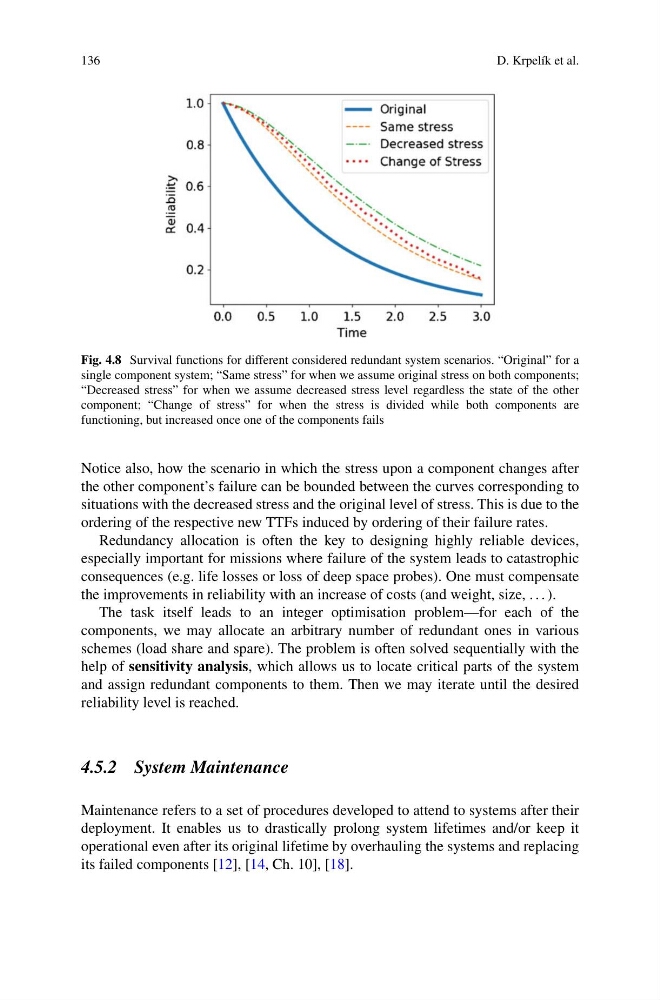
Fig. 4.8 Survival functions for different considered redundant system scenarios. “Original” for a
single component system; “Same stress” for when we assume original stress on both components;
“Decreased stress” for when we assume decreased stress level regardless the state of the other
component; “Change of stress” for when the stress is divided while both components are
functioning, but increased once one of the components fails
Notice also, how the scenario in which the stress upon a component changes after
the other component’s failure can be bounded between the curves corresponding to
situations with the decreased stress and the original level of stress. This is due to the
ordering of the respective new TTFs induced by ordering of their failure rates.
Redundancy allocation is often the key to designing highly reliable devices,
especially important for missions where failure of the system leads to catastrophic
consequences (e.g. life losses or loss of deep space probes). One must compensate
the improvements in reliability with an increase of costs (and weight, size, . . . ).
The task itself leads to an integer optimisation problem—for each of the
components, we may allocate an arbitrary number of redundant ones in various
schemes (load share and spare). The problem is often solved sequentially with the
help of sensitivity analysis, which allows us to locate critical parts of the system
and assign redundant components to them. Then we may iterate until the desired
reliability level is reached.
4.5.2 System Maintenance
Maintenance refers to a set of procedures developed to attend to systems after their
deployment. It enables us to drastically prolong system lifetimes and/or keep it
operational even after its original lifetime by overhauling the systems and replacing
its failed components [12], [14, Ch. 10], [18].
D. Krpelík et al.
Fig. 4.8 Survival functions for different considered redundant system scenarios. “Original” for a
single component system; “Same stress” for when we assume original stress on both components;
“Decreased stress” for when we assume decreased stress level regardless the state of the other
component; “Change of stress” for when the stress is divided while both components are
functioning, but increased once one of the components fails
Notice also, how the scenario in which the stress upon a component changes after
the other component’s failure can be bounded between the curves corresponding to
situations with the decreased stress and the original level of stress. This is due to the
ordering of the respective new TTFs induced by ordering of their failure rates.
Redundancy allocation is often the key to designing highly reliable devices,
especially important for missions where failure of the system leads to catastrophic
consequences (e.g. life losses or loss of deep space probes). One must compensate
the improvements in reliability with an increase of costs (and weight, size, . . . ).
The task itself leads to an integer optimisation problem—for each of the
components, we may allocate an arbitrary number of redundant ones in various
schemes (load share and spare). The problem is often solved sequentially with the
help of sensitivity analysis, which allows us to locate critical parts of the system
and assign redundant components to them. Then we may iterate until the desired
reliability level is reached.
4.5.2 System Maintenance
Maintenance refers to a set of procedures developed to attend to systems after their
deployment. It enables us to drastically prolong system lifetimes and/or keep it
operational even after its original lifetime by overhauling the systems and replacing
its failed components [12], [14, Ch. 10], [18].