

118
D. Krpelík et al.
4.3.1 Structure Function
Description of the dependency among the state of the system and the states of
its components can be provided by a deterministic function. For each possible
combination of components states, functioning or failed, we determine whether the
system is functioning or not. The uncertainty of the system state will then arise
solely due to the uncertainties about the states of its components. Let us denote
the (deterministic) state of the system as x S ∈ {0, 1} and a vector of states of
its N components as
x ∈ {0, 1} N . We will restrict ourselves to systems with
binary components, since it covers many practical scenarios. This restriction can
be dropped if necessary to describe any relationship among the system and its
components but would lead to more complicated mathematical models. We define
the (deterministic) structure function as a function ϕ which maps states of the
components onto the state of the system; thus x S = ϕ( x). The structure function is
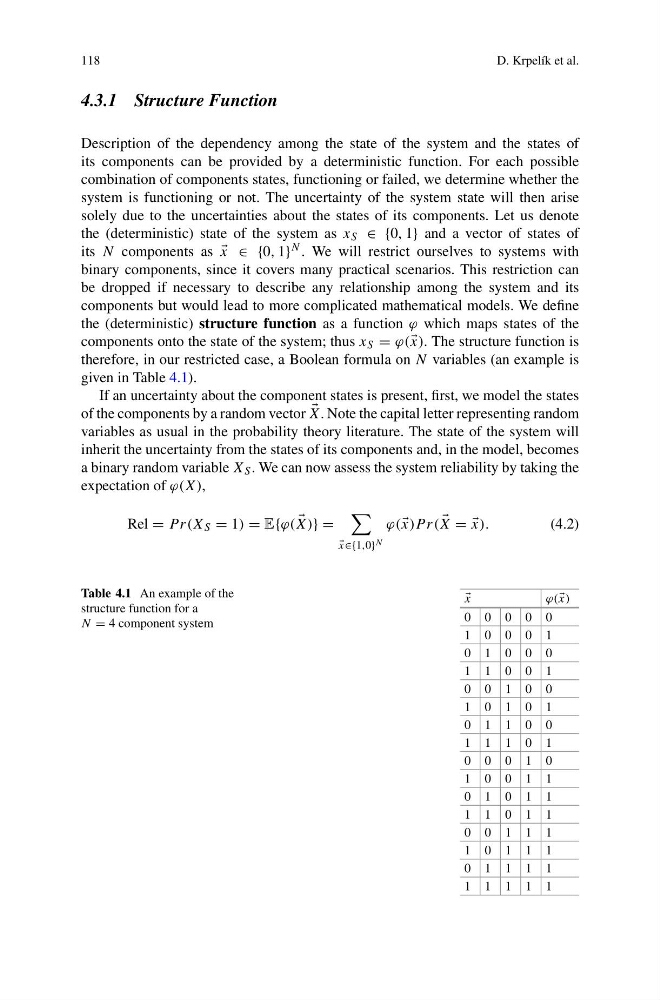
therefore, in our restricted case, a Boolean formula on N variables (an example is
given in Table 4.1).
If an uncertainty about the component states is present, first, we model the states
of the components by a random vector
X. Note the capital letter representing random
variables as usual in the probability theory literature. The state of the system will
inherit the uncertainty from the states of its components and, in the model, becomes
a binary random variable X S . We can now assess the system reliability by taking the
expectation of ϕ(X),
Rel = P r(X S = 1) = E{ϕ(
X)} =
x∈{1,0} N
ϕ( x)P r(
X = =
x).
(4.2)
Table 4.1 An example of the
structure function for a
N = 4 component system
x
ϕ( x)
0 0 0 0 0
1 0 0 0 1
0 1 0 0 0
1 1 0 0 1
0 0 1 0 0
1 0 1 0 1
0 1 1 0 0
1 1 1 0 1
0 0 0 1 0
1 0 0 1 1
0 1 0 1 1
1 1 0 1 1
0 0 1 1 1
1 0 1 1 1
0 1 1 1 1
1 1 1 1 1
D. Krpelík et al.
4.3.1 Structure Function
Description of the dependency among the state of the system and the states of
its components can be provided by a deterministic function. For each possible
combination of components states, functioning or failed, we determine whether the
system is functioning or not. The uncertainty of the system state will then arise
solely due to the uncertainties about the states of its components. Let us denote
the (deterministic) state of the system as x S ∈ {0, 1} and a vector of states of
its N components as
x ∈ {0, 1} N . We will restrict ourselves to systems with
binary components, since it covers many practical scenarios. This restriction can
be dropped if necessary to describe any relationship among the system and its
components but would lead to more complicated mathematical models. We define
the (deterministic) structure function as a function ϕ which maps states of the
components onto the state of the system; thus x S = ϕ( x). The structure function is
therefore, in our restricted case, a Boolean formula on N variables (an example is
given in Table 4.1).
If an uncertainty about the component states is present, first, we model the states
of the components by a random vector
X. Note the capital letter representing random
variables as usual in the probability theory literature. The state of the system will
inherit the uncertainty from the states of its components and, in the model, becomes
a binary random variable X S . We can now assess the system reliability by taking the
expectation of ϕ(X),
Rel = P r(X S = 1) = E{ϕ(
X)} =
x∈{1,0} N
ϕ( x)P r(
X = =
x).
(4.2)
Table 4.1 An example of the
structure function for a
N = 4 component system
x
ϕ( x)
0 0 0 0 0
1 0 0 0 1
0 1 0 0 0
1 1 0 0 1
0 0 1 0 0
1 0 1 0 1
0 1 1 0 0
1 1 1 0 1
0 0 0 1 0
1 0 0 1 1
0 1 0 1 1
1 1 0 1 1
0 0 1 1 1
1 0 1 1 1
0 1 1 1 1
1 1 1 1 1