

6 User Activity Matters: An Activity Theory …
89
developed to support designers to breakdown users’ activities and reconstruct the
activities in a digital platform. Apart from the engagement, the interactive format
of the tool can also make the heavy theoretical concepts be more easily applied to
address real design issues (Bødker and Klokmose 2011).
6.4 Introduction to the ACD Toolkit Prototype
To develop the first version of the sustainable ACD toolkit prototype, we incorporated
the literature insights on the use of activity theoretical concepts in solving sustainability design issues (see Sect. 3.1) with the toolkit development requirements we
have identified above. We decided to use a physical cube as a way to represent the
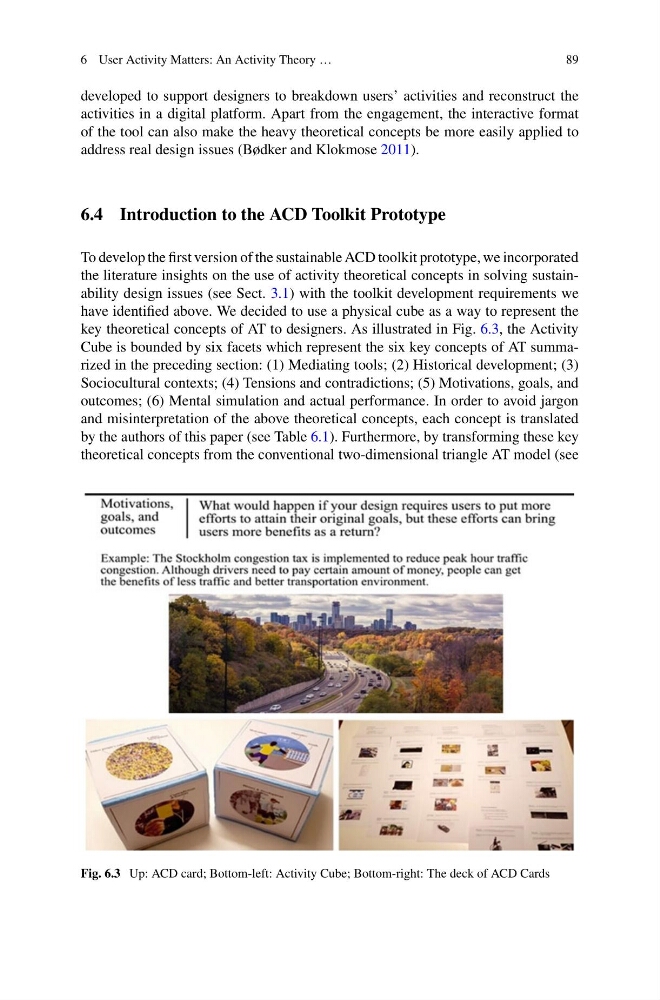
key theoretical concepts of AT to designers. As illustrated in Fig. 6.3, the Activity
Cube is bounded by six facets which represent the six key concepts of AT summarized in the preceding section: (1) Mediating tools; (2) Historical development; (3)
Sociocultural contexts; (4) Tensions and contradictions; (5) Motivations, goals, and
outcomes; (6) Mental simulation and actual performance. In order to avoid jargon
and misinterpretation of the above theoretical concepts, each concept is translated
by the authors of this paper (see Table 6.1). Furthermore, by transforming these key
theoretical concepts from the conventional two-dimensional triangle AT model (see
Fig. 6.3 Up: ACD card; Bottom-left: Activity Cube; Bottom-right: The deck of ACD Cards
89
developed to support designers to breakdown users’ activities and reconstruct the
activities in a digital platform. Apart from the engagement, the interactive format
of the tool can also make the heavy theoretical concepts be more easily applied to
address real design issues (Bødker and Klokmose 2011).
6.4 Introduction to the ACD Toolkit Prototype
To develop the first version of the sustainable ACD toolkit prototype, we incorporated
the literature insights on the use of activity theoretical concepts in solving sustainability design issues (see Sect. 3.1) with the toolkit development requirements we
have identified above. We decided to use a physical cube as a way to represent the
key theoretical concepts of AT to designers. As illustrated in Fig. 6.3, the Activity
Cube is bounded by six facets which represent the six key concepts of AT summarized in the preceding section: (1) Mediating tools; (2) Historical development; (3)
Sociocultural contexts; (4) Tensions and contradictions; (5) Motivations, goals, and
outcomes; (6) Mental simulation and actual performance. In order to avoid jargon
and misinterpretation of the above theoretical concepts, each concept is translated
by the authors of this paper (see Table 6.1). Furthermore, by transforming these key
theoretical concepts from the conventional two-dimensional triangle AT model (see
Fig. 6.3 Up: ACD card; Bottom-left: Activity Cube; Bottom-right: The deck of ACD Cards