

6 User Activity Matters: An Activity Theory …
87
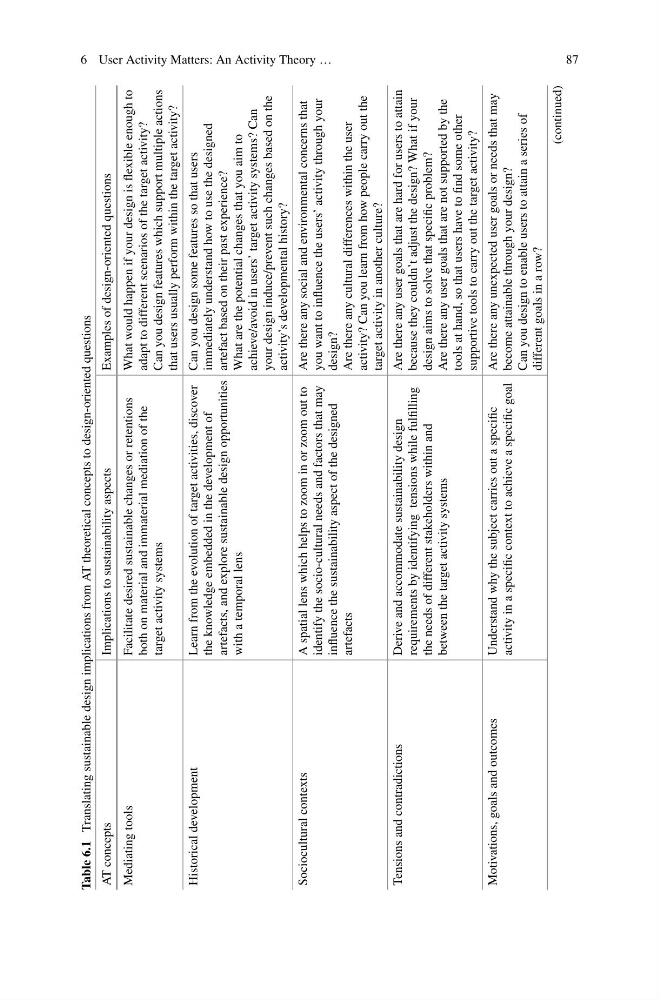
Table 6.1
Translating sustainable design implications from AT theoretical concepts to design-oriented questions
AT concepts
Implications to sustainability aspects
Examples of design-oriented questions
Mediating tools
Facilitate desired sustainable changes or retentions
both on material and immaterial mediation of the
target activity systems
What would happen if your design is flexible enough to
adapt to different scenarios of the target activity?
Can you design features which support multiple actions
that users usually perform within the target activity?
Historical development
Learn from the evolution of target activities, discover
the knowledge embedded in the development of
artefacts, and explore sustainable design opportunities
with a temporal lens
Can you design some features so that users
immediately understand how to use the designed
artefact based on their past experience?
What are the potential changes that you aim to
achieve/avoid in users’ target activity systems? Can
your design induce/prevent such changes based on the
activity’s developmental history?
Sociocultural contexts
A spatial lens which helps to zoom in or zoom out to
identify the socio-cultural needs and factors that may
influence the sustainability aspect of the designed
artefacts
Are there any social and environmental concerns that
you want to influence the users’ activity through your
design?
Are there any cultural differences within the user
activity? Can you learn from how people carry out the
target activity in another culture?
Tensions and contradictions
Derive and accommodate sustainability design
requirements by identifying tensions while fulfilling
the needs of different stakeholders within and
between the target activity systems
Are there any user goals that are hard for users to attain
because they couldn’t adjust the design? What if your
design aims to solve that specific problem?
Are there any user goals that are not supported by the
tools at hand, so that users have to find some other
supportive tools to carry out the target activity?
Motivations, goals and outcomes
Understand why the subject carries out a specific
activity in a specific context to achieve a specific goal
Are there any unexpected user goals or needs that may
become attainable through your design?
Can you design to enable users to attain a series of
different goals in a row?
(continued)
87
Table 6.1
Translating sustainable design implications from AT theoretical concepts to design-oriented questions
AT concepts
Implications to sustainability aspects
Examples of design-oriented questions
Mediating tools
Facilitate desired sustainable changes or retentions
both on material and immaterial mediation of the
target activity systems
What would happen if your design is flexible enough to
adapt to different scenarios of the target activity?
Can you design features which support multiple actions
that users usually perform within the target activity?
Historical development
Learn from the evolution of target activities, discover
the knowledge embedded in the development of
artefacts, and explore sustainable design opportunities
with a temporal lens
Can you design some features so that users
immediately understand how to use the designed
artefact based on their past experience?
What are the potential changes that you aim to
achieve/avoid in users’ target activity systems? Can
your design induce/prevent such changes based on the
activity’s developmental history?
Sociocultural contexts
A spatial lens which helps to zoom in or zoom out to
identify the socio-cultural needs and factors that may
influence the sustainability aspect of the designed
artefacts
Are there any social and environmental concerns that
you want to influence the users’ activity through your
design?
Are there any cultural differences within the user
activity? Can you learn from how people carry out the
target activity in another culture?
Tensions and contradictions
Derive and accommodate sustainability design
requirements by identifying tensions while fulfilling
the needs of different stakeholders within and
between the target activity systems
Are there any user goals that are hard for users to attain
because they couldn’t adjust the design? What if your
design aims to solve that specific problem?
Are there any user goals that are not supported by the
tools at hand, so that users have to find some other
supportive tools to carry out the target activity?
Motivations, goals and outcomes
Understand why the subject carries out a specific
activity in a specific context to achieve a specific goal
Are there any unexpected user goals or needs that may
become attainable through your design?
Can you design to enable users to attain a series of
different goals in a row?
(continued)