

6 User Activity Matters: An Activity Theory …
81
report on the initial development and evaluation of the AT-informed design ideation
toolkit—sustainable ACD toolkit, which aims to enable designers to integrate the
understandings of users’ dynamic activities with specific sustainable design goals in
the early-stage design ideation process.
6.2 Activity Theoretical Background
Activity theory was first proposed by Leontiev with an origin in psychology (Leont’ev
1978). AT views the human activity as purposeful need-based interaction between
the subject (actor) and the object (world) (Leont’ev 2011; Vygotsky 1978). Unlike
traditional psychological theories which aim at providing means to predict subjects’
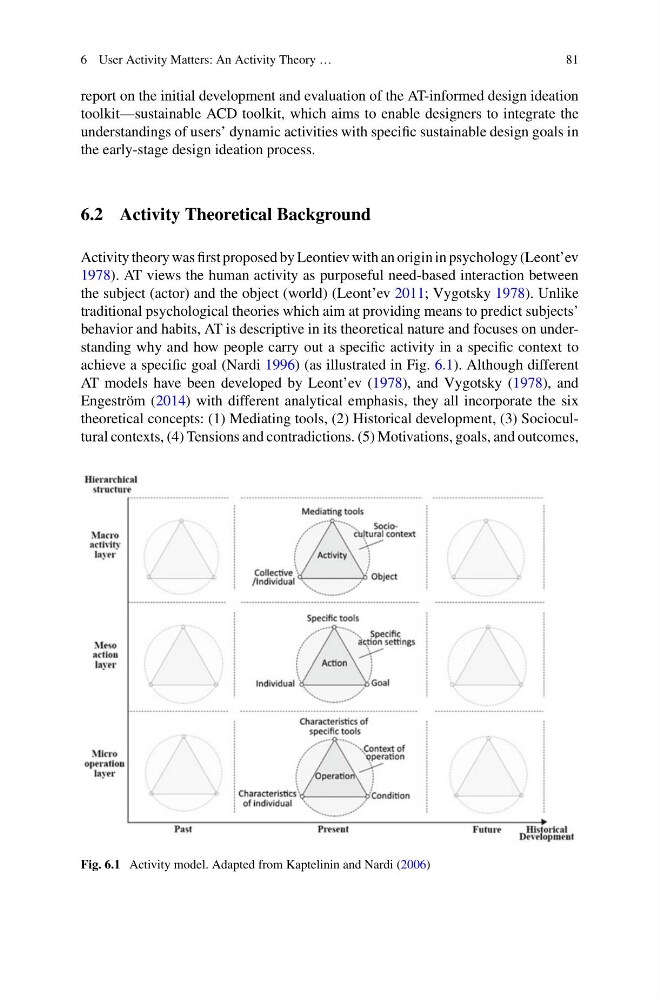
behavior and habits, AT is descriptive in its theoretical nature and focuses on understanding why and how people carry out a specific activity in a specific context to
achieve a specific goal (Nardi 1996) (as illustrated in Fig. 6.1). Although different
AT models have been developed by Leont’ev (1978), and Vygotsky (1978), and
Engeström (2014) with different analytical emphasis, they all incorporate the six
theoretical concepts: (1) Mediating tools, (2) Historical development, (3) Sociocultural contexts, (4) Tensions and contradictions. (5) Motivations, goals, and outcomes,
Fig. 6.1 Activity model. Adapted from Kaptelinin and Nardi (2006)
81
report on the initial development and evaluation of the AT-informed design ideation
toolkit—sustainable ACD toolkit, which aims to enable designers to integrate the
understandings of users’ dynamic activities with specific sustainable design goals in
the early-stage design ideation process.
6.2 Activity Theoretical Background
Activity theory was first proposed by Leontiev with an origin in psychology (Leont’ev
1978). AT views the human activity as purposeful need-based interaction between
the subject (actor) and the object (world) (Leont’ev 2011; Vygotsky 1978). Unlike
traditional psychological theories which aim at providing means to predict subjects’
behavior and habits, AT is descriptive in its theoretical nature and focuses on understanding why and how people carry out a specific activity in a specific context to
achieve a specific goal (Nardi 1996) (as illustrated in Fig. 6.1). Although different
AT models have been developed by Leont’ev (1978), and Vygotsky (1978), and
Engeström (2014) with different analytical emphasis, they all incorporate the six
theoretical concepts: (1) Mediating tools, (2) Historical development, (3) Sociocultural contexts, (4) Tensions and contradictions. (5) Motivations, goals, and outcomes,
Fig. 6.1 Activity model. Adapted from Kaptelinin and Nardi (2006)