

5 Consumer’s Perception of Plastics in Everyday …
63
widely accepted personality traits are the “Big Five” dimensions or the Five-Factor
Model of Costa and McCrae (1987), Brunel and Kumar (2007), Openness, Conscientiousness, Extraversion, Agreeableness, and Neuroticism. In addition, relationships
between products and personalities (and thus, materials) have been found as well, and
are translated into everyday personality adjectives by Govers (2004), Mugge et al.
(2009). Finally, Aaker (1997) extended the Big Five structure to brand personality,
including socio-demographic aspects such as gender and social class, which was
adapted by Geuens et al. (2009) to a new and cross-cultural validated brand personality measure that is easy to comprehend: Responsibility, Activity, Aggressiveness,
Simplicity, and Emotionality.
From a product perspective, a critical market is that of Fast Moving Consumer
Goods (FMCG) and other everyday consumer products that are sold rather quickly
and at a relative low cost, and are most often materialized by plastics (Çelen et al.
2005). The perception of plastics materials has known a changing path, as it was
introduced as an imitation material in the ’50, then re-valued as a versatile material
thanks to Tupperware (Manzini 1986), but is nowadays regarded as the cause for
many environmental issues such as the plastic soup. However, plastics can still offer
valuable sustainable opportunities, when used smartly and correctly, i.e. when a
designer can create product life extension through meaningful materials experience.
5.2 Research Aim
In this paper, we aim to explore possible relationships between (plastic) materials,
found in everyday products, their expressive value and the link with the personality
of the consumer, whereby personality in this research is defined in terms of the five
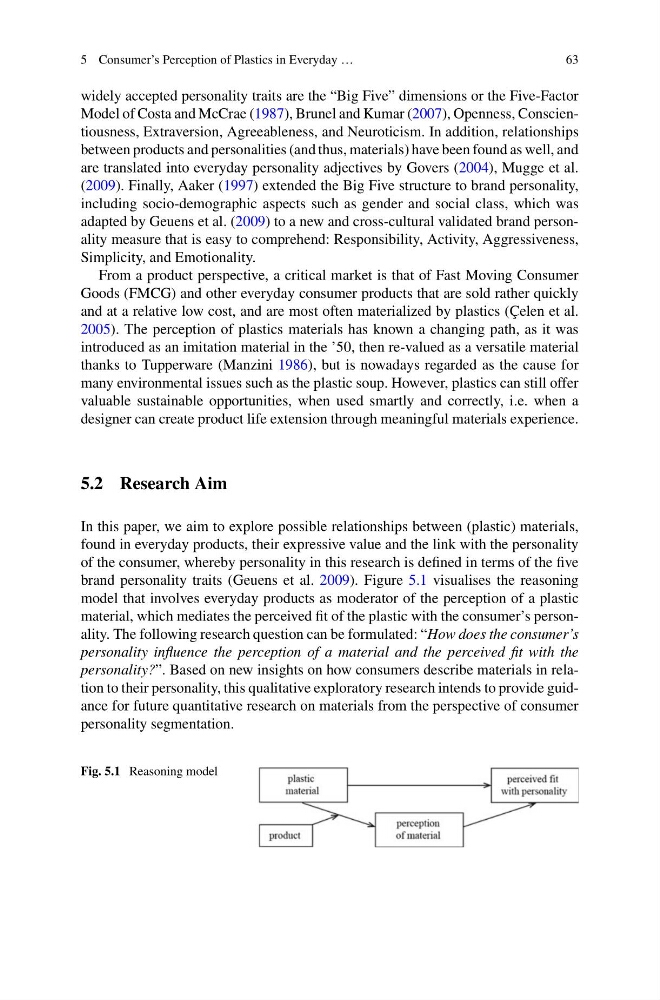
brand personality traits (Geuens et al. 2009). Figure 5.1 visualises the reasoning
model that involves everyday products as moderator of the perception of a plastic
material, which mediates the perceived fit of the plastic with the consumer’s personality. The following research question can be formulated: “How does the consumer’s
personality influence the perception of a material and the perceived fit with the
personality?”. Based on new insights on how consumers describe materials in relation to their personality, this qualitative exploratory research intends to provide guidance for future quantitative research on materials from the perspective of consumer
personality segmentation.
Fig. 5.1 Reasoning model
63
widely accepted personality traits are the “Big Five” dimensions or the Five-Factor
Model of Costa and McCrae (1987), Brunel and Kumar (2007), Openness, Conscientiousness, Extraversion, Agreeableness, and Neuroticism. In addition, relationships
between products and personalities (and thus, materials) have been found as well, and
are translated into everyday personality adjectives by Govers (2004), Mugge et al.
(2009). Finally, Aaker (1997) extended the Big Five structure to brand personality,
including socio-demographic aspects such as gender and social class, which was
adapted by Geuens et al. (2009) to a new and cross-cultural validated brand personality measure that is easy to comprehend: Responsibility, Activity, Aggressiveness,
Simplicity, and Emotionality.
From a product perspective, a critical market is that of Fast Moving Consumer
Goods (FMCG) and other everyday consumer products that are sold rather quickly
and at a relative low cost, and are most often materialized by plastics (Çelen et al.
2005). The perception of plastics materials has known a changing path, as it was
introduced as an imitation material in the ’50, then re-valued as a versatile material
thanks to Tupperware (Manzini 1986), but is nowadays regarded as the cause for
many environmental issues such as the plastic soup. However, plastics can still offer
valuable sustainable opportunities, when used smartly and correctly, i.e. when a
designer can create product life extension through meaningful materials experience.
5.2 Research Aim
In this paper, we aim to explore possible relationships between (plastic) materials,
found in everyday products, their expressive value and the link with the personality
of the consumer, whereby personality in this research is defined in terms of the five
brand personality traits (Geuens et al. 2009). Figure 5.1 visualises the reasoning
model that involves everyday products as moderator of the perception of a plastic
material, which mediates the perceived fit of the plastic with the consumer’s personality. The following research question can be formulated: “How does the consumer’s
personality influence the perception of a material and the perceived fit with the
personality?”. Based on new insights on how consumers describe materials in relation to their personality, this qualitative exploratory research intends to provide guidance for future quantitative research on materials from the perspective of consumer
personality segmentation.
Fig. 5.1 Reasoning model