

43 A Feasibility Study of a Japanese Power …
649
43.3 A Japanese Power to Gas Concept
The model area of this concept is Rokkasho Village in Aomori Prefecture. The village
locates in north east end of Honshu Island, Japan. As many cold and rural areas in
Japan, fossil fuels, especially manually transported fuel oil is used for water and
room heating in winter. Especially, Aomori Prefecture has the second largest fuel
oil consumption in Japan (The Institute of Energy Economics 2007). Fuel oil is an
imported fossil resource, so such energy supply is not sustainable. On the other hand,
Rokkasho Village has great renewable energy potential and there are already a lot of
wind turbines and photo voltaic panels. However, Japan has no nation-wide natural
gas pipelines as Europe (Shibata 2016), so if renewable hydrogen is produced in
Rokkasho Village and similar rural areas, it is not easy and cheap to transport to
other areas.
Based on these situations, the authors propose “fuel cell combined heat and power
system for cold area with local hydrogen supply chain” as a feasible Japanese Power
to Gas concept. Part of heat and electricity demand in the area is supplied by fuel
cells using locally produced renewable hydrogen. The hydrogen output from the
electrolyzer is stored without additional compression (< 1.0 MPa) and distributed
through the local hydrogen pipeline network using differential pressure. The system
contributes to reduce CO 2 emission from water and room heating and the hydrogen
supply cost is minimized because the transportation distance is minimized. Fuel
expenditure is back to local renewable energy producers not to foreign countries. This
concept is applicable to similar areas, which is cold, rural, and having rich renewable
energies. This model can be realized around 2030, when renewable energies operated
under Japanese FIT (Feed-in-Tariff) rules will be released to free electric power
market. The target year of the feasibility study is 2030 and the authors used the data
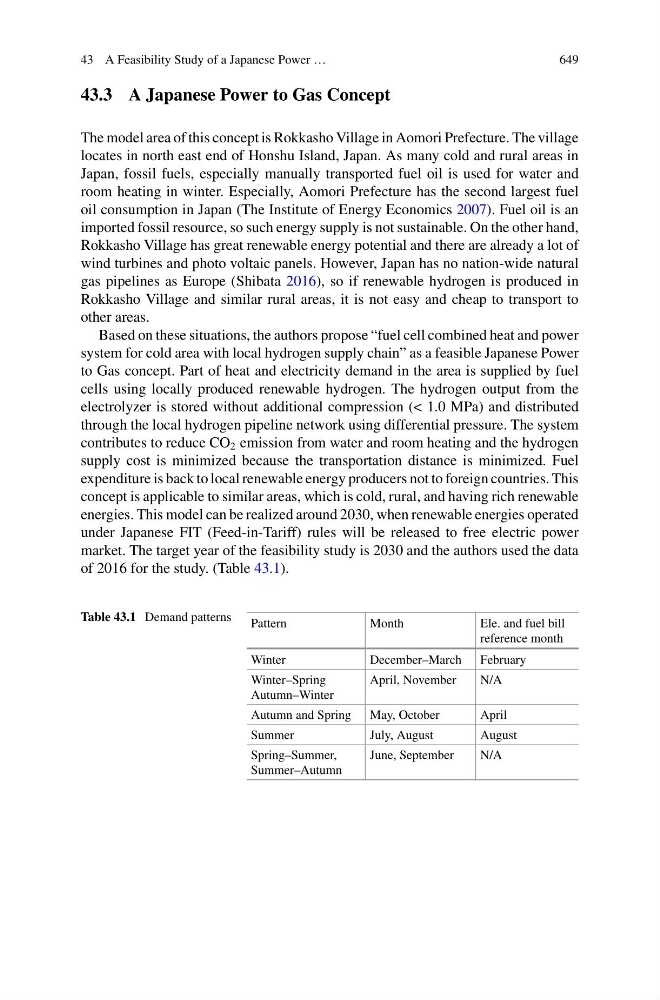
of 2016 for the study. (Table 43.1).
Table 43.1 Demand patterns
Pattern
Month
Ele. and fuel bill
reference month
Winter
December–March February
Winter–Spring
Autumn–Winter
April, November
N/A
Autumn and Spring May, October
April
Summer
July, August
August
Spring–Summer,
Summer–Autumn
June, September
N/A