

42 Dynamic Simulation of Woody Biomass Co-generation System …
637
42.3.2 Model for Calculating Annual Cost
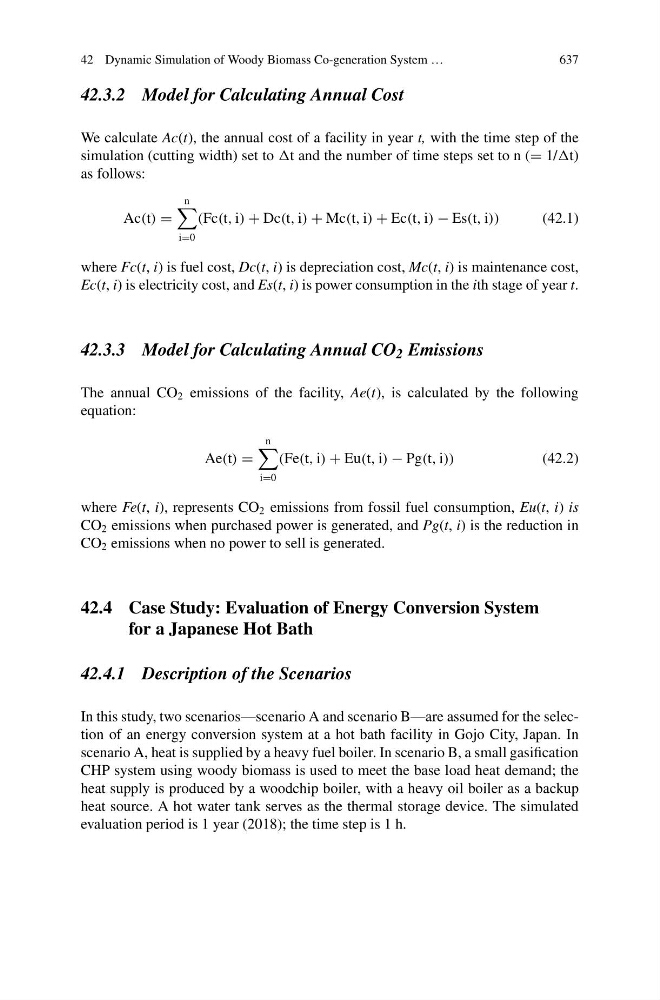
We calculate Ac(t), the annual cost of a facility in year t, with the time step of the
simulation (cutting width) set to t and the number of time steps set to n (= 1/t)
as follows:
Ac(t) =
n
i=0
(Fc(t, i) + Dc(t, i) + Mc(t, i) + Ec(t, i) − Es(t, i))
(42.1)
where Fc(t, i) is fuel cost, Dc(t, i) is depreciation cost, Mc(t, i) is maintenance cost,
Ec(t, i) is electricity cost, and Es(t, i) is power consumption in the ith stage of year t.
42.3.3 Model for Calculating Annual CO 2 Emissions
The annual CO 2 emissions of the facility, Ae(t), is calculated by the following
equation:
Ae(t) =
n
i=0
(Fe(t, i) + Eu(t, i) − Pg(t, i))
(42.2)
where Fe(t, i), represents CO 2 emissions from fossil fuel consumption, Eu(t, i) is
CO 2 emissions when purchased power is generated, and Pg(t, i) is the reduction in
CO 2 emissions when no power to sell is generated.
42.4 Case Study: Evaluation of Energy Conversion System
for a Japanese Hot Bath
42.4.1 Description of the Scenarios
In this study, two scenarios—scenario A and scenario B—are assumed for the selection of an energy conversion system at a hot bath facility in Gojo City, Japan. In
scenario A, heat is supplied by a heavy fuel boiler. In scenario B, a small gasification
CHP system using woody biomass is used to meet the base load heat demand; the
heat supply is produced by a woodchip boiler, with a heavy oil boiler as a backup
heat source. A hot water tank serves as the thermal storage device. The simulated
evaluation period is 1 year (2018); the time step is 1 h.