

37 Evaluation and Improvement Proposals for a Business Facility …
567
Table 37.2 Ratio of refrigerator to total output
Month
Heat dissipation
Output of adsorption type
refrigerator
Ratio of refrigerator to total
output
MJ/M
MJ/M
%
April
20,790
460
2.21
May
46,390
4150
8.95
June
69,800
4530
6.49
July
137,250
7760
5.65
August
145,810
5190
3.56
September
83,720
5490
6.56
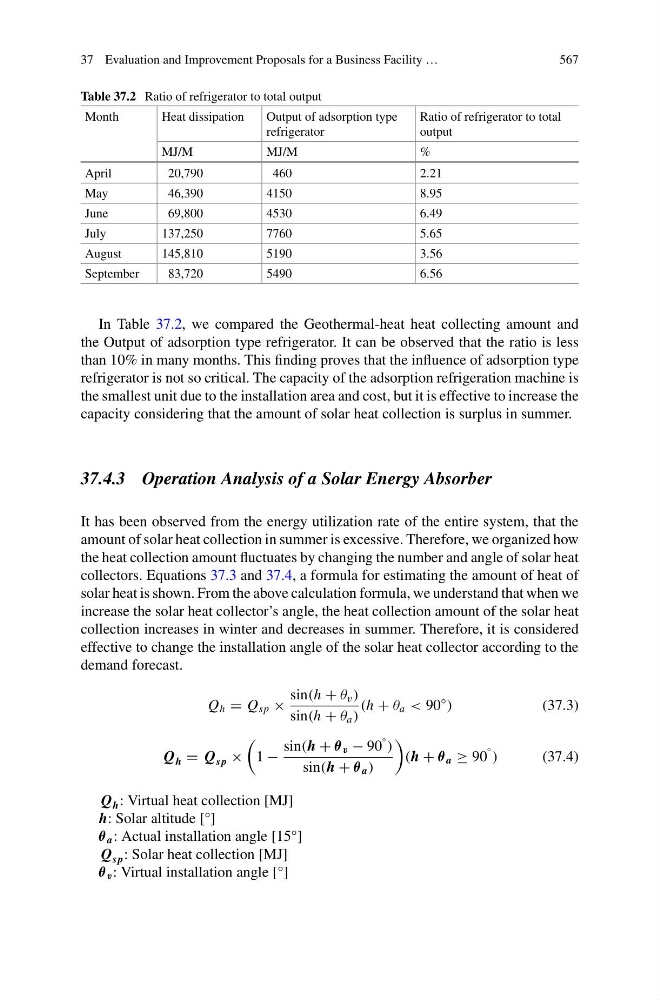
In Table 37.2, we compared the Geothermal-heat heat collecting amount and
the Output of adsorption type refrigerator. It can be observed that the ratio is less
than 10% in many months. This finding proves that the influence of adsorption type
refrigerator is not so critical. The capacity of the adsorption refrigeration machine is
the smallest unit due to the installation area and cost, but it is effective to increase the
capacity considering that the amount of solar heat collection is surplus in summer.
37.4.3 Operation Analysis of a Solar Energy Absorber
It has been observed from the energy utilization rate of the entire system, that the
amount of solar heat collection in summer is excessive. Therefore, we organized how
the heat collection amount fluctuates by changing the number and angle of solar heat
collectors. Equations 37.3 and 37.4, a formula for estimating the amount of heat of
solar heat is shown. From the above calculation formula, we understand that when we
increase the solar heat collector’s angle, the heat collection amount of the solar heat
collection increases in winter and decreases in summer. Therefore, it is considered
effective to change the installation angle of the solar heat collector according to the
demand forecast.
Q h = Q sp ×
sin(h + θ v )
sin(h + θ a )
(h + θ a < 90
◦
)
(37.3)
Q h = Q sp ×
1 −
sin(h + θ v − 90
◦ )
sin(h + θ a )
(h + θ a ≥ 90
◦ )
(37.4)
Q h : Virtual heat collection [MJ]
h: Solar altitude [°]
θ a : Actual installation angle [15°]
Q sp : Solar heat collection [MJ]
θ v : Virtual installation angle [°]
567
Table 37.2 Ratio of refrigerator to total output
Month
Heat dissipation
Output of adsorption type
refrigerator
Ratio of refrigerator to total
output
MJ/M
MJ/M
%
April
20,790
460
2.21
May
46,390
4150
8.95
June
69,800
4530
6.49
July
137,250
7760
5.65
August
145,810
5190
3.56
September
83,720
5490
6.56
In Table 37.2, we compared the Geothermal-heat heat collecting amount and
the Output of adsorption type refrigerator. It can be observed that the ratio is less
than 10% in many months. This finding proves that the influence of adsorption type
refrigerator is not so critical. The capacity of the adsorption refrigeration machine is
the smallest unit due to the installation area and cost, but it is effective to increase the
capacity considering that the amount of solar heat collection is surplus in summer.
37.4.3 Operation Analysis of a Solar Energy Absorber
It has been observed from the energy utilization rate of the entire system, that the
amount of solar heat collection in summer is excessive. Therefore, we organized how
the heat collection amount fluctuates by changing the number and angle of solar heat
collectors. Equations 37.3 and 37.4, a formula for estimating the amount of heat of
solar heat is shown. From the above calculation formula, we understand that when we
increase the solar heat collector’s angle, the heat collection amount of the solar heat
collection increases in winter and decreases in summer. Therefore, it is considered
effective to change the installation angle of the solar heat collector according to the
demand forecast.
Q h = Q sp ×
sin(h + θ v )
sin(h + θ a )
(h + θ a < 90
◦
)
(37.3)
Q h = Q sp ×
1 −
sin(h + θ v − 90
◦ )
sin(h + θ a )
(h + θ a ≥ 90
◦ )
(37.4)
Q h : Virtual heat collection [MJ]
h: Solar altitude [°]
θ a : Actual installation angle [15°]
Q sp : Solar heat collection [MJ]
θ v : Virtual installation angle [°]