

36 The Readiness Levels of Japan Supported Biomass Energy …
543
Table 36.1 Conversion of
project readiness level
terminology
Readiness level in the original
names used by fund provider
Readiness level in generic
terms
Basic research
Basic research
Capacity building/Networking
Methodology proposal
Research experiment
Research experiment
Feasibility study
Feasibility study
Feasibility survey
Project planning study
Pilot demonstration project
Pilot demonstration project
Demonstration project
Model project
Full scale
Full scale operation
Full scale operation
Full scale demonstration project
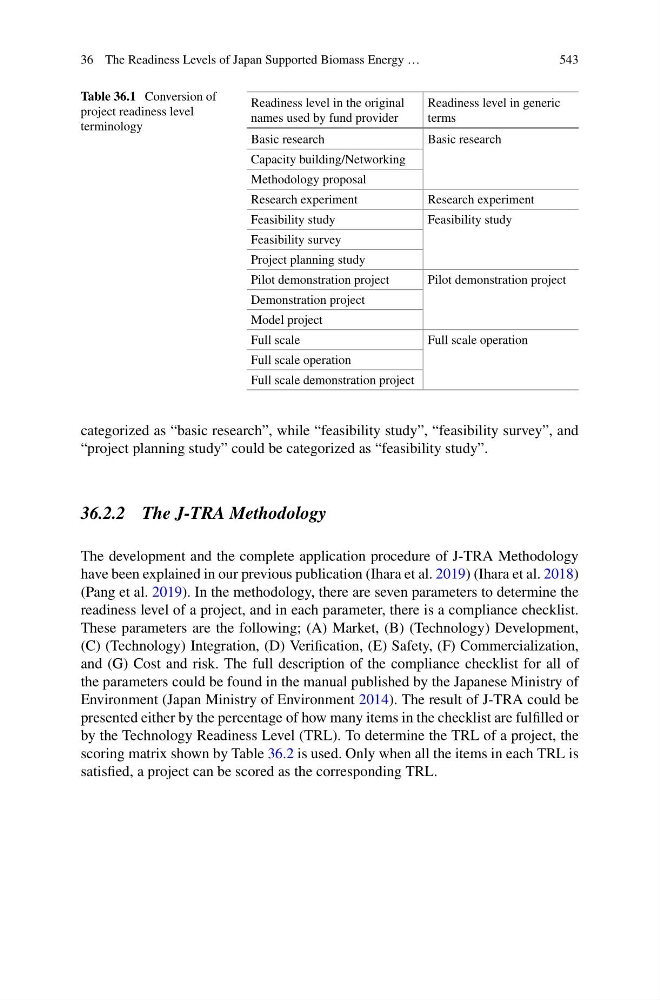
categorized as “basic research”, while “feasibility study”, “feasibility survey”, and
“project planning study” could be categorized as “feasibility study”.
36.2.2 The J-TRA Methodology
The development and the complete application procedure of J-TRA Methodology
have been explained in our previous publication (Ihara et al. 2019) (Ihara et al. 2018)
(Pang et al. 2019). In the methodology, there are seven parameters to determine the
readiness level of a project, and in each parameter, there is a compliance checklist.
These parameters are the following; (A) Market, (B) (Technology) Development,
(C) (Technology) Integration, (D) Verification, (E) Safety, (F) Commercialization,
and (G) Cost and risk. The full description of the compliance checklist for all of
the parameters could be found in the manual published by the Japanese Ministry of
Environment (Japan Ministry of Environment 2014). The result of J-TRA could be
presented either by the percentage of how many items in the checklist are fulfilled or
by the Technology Readiness Level (TRL). To determine the TRL of a project, the
scoring matrix shown by Table 36.2 is used. Only when all the items in each TRL is
satisfied, a project can be scored as the corresponding TRL.
543
Table 36.1 Conversion of
project readiness level
terminology
Readiness level in the original
names used by fund provider
Readiness level in generic
terms
Basic research
Basic research
Capacity building/Networking
Methodology proposal
Research experiment
Research experiment
Feasibility study
Feasibility study
Feasibility survey
Project planning study
Pilot demonstration project
Pilot demonstration project
Demonstration project
Model project
Full scale
Full scale operation
Full scale operation
Full scale demonstration project
categorized as “basic research”, while “feasibility study”, “feasibility survey”, and
“project planning study” could be categorized as “feasibility study”.
36.2.2 The J-TRA Methodology
The development and the complete application procedure of J-TRA Methodology
have been explained in our previous publication (Ihara et al. 2019) (Ihara et al. 2018)
(Pang et al. 2019). In the methodology, there are seven parameters to determine the
readiness level of a project, and in each parameter, there is a compliance checklist.
These parameters are the following; (A) Market, (B) (Technology) Development,
(C) (Technology) Integration, (D) Verification, (E) Safety, (F) Commercialization,
and (G) Cost and risk. The full description of the compliance checklist for all of
the parameters could be found in the manual published by the Japanese Ministry of
Environment (Japan Ministry of Environment 2014). The result of J-TRA could be
presented either by the percentage of how many items in the checklist are fulfilled or
by the Technology Readiness Level (TRL). To determine the TRL of a project, the
scoring matrix shown by Table 36.2 is used. Only when all the items in each TRL is
satisfied, a project can be scored as the corresponding TRL.