

35 Exergy and Environmental Analysis of a Bio-Hydrogen Supply …
529
35.2.3 Exergy Analysis
Exergy analysis is an energy assessment methodology that can evaluate the maximum
effective energy of a target system. The advantage of exergy analysis is that we can
assess the maximum effective energy and the energy loss caused by an entropy
increment because exergy analysis is based on both the first and second laws of thermodynamics (Kondo et al. 2018). This means of assessment based on the maximum
effective energy and energy loss is important for understanding biomass-derived
hydrogen, whose feedstocks have low heating values and should be effectively used.
Thus, the total exergy efficiency of each hydrogen path was investigated. Exergy can
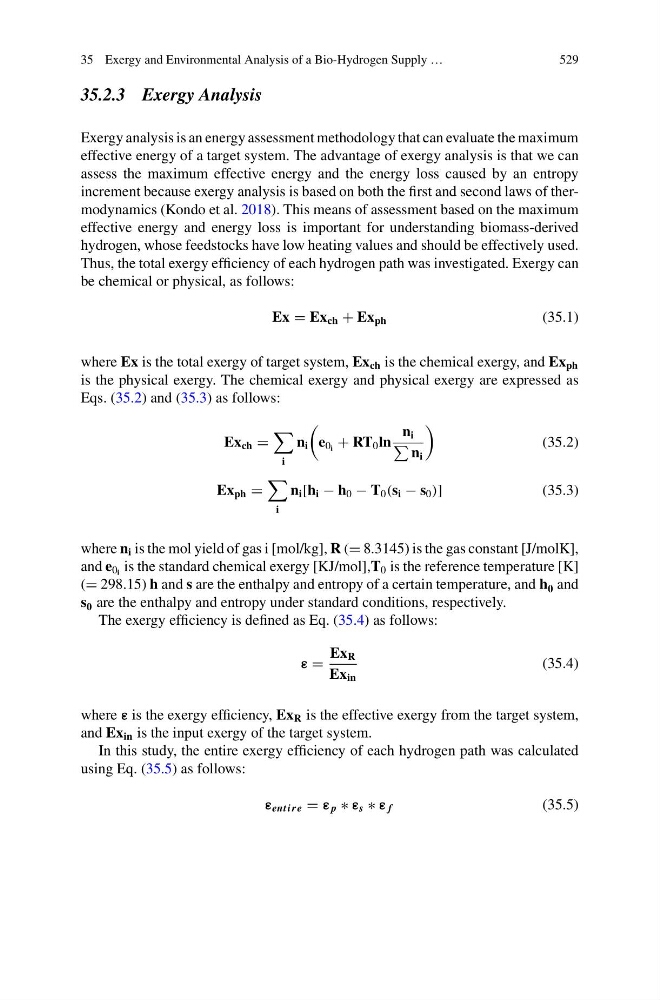
be chemical or physical, as follows:
Ex = Ex ch + Ex ph
(35.1)
where Ex is the total exergy of target system, Ex ch is the chemical exergy, and Ex ph
is the physical exergy. The chemical exergy and physical exergy are expressed as
Eqs. (35.2) and (35.3) as follows:
Ex ch =
i
n i
e 0 i + RT 0 ln
n i
n i
(35.2)
Ex ph =
i
n i [h i − h 0 − T 0 (s i − s 0 )]
(35.3)
where n i is the mol yield of gas i [mol/kg], R (= 8.3145) is the gas constant [J/molK],
and e 0 i is the standard chemical exergy [KJ/mol],T 0 is the reference temperature [K]
(= 298.15) h and s are the enthalpy and entropy of a certain temperature, and h 0 and
s 0 are the enthalpy and entropy under standard conditions, respectively.
The exergy efficiency is defined as Eq. (35.4) as follows:
ε =
Ex R
Ex in
(35.4)
where ε is the exergy efficiency, Ex R is the effective exergy from the target system,
and Ex in is the input exergy of the target system.
In this study, the entire exergy efficiency of each hydrogen path was calculated
using Eq. (35.5) as follows:
ε ent i r e = ε p ∗ ε s ∗ ε f
(35.5)
529
35.2.3 Exergy Analysis
Exergy analysis is an energy assessment methodology that can evaluate the maximum
effective energy of a target system. The advantage of exergy analysis is that we can
assess the maximum effective energy and the energy loss caused by an entropy
increment because exergy analysis is based on both the first and second laws of thermodynamics (Kondo et al. 2018). This means of assessment based on the maximum
effective energy and energy loss is important for understanding biomass-derived
hydrogen, whose feedstocks have low heating values and should be effectively used.
Thus, the total exergy efficiency of each hydrogen path was investigated. Exergy can
be chemical or physical, as follows:
Ex = Ex ch + Ex ph
(35.1)
where Ex is the total exergy of target system, Ex ch is the chemical exergy, and Ex ph
is the physical exergy. The chemical exergy and physical exergy are expressed as
Eqs. (35.2) and (35.3) as follows:
Ex ch =
i
n i
e 0 i + RT 0 ln
n i
n i
(35.2)
Ex ph =
i
n i [h i − h 0 − T 0 (s i − s 0 )]
(35.3)
where n i is the mol yield of gas i [mol/kg], R (= 8.3145) is the gas constant [J/molK],
and e 0 i is the standard chemical exergy [KJ/mol],T 0 is the reference temperature [K]
(= 298.15) h and s are the enthalpy and entropy of a certain temperature, and h 0 and
s 0 are the enthalpy and entropy under standard conditions, respectively.
The exergy efficiency is defined as Eq. (35.4) as follows:
ε =
Ex R
Ex in
(35.4)
where ε is the exergy efficiency, Ex R is the effective exergy from the target system,
and Ex in is the input exergy of the target system.
In this study, the entire exergy efficiency of each hydrogen path was calculated
using Eq. (35.5) as follows:
ε ent i r e = ε p ∗ ε s ∗ ε f
(35.5)