

33 Optimal Design and Operation of a Residential Hybrid Microgrid …
507
33.3.2 Optimization Model
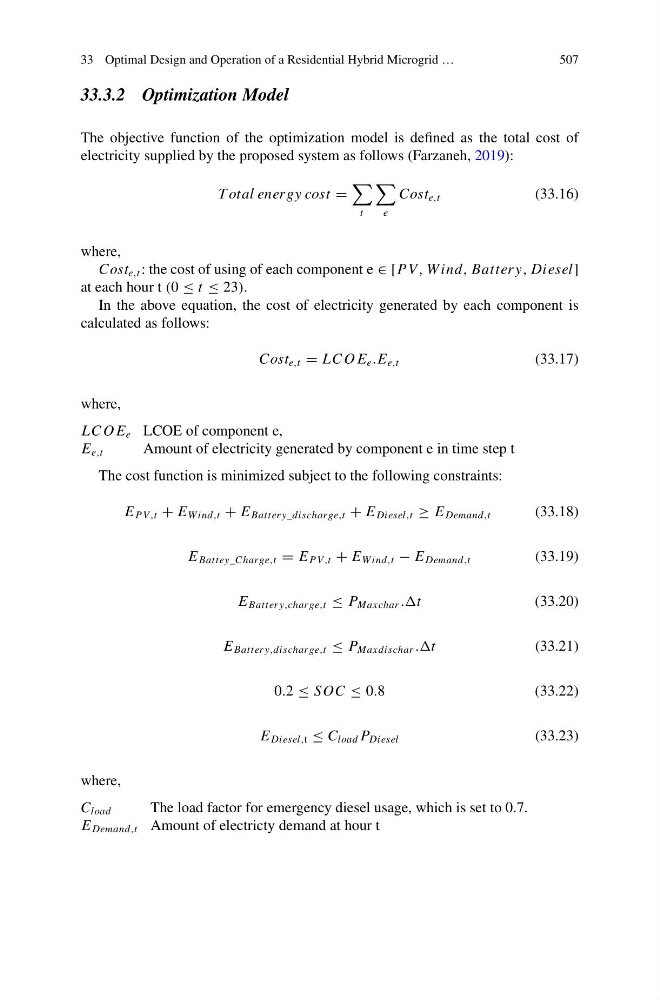
The objective function of the optimization model is defined as the total cost of
electricity supplied by the proposed system as follows (Farzaneh, 2019):
T otal energy cost =
t
e
Cost e,t
(33.16)
where,
Cost e,t : the cost of using of each component e ∈ [PV, W ind, Batter y, Diesel]
at each hour t (0 ≤ t ≤ 23).
In the above equation, the cost of electricity generated by each component is
calculated as follows:
Cost e,t = LC O E e .E e,t
(33.17)
where,
LC O E e LCOE of component e,
E e,t
Amount of electricity generated by component e in time step t
The cost function is minimized subject to the following constraints:
E PV,t + E W ind,t + E Batter y_discharge,t + E Diesel,t ≥ E Demand,t
(33.18)
E Battey_Charge,t = E PV,t + E W ind,t − E Demand,t
(33.19)
E Batter y,charge,t ≤ P Maxchar ..t
(33.20)
E Batter y,discharge,t ≤ P Maxdischar ..t
(33.21)
0.2 ≤ SOC ≤ 0.8
(33.22)
E Diesel,t ≤ C load P Diesel
(33.23)
where,
C load
The load factor for emergency diesel usage, which is set to 0.7.
E Demand,t Amount of electricty demand at hour t
507
33.3.2 Optimization Model
The objective function of the optimization model is defined as the total cost of
electricity supplied by the proposed system as follows (Farzaneh, 2019):
T otal energy cost =
t
e
Cost e,t
(33.16)
where,
Cost e,t : the cost of using of each component e ∈ [PV, W ind, Batter y, Diesel]
at each hour t (0 ≤ t ≤ 23).
In the above equation, the cost of electricity generated by each component is
calculated as follows:
Cost e,t = LC O E e .E e,t
(33.17)
where,
LC O E e LCOE of component e,
E e,t
Amount of electricity generated by component e in time step t
The cost function is minimized subject to the following constraints:
E PV,t + E W ind,t + E Batter y_discharge,t + E Diesel,t ≥ E Demand,t
(33.18)
E Battey_Charge,t = E PV,t + E W ind,t − E Demand,t
(33.19)
E Batter y,charge,t ≤ P Maxchar ..t
(33.20)
E Batter y,discharge,t ≤ P Maxdischar ..t
(33.21)
0.2 ≤ SOC ≤ 0.8
(33.22)
E Diesel,t ≤ C load P Diesel
(33.23)
where,
C load
The load factor for emergency diesel usage, which is set to 0.7.
E Demand,t Amount of electricty demand at hour t