

500
Y. Yoshida et al.
the government of Japan has introduced several energy resilience programs, particularly in the residential and commercial sectors in urban areas. Among all new
concepts in power generation, the residential community Microgrids serve as the selfsustaining and autonomous hybrid power systems which can use a variety of RERs
such as solar and wind and operate disconnected from the utility grid when outages
occur. However, integrating several energy sources in microgrids also increases the
complexity of the system. It is because that the main drawback of RERs is their
unpredictable natures, which raises concerns about the reliability of the power to the
user (Singh et al. 2016). Besides, the increasing penetration of RERs with intermittent power generation brings more significant technical challenges to maintaining
the balance of power supply and demand in the power system. To this aim, diesel
generators and battery storages are widely used as backup power to cover the supply
and demand mismatch and improve the system stability in microgrids. However, the
main disadvantages of using diesel generators with microgrid systems are their costs
and environmental impacts from burning fossil fuel such as gas oil, kerosene, or fuel
oil (Singh et al. 2016).
The optimal design of a microgrid in autonomous mode needs a solid understanding of the dynamic nature of the distribution network, which challenges the
stability and control effectiveness of the system. In addition to the reliability of the
system, the economic viability of the system plays a key role in cost-effective design
and usage of a microgrid (Yoshida and Farzaneh, 2020; Shaqour et al., 2020).
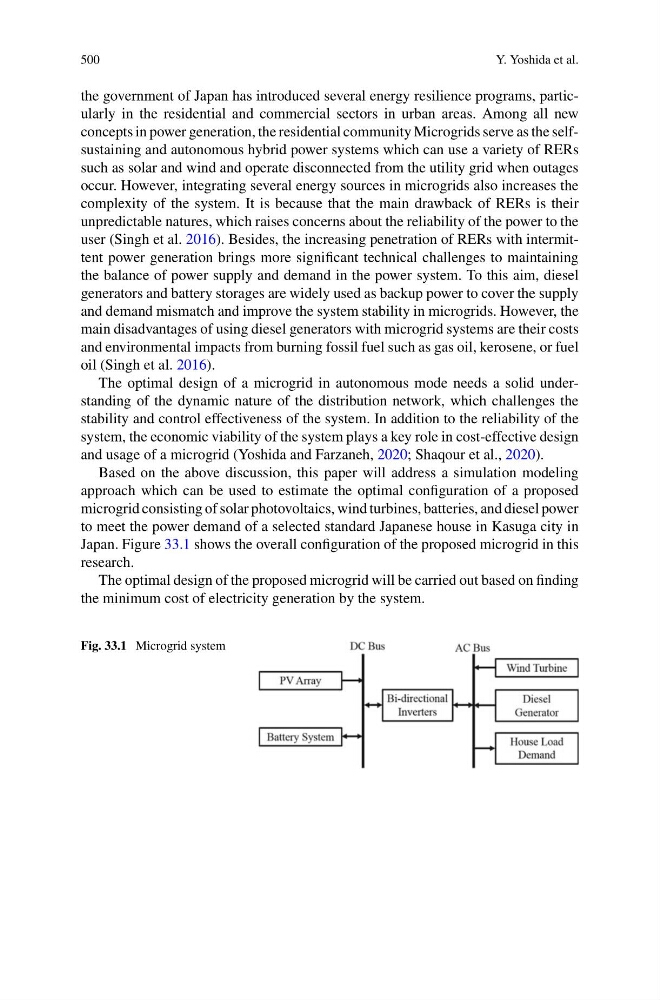
Based on the above discussion, this paper will address a simulation modeling
approach which can be used to estimate the optimal configuration of a proposed
microgrid consisting of solar photovoltaics, wind turbines, batteries, and diesel power
to meet the power demand of a selected standard Japanese house in Kasuga city in
Japan. Figure 33.1 shows the overall configuration of the proposed microgrid in this
research.
The optimal design of the proposed microgrid will be carried out based on finding
the minimum cost of electricity generation by the system.
Fig. 33.1 Microgrid system
Y. Yoshida et al.
the government of Japan has introduced several energy resilience programs, particularly in the residential and commercial sectors in urban areas. Among all new
concepts in power generation, the residential community Microgrids serve as the selfsustaining and autonomous hybrid power systems which can use a variety of RERs
such as solar and wind and operate disconnected from the utility grid when outages
occur. However, integrating several energy sources in microgrids also increases the
complexity of the system. It is because that the main drawback of RERs is their
unpredictable natures, which raises concerns about the reliability of the power to the
user (Singh et al. 2016). Besides, the increasing penetration of RERs with intermittent power generation brings more significant technical challenges to maintaining
the balance of power supply and demand in the power system. To this aim, diesel
generators and battery storages are widely used as backup power to cover the supply
and demand mismatch and improve the system stability in microgrids. However, the
main disadvantages of using diesel generators with microgrid systems are their costs
and environmental impacts from burning fossil fuel such as gas oil, kerosene, or fuel
oil (Singh et al. 2016).
The optimal design of a microgrid in autonomous mode needs a solid understanding of the dynamic nature of the distribution network, which challenges the
stability and control effectiveness of the system. In addition to the reliability of the
system, the economic viability of the system plays a key role in cost-effective design
and usage of a microgrid (Yoshida and Farzaneh, 2020; Shaqour et al., 2020).
Based on the above discussion, this paper will address a simulation modeling
approach which can be used to estimate the optimal configuration of a proposed
microgrid consisting of solar photovoltaics, wind turbines, batteries, and diesel power
to meet the power demand of a selected standard Japanese house in Kasuga city in
Japan. Figure 33.1 shows the overall configuration of the proposed microgrid in this
research.
The optimal design of the proposed microgrid will be carried out based on finding
the minimum cost of electricity generation by the system.
Fig. 33.1 Microgrid system