

492
N. Takatsu and H. Farzaneh
Table 32.1 Product gas from
gasification of 1 kg/h
feedstock
Product gas [g/h]
CO
H 2
CO 2
CH 4
178.7
36.2
383.9
4.2
Using the SCWG model, the amount of product gas from the supercritical water
gasification of typical feedstock with a chemical formula of C 108 H 171 O 63 at the
operating temperature of 973.15[K] is given in Table 32.1.
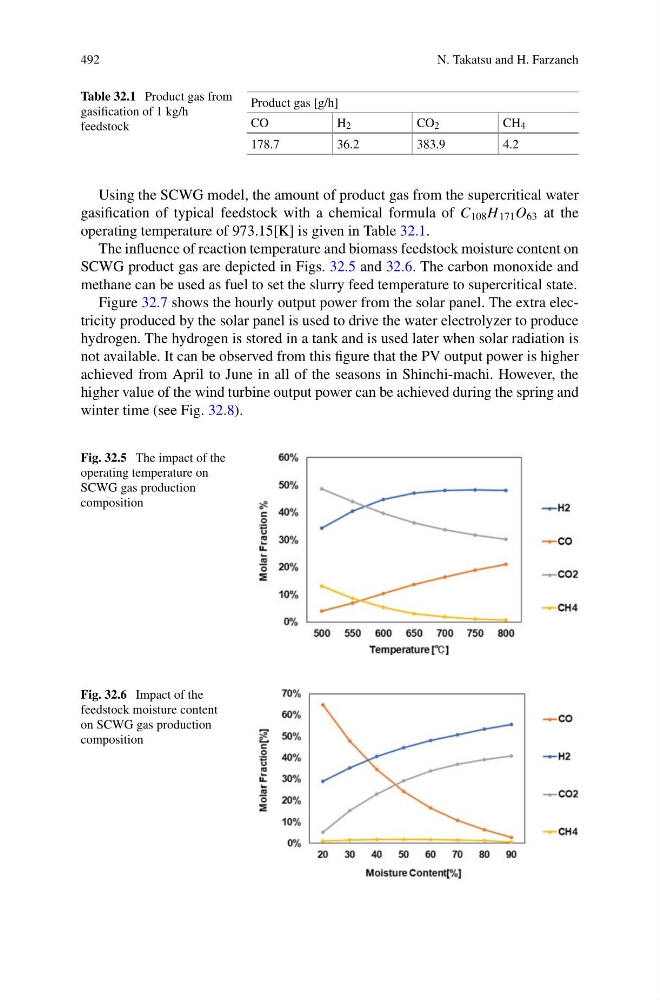
The influence of reaction temperature and biomass feedstock moisture content on
SCWG product gas are depicted in Figs. 32.5 and 32.6. The carbon monoxide and
methane can be used as fuel to set the slurry feed temperature to supercritical state.
Figure 32.7 shows the hourly output power from the solar panel. The extra electricity produced by the solar panel is used to drive the water electrolyzer to produce
hydrogen. The hydrogen is stored in a tank and is used later when solar radiation is
not available. It can be observed from this figure that the PV output power is higher
achieved from April to June in all of the seasons in Shinchi-machi. However, the
higher value of the wind turbine output power can be achieved during the spring and
winter time (see Fig. 32.8).
Fig. 32.5 The impact of the
operating temperature on
SCWG gas production
composition
Fig. 32.6 Impact of the
feedstock moisture content
on SCWG gas production
composition
N. Takatsu and H. Farzaneh
Table 32.1 Product gas from
gasification of 1 kg/h
feedstock
Product gas [g/h]
CO
H 2
CO 2
CH 4
178.7
36.2
383.9
4.2
Using the SCWG model, the amount of product gas from the supercritical water
gasification of typical feedstock with a chemical formula of C 108 H 171 O 63 at the
operating temperature of 973.15[K] is given in Table 32.1.
The influence of reaction temperature and biomass feedstock moisture content on
SCWG product gas are depicted in Figs. 32.5 and 32.6. The carbon monoxide and
methane can be used as fuel to set the slurry feed temperature to supercritical state.
Figure 32.7 shows the hourly output power from the solar panel. The extra electricity produced by the solar panel is used to drive the water electrolyzer to produce
hydrogen. The hydrogen is stored in a tank and is used later when solar radiation is
not available. It can be observed from this figure that the PV output power is higher
achieved from April to June in all of the seasons in Shinchi-machi. However, the
higher value of the wind turbine output power can be achieved during the spring and
winter time (see Fig. 32.8).
Fig. 32.5 The impact of the
operating temperature on
SCWG gas production
composition
Fig. 32.6 Impact of the
feedstock moisture content
on SCWG gas production
composition