

31 Development of a Method for Measuring Resource Efficiency …
471
Resource impact coefficient is the resource impact per weight of each resource.
This is described in detail in Sect. 2.3.
Also, in resource evaluation, for example, there are Factor X and Material
Circularity Indicator (MCT).
However, since there is nothing that can evaluate the three items that we place
importance.
31.2.2 Resource Efficiency Indicator
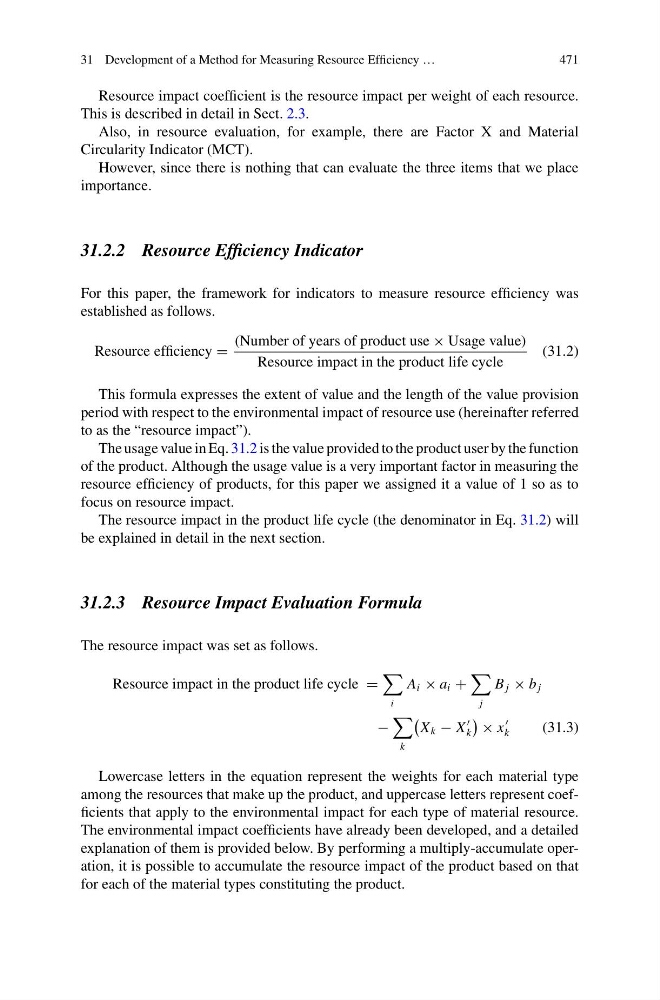
For this paper, the framework for indicators to measure resource efficiency was
established as follows.
Resource efficiency =
(Number of years of product use × Usage value)
Resource impact in the product life cycle
(31.2)
This formula expresses the extent of value and the length of the value provision
period with respect to the environmental impact of resource use (hereinafter referred
to as the “resource impact”).
The usage value in Eq. 31.2 is the value provided to the product user by the function
of the product. Although the usage value is a very important factor in measuring the
resource efficiency of products, for this paper we assigned it a value of 1 so as to
focus on resource impact.
The resource impact in the product life cycle (the denominator in Eq. 31.2) will
be explained in detail in the next section.
31.2.3 Resource Impact Evaluation Formula
The resource impact was set as follows.
Resource impact in the product life cycle =
i
A i × a i +
j
B j × b j
−
k
X k − X
k
× x
k
(31.3)
Lowercase letters in the equation represent the weights for each material type
among the resources that make up the product, and uppercase letters represent coefficients that apply to the environmental impact for each type of material resource.
The environmental impact coefficients have already been developed, and a detailed
explanation of them is provided below. By performing a multiply-accumulate operation, it is possible to accumulate the resource impact of the product based on that
for each of the material types constituting the product.
471
Resource impact coefficient is the resource impact per weight of each resource.
This is described in detail in Sect. 2.3.
Also, in resource evaluation, for example, there are Factor X and Material
Circularity Indicator (MCT).
However, since there is nothing that can evaluate the three items that we place
importance.
31.2.2 Resource Efficiency Indicator
For this paper, the framework for indicators to measure resource efficiency was
established as follows.
Resource efficiency =
(Number of years of product use × Usage value)
Resource impact in the product life cycle
(31.2)
This formula expresses the extent of value and the length of the value provision
period with respect to the environmental impact of resource use (hereinafter referred
to as the “resource impact”).
The usage value in Eq. 31.2 is the value provided to the product user by the function
of the product. Although the usage value is a very important factor in measuring the
resource efficiency of products, for this paper we assigned it a value of 1 so as to
focus on resource impact.
The resource impact in the product life cycle (the denominator in Eq. 31.2) will
be explained in detail in the next section.
31.2.3 Resource Impact Evaluation Formula
The resource impact was set as follows.
Resource impact in the product life cycle =
i
A i × a i +
j
B j × b j
−
k
X k − X
k
× x
k
(31.3)
Lowercase letters in the equation represent the weights for each material type
among the resources that make up the product, and uppercase letters represent coefficients that apply to the environmental impact for each type of material resource.
The environmental impact coefficients have already been developed, and a detailed
explanation of them is provided below. By performing a multiply-accumulate operation, it is possible to accumulate the resource impact of the product based on that
for each of the material types constituting the product.