

464
X. Chen et al.
issues are influenced by various factors, such as economic, environmental, geopolitical and sociological risks. The classification of critical or non-critical materials
defined by the commonly-used two-matrix or three-dimensions approaches may
make the decision makers pay more attention to certain materials at a global level,
while our approach provides a more detailed “dashboard” of risk metrics regarding
the raw materials used in their particular systems at a regional or business level. Thus,
from business perspective, criticality assessment should consider multiple factors
given that different systems may be exposed to different risks which in turn trigger
different business strategies to mitigate the risks. The risk metrics defined in this
paper support the evaluation of supply chain risk of a critical material. The results
indicates that Yttrium is the most critical materials among the selected three materials, due to its very high risk levels in the aspects of environmental country risk,
sourcing and geopolitical risk, and monopoly of supply risk. This is because the
supply of Yttrium is mainly dominated by a few countries, like China (95% of global
production and 41% of shares of reserves), as well the mining and processing of
Yttrium causes serious environmental problems (Zhang et al. 2017). Based on such
results, the decision makers can focus on the strategies to either exploit potential
markets outside China (e.g., US, Australia, India) in order to reduce supply risk, or
formulate more strict regulations to the material mining and processing operations
for environment protection. Therefore, the multiple risk metrics for criticality assessment can support the decision makers to identify and manage the risks of the biggest
concern at a business level. However, there are mainly two limitations. The first one
is that quantitative data are not always available or are too costly to be collected.
The second one is that “trade-off” problem arises when using multiple risk metrics
that are measured in different scales, so diverse aggregation approaches may yield
different results. Therefore, the fuzzy linguistic approach is proposed to overcome
these limitations.
In real-world communication, people are more inclined to use natural language
intuitively for qualitative assessment (e.g., quality evaluation, expert elicitation),
especially when no quantitative information is available. Even in this case, the quantitative data has been translated to linguistic terms to assess the risk level, because
the decision makers usually rely on the risk terms rather than the numerical values.
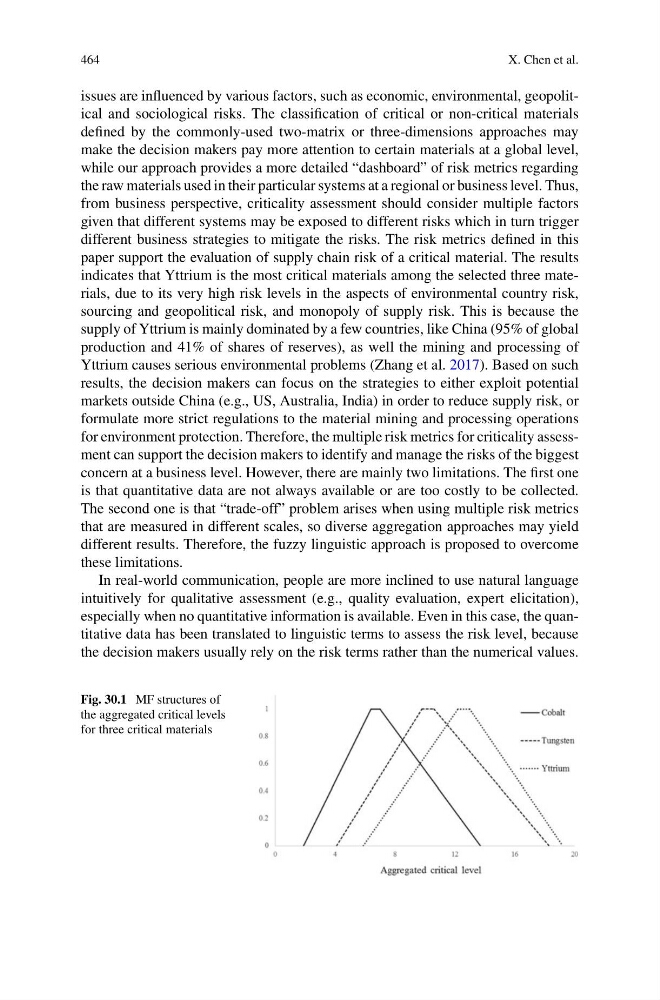
Fig. 30.1 MF structures of
the aggregated critical levels
for three critical materials
X. Chen et al.
issues are influenced by various factors, such as economic, environmental, geopolitical and sociological risks. The classification of critical or non-critical materials
defined by the commonly-used two-matrix or three-dimensions approaches may
make the decision makers pay more attention to certain materials at a global level,
while our approach provides a more detailed “dashboard” of risk metrics regarding
the raw materials used in their particular systems at a regional or business level. Thus,
from business perspective, criticality assessment should consider multiple factors
given that different systems may be exposed to different risks which in turn trigger
different business strategies to mitigate the risks. The risk metrics defined in this
paper support the evaluation of supply chain risk of a critical material. The results
indicates that Yttrium is the most critical materials among the selected three materials, due to its very high risk levels in the aspects of environmental country risk,
sourcing and geopolitical risk, and monopoly of supply risk. This is because the
supply of Yttrium is mainly dominated by a few countries, like China (95% of global
production and 41% of shares of reserves), as well the mining and processing of
Yttrium causes serious environmental problems (Zhang et al. 2017). Based on such
results, the decision makers can focus on the strategies to either exploit potential
markets outside China (e.g., US, Australia, India) in order to reduce supply risk, or
formulate more strict regulations to the material mining and processing operations
for environment protection. Therefore, the multiple risk metrics for criticality assessment can support the decision makers to identify and manage the risks of the biggest
concern at a business level. However, there are mainly two limitations. The first one
is that quantitative data are not always available or are too costly to be collected.
The second one is that “trade-off” problem arises when using multiple risk metrics
that are measured in different scales, so diverse aggregation approaches may yield
different results. Therefore, the fuzzy linguistic approach is proposed to overcome
these limitations.
In real-world communication, people are more inclined to use natural language
intuitively for qualitative assessment (e.g., quality evaluation, expert elicitation),
especially when no quantitative information is available. Even in this case, the quantitative data has been translated to linguistic terms to assess the risk level, because
the decision makers usually rely on the risk terms rather than the numerical values.
Fig. 30.1 MF structures of
the aggregated critical levels
for three critical materials