

29 Influence of Thermal Conductivity and Subsurface Temperature …
449
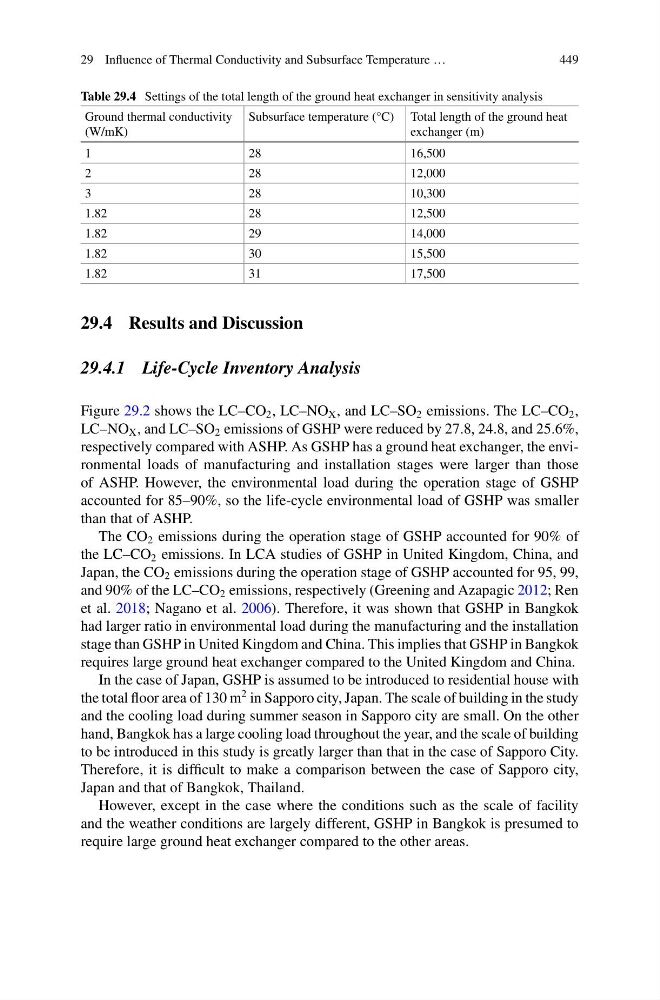
Table 29.4 Settings of the total length of the ground heat exchanger in sensitivity analysis
Ground thermal conductivity
(W/mK)
Subsurface temperature (°C) Total length of the ground heat
exchanger (m)
1
28
16,500
2
28
12,000
3
28
10,300
1.82
28
12,500
1.82
29
14,000
1.82
30
15,500
1.82
31
17,500
29.4 Results and Discussion
29.4.1 Life-Cycle Inventory Analysis
Figure 29.2 shows the LC–CO 2 , LC–NO X , and LC–SO 2 emissions. The LC–CO 2 ,
LC–NO X , and LC–SO 2 emissions of GSHP were reduced by 27.8, 24.8, and 25.6%,
respectively compared with ASHP. As GSHP has a ground heat exchanger, the environmental loads of manufacturing and installation stages were larger than those
of ASHP. However, the environmental load during the operation stage of GSHP
accounted for 85–90%, so the life-cycle environmental load of GSHP was smaller
than that of ASHP.
The CO 2 emissions during the operation stage of GSHP accounted for 90% of
the LC–CO 2 emissions. In LCA studies of GSHP in United Kingdom, China, and
Japan, the CO 2 emissions during the operation stage of GSHP accounted for 95, 99,
and 90% of the LC–CO 2 emissions, respectively (Greening and Azapagic 2012; Ren
et al. 2018; Nagano et al. 2006). Therefore, it was shown that GSHP in Bangkok
had larger ratio in environmental load during the manufacturing and the installation
stage than GSHP in United Kingdom and China. This implies that GSHP in Bangkok
requires large ground heat exchanger compared to the United Kingdom and China.
In the case of Japan, GSHP is assumed to be introduced to residential house with
the total floor area of 130 m
2 in Sapporo city, Japan. The scale of building in the study
and the cooling load during summer season in Sapporo city are small. On the other
hand, Bangkok has a large cooling load throughout the year, and the scale of building
to be introduced in this study is greatly larger than that in the case of Sapporo City.
Therefore, it is difficult to make a comparison between the case of Sapporo city,
Japan and that of Bangkok, Thailand.
However, except in the case where the conditions such as the scale of facility
and the weather conditions are largely different, GSHP in Bangkok is presumed to
require large ground heat exchanger compared to the other areas.
449
Table 29.4 Settings of the total length of the ground heat exchanger in sensitivity analysis
Ground thermal conductivity
(W/mK)
Subsurface temperature (°C) Total length of the ground heat
exchanger (m)
1
28
16,500
2
28
12,000
3
28
10,300
1.82
28
12,500
1.82
29
14,000
1.82
30
15,500
1.82
31
17,500
29.4 Results and Discussion
29.4.1 Life-Cycle Inventory Analysis
Figure 29.2 shows the LC–CO 2 , LC–NO X , and LC–SO 2 emissions. The LC–CO 2 ,
LC–NO X , and LC–SO 2 emissions of GSHP were reduced by 27.8, 24.8, and 25.6%,
respectively compared with ASHP. As GSHP has a ground heat exchanger, the environmental loads of manufacturing and installation stages were larger than those
of ASHP. However, the environmental load during the operation stage of GSHP
accounted for 85–90%, so the life-cycle environmental load of GSHP was smaller
than that of ASHP.
The CO 2 emissions during the operation stage of GSHP accounted for 90% of
the LC–CO 2 emissions. In LCA studies of GSHP in United Kingdom, China, and
Japan, the CO 2 emissions during the operation stage of GSHP accounted for 95, 99,
and 90% of the LC–CO 2 emissions, respectively (Greening and Azapagic 2012; Ren
et al. 2018; Nagano et al. 2006). Therefore, it was shown that GSHP in Bangkok
had larger ratio in environmental load during the manufacturing and the installation
stage than GSHP in United Kingdom and China. This implies that GSHP in Bangkok
requires large ground heat exchanger compared to the United Kingdom and China.
In the case of Japan, GSHP is assumed to be introduced to residential house with
the total floor area of 130 m
2 in Sapporo city, Japan. The scale of building in the study
and the cooling load during summer season in Sapporo city are small. On the other
hand, Bangkok has a large cooling load throughout the year, and the scale of building
to be introduced in this study is greatly larger than that in the case of Sapporo City.
Therefore, it is difficult to make a comparison between the case of Sapporo city,
Japan and that of Bangkok, Thailand.
However, except in the case where the conditions such as the scale of facility
and the weather conditions are largely different, GSHP in Bangkok is presumed to
require large ground heat exchanger compared to the other areas.