

21 Progress for Life Cycle Sustainability Assessment by Means …
341
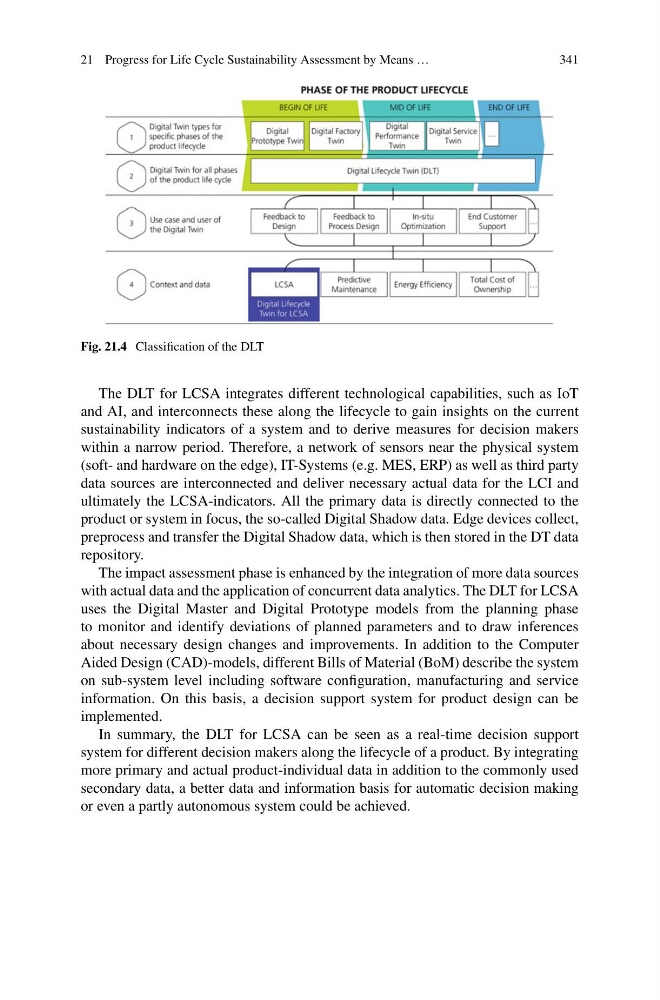
Fig. 21.4 Classification of the DLT
The DLT for LCSA integrates different technological capabilities, such as IoT
and AI, and interconnects these along the lifecycle to gain insights on the current
sustainability indicators of a system and to derive measures for decision makers
within a narrow period. Therefore, a network of sensors near the physical system
(soft- and hardware on the edge), IT-Systems (e.g. MES, ERP) as well as third party
data sources are interconnected and deliver necessary actual data for the LCI and
ultimately the LCSA-indicators. All the primary data is directly connected to the
product or system in focus, the so-called Digital Shadow data. Edge devices collect,
preprocess and transfer the Digital Shadow data, which is then stored in the DT data
repository.
The impact assessment phase is enhanced by the integration of more data sources
with actual data and the application of concurrent data analytics. The DLT for LCSA
uses the Digital Master and Digital Prototype models from the planning phase
to monitor and identify deviations of planned parameters and to draw inferences
about necessary design changes and improvements. In addition to the Computer
Aided Design (CAD)-models, different Bills of Material (BoM) describe the system
on sub-system level including software configuration, manufacturing and service
information. On this basis, a decision support system for product design can be
implemented.
In summary, the DLT for LCSA can be seen as a real-time decision support
system for different decision makers along the lifecycle of a product. By integrating
more primary and actual product-individual data in addition to the commonly used
secondary data, a better data and information basis for automatic decision making
or even a partly autonomous system could be achieved.
341
Fig. 21.4 Classification of the DLT
The DLT for LCSA integrates different technological capabilities, such as IoT
and AI, and interconnects these along the lifecycle to gain insights on the current
sustainability indicators of a system and to derive measures for decision makers
within a narrow period. Therefore, a network of sensors near the physical system
(soft- and hardware on the edge), IT-Systems (e.g. MES, ERP) as well as third party
data sources are interconnected and deliver necessary actual data for the LCI and
ultimately the LCSA-indicators. All the primary data is directly connected to the
product or system in focus, the so-called Digital Shadow data. Edge devices collect,
preprocess and transfer the Digital Shadow data, which is then stored in the DT data
repository.
The impact assessment phase is enhanced by the integration of more data sources
with actual data and the application of concurrent data analytics. The DLT for LCSA
uses the Digital Master and Digital Prototype models from the planning phase
to monitor and identify deviations of planned parameters and to draw inferences
about necessary design changes and improvements. In addition to the Computer
Aided Design (CAD)-models, different Bills of Material (BoM) describe the system
on sub-system level including software configuration, manufacturing and service
information. On this basis, a decision support system for product design can be
implemented.
In summary, the DLT for LCSA can be seen as a real-time decision support
system for different decision makers along the lifecycle of a product. By integrating
more primary and actual product-individual data in addition to the commonly used
secondary data, a better data and information basis for automatic decision making
or even a partly autonomous system could be achieved.