

21 Progress for Life Cycle Sustainability Assessment by Means …
333
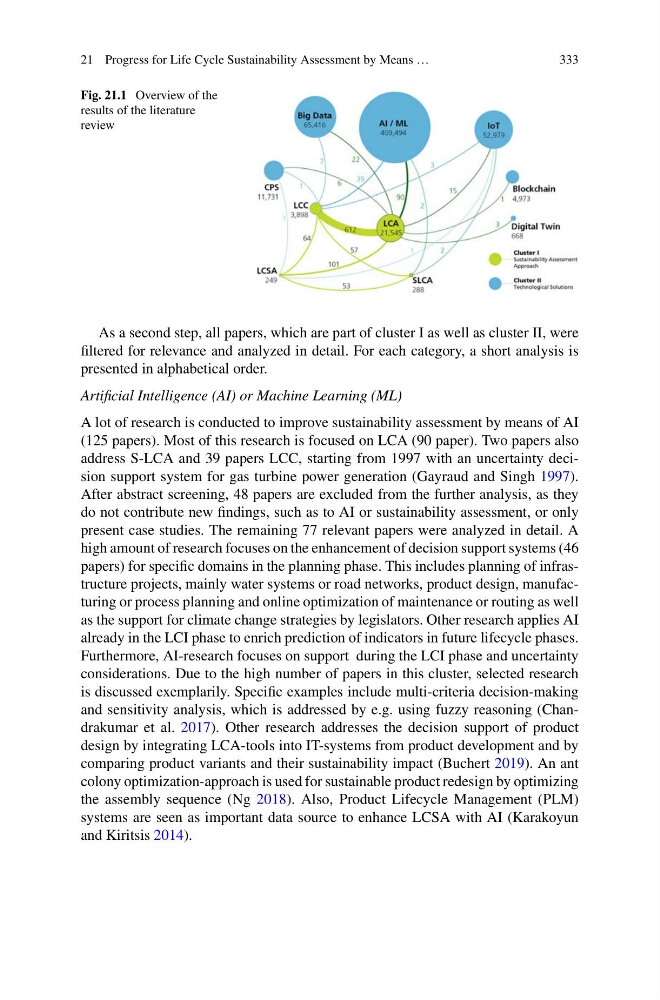
Fig. 21.1 Overview of the
results of the literature
review
As a second step, all papers, which are part of cluster I as well as cluster II, were
filtered for relevance and analyzed in detail. For each category, a short analysis is
presented in alphabetical order.
Artificial Intelligence (AI) or Machine Learning (ML)
A lot of research is conducted to improve sustainability assessment by means of AI
(125 papers). Most of this research is focused on LCA (90 paper). Two papers also
address S-LCA and 39 papers LCC, starting from 1997 with an uncertainty decision support system for gas turbine power generation (Gayraud and Singh 1997).
After abstract screening, 48 papers are excluded from the further analysis, as they
do not contribute new findings, such as to AI or sustainability assessment, or only
present case studies. The remaining 77 relevant papers were analyzed in detail. A
high amount of research focuses on the enhancement of decision support systems (46
papers) for specific domains in the planning phase. This includes planning of infrastructure projects, mainly water systems or road networks, product design, manufacturing or process planning and online optimization of maintenance or routing as well
as the support for climate change strategies by legislators. Other research applies AI
already in the LCI phase to enrich prediction of indicators in future lifecycle phases.
Furthermore, AI-research focuses on support during the LCI phase and uncertainty
considerations. Due to the high number of papers in this cluster, selected research
is discussed exemplarily. Specific examples include multi-criteria decision-making
and sensitivity analysis, which is addressed by e.g. using fuzzy reasoning (Chandrakumar et al. 2017). Other research addresses the decision support of product
design by integrating LCA-tools into IT-systems from product development and by
comparing product variants and their sustainability impact (Buchert 2019). An ant
colony optimization-approach is used for sustainable product redesign by optimizing
the assembly sequence (Ng 2018). Also, Product Lifecycle Management (PLM)
systems are seen as important data source to enhance LCSA with AI (Karakoyun
and Kiritsis 2014).
333
Fig. 21.1 Overview of the
results of the literature
review
As a second step, all papers, which are part of cluster I as well as cluster II, were
filtered for relevance and analyzed in detail. For each category, a short analysis is
presented in alphabetical order.
Artificial Intelligence (AI) or Machine Learning (ML)
A lot of research is conducted to improve sustainability assessment by means of AI
(125 papers). Most of this research is focused on LCA (90 paper). Two papers also
address S-LCA and 39 papers LCC, starting from 1997 with an uncertainty decision support system for gas turbine power generation (Gayraud and Singh 1997).
After abstract screening, 48 papers are excluded from the further analysis, as they
do not contribute new findings, such as to AI or sustainability assessment, or only
present case studies. The remaining 77 relevant papers were analyzed in detail. A
high amount of research focuses on the enhancement of decision support systems (46
papers) for specific domains in the planning phase. This includes planning of infrastructure projects, mainly water systems or road networks, product design, manufacturing or process planning and online optimization of maintenance or routing as well
as the support for climate change strategies by legislators. Other research applies AI
already in the LCI phase to enrich prediction of indicators in future lifecycle phases.
Furthermore, AI-research focuses on support during the LCI phase and uncertainty
considerations. Due to the high number of papers in this cluster, selected research
is discussed exemplarily. Specific examples include multi-criteria decision-making
and sensitivity analysis, which is addressed by e.g. using fuzzy reasoning (Chandrakumar et al. 2017). Other research addresses the decision support of product
design by integrating LCA-tools into IT-systems from product development and by
comparing product variants and their sustainability impact (Buchert 2019). An ant
colony optimization-approach is used for sustainable product redesign by optimizing
the assembly sequence (Ng 2018). Also, Product Lifecycle Management (PLM)
systems are seen as important data source to enhance LCSA with AI (Karakoyun
and Kiritsis 2014).