

194
M. Kohno and M. Hirao
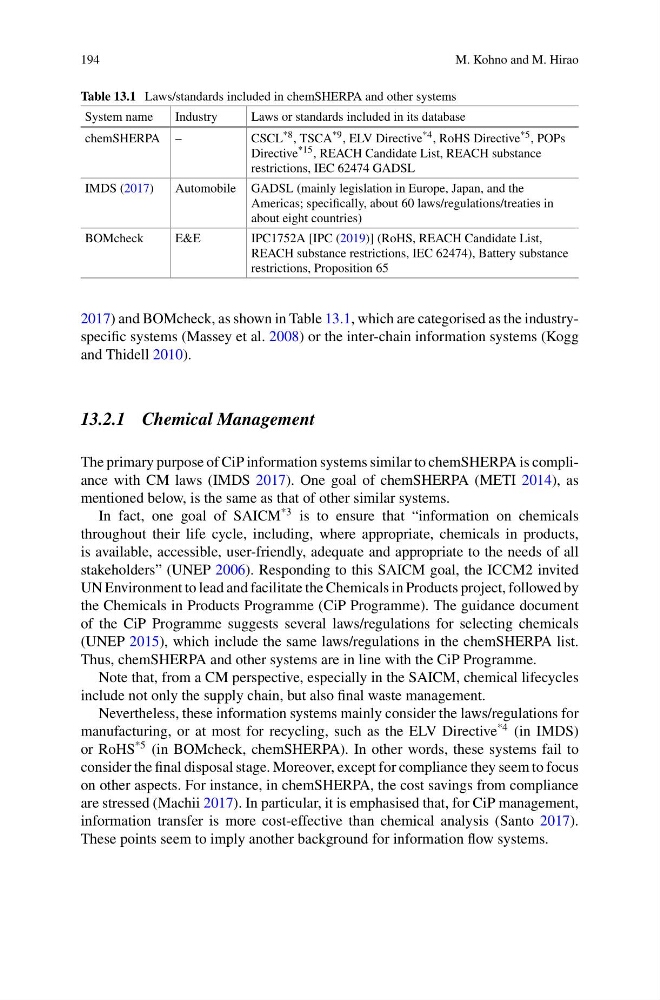
Table 13.1 Laws/standards included in chemSHERPA and other systems
System name
Industry
Laws or standards included in its database
chemSHERPA –
CSCL *8 , TSCA *9 , ELV Directive *4 , RoHS Directive *5 , POPs
Directive *15 , REACH Candidate List, REACH substance
restrictions, IEC 62474 GADSL
IMDS (2017)
Automobile GADSL (mainly legislation in Europe, Japan, and the
Americas; specifically, about 60 laws/regulations/treaties in
about eight countries)
BOMcheck
E&E
IPC1752A [IPC (2019)] (RoHS, REACH Candidate List,
REACH substance restrictions, IEC 62474), Battery substance
restrictions, Proposition 65
2017) and BOMcheck, as shown in Table 13.1, which are categorised as the industryspecific systems (Massey et al. 2008) or the inter-chain information systems (Kogg
and Thidell 2010).
13.2.1 Chemical Management
The primary purpose of CiP information systems similar to chemSHERPA is compliance with CM laws (IMDS 2017). One goal of chemSHERPA (METI 2014), as
mentioned below, is the same as that of other similar systems.
In fact, one goal of SAICM
*3 is to ensure that “information on chemicals
throughout their life cycle, including, where appropriate, chemicals in products,
is available, accessible, user-friendly, adequate and appropriate to the needs of all
stakeholders” (UNEP 2006). Responding to this SAICM goal, the ICCM2 invited
UN Environment to lead and facilitate the Chemicals in Products project, followed by
the Chemicals in Products Programme (CiP Programme). The guidance document
of the CiP Programme suggests several laws/regulations for selecting chemicals
(UNEP 2015), which include the same laws/regulations in the chemSHERPA list.
Thus, chemSHERPA and other systems are in line with the CiP Programme.
Note that, from a CM perspective, especially in the SAICM, chemical lifecycles
include not only the supply chain, but also final waste management.
Nevertheless, these information systems mainly consider the laws/regulations for
manufacturing, or at most for recycling, such as the ELV Directive
*4 (in IMDS)
or RoHS
*5 (in BOMcheck, chemSHERPA). In other words, these systems fail to
consider the final disposal stage. Moreover, except for compliance they seem to focus
on other aspects. For instance, in chemSHERPA, the cost savings from compliance
are stressed (Machii 2017). In particular, it is emphasised that, for CiP management,
information transfer is more cost-effective than chemical analysis (Santo 2017).
These points seem to imply another background for information flow systems.
M. Kohno and M. Hirao
Table 13.1 Laws/standards included in chemSHERPA and other systems
System name
Industry
Laws or standards included in its database
chemSHERPA –
CSCL *8 , TSCA *9 , ELV Directive *4 , RoHS Directive *5 , POPs
Directive *15 , REACH Candidate List, REACH substance
restrictions, IEC 62474 GADSL
IMDS (2017)
Automobile GADSL (mainly legislation in Europe, Japan, and the
Americas; specifically, about 60 laws/regulations/treaties in
about eight countries)
BOMcheck
E&E
IPC1752A [IPC (2019)] (RoHS, REACH Candidate List,
REACH substance restrictions, IEC 62474), Battery substance
restrictions, Proposition 65
2017) and BOMcheck, as shown in Table 13.1, which are categorised as the industryspecific systems (Massey et al. 2008) or the inter-chain information systems (Kogg
and Thidell 2010).
13.2.1 Chemical Management
The primary purpose of CiP information systems similar to chemSHERPA is compliance with CM laws (IMDS 2017). One goal of chemSHERPA (METI 2014), as
mentioned below, is the same as that of other similar systems.
In fact, one goal of SAICM
*3 is to ensure that “information on chemicals
throughout their life cycle, including, where appropriate, chemicals in products,
is available, accessible, user-friendly, adequate and appropriate to the needs of all
stakeholders” (UNEP 2006). Responding to this SAICM goal, the ICCM2 invited
UN Environment to lead and facilitate the Chemicals in Products project, followed by
the Chemicals in Products Programme (CiP Programme). The guidance document
of the CiP Programme suggests several laws/regulations for selecting chemicals
(UNEP 2015), which include the same laws/regulations in the chemSHERPA list.
Thus, chemSHERPA and other systems are in line with the CiP Programme.
Note that, from a CM perspective, especially in the SAICM, chemical lifecycles
include not only the supply chain, but also final waste management.
Nevertheless, these information systems mainly consider the laws/regulations for
manufacturing, or at most for recycling, such as the ELV Directive
*4 (in IMDS)
or RoHS
*5 (in BOMcheck, chemSHERPA). In other words, these systems fail to
consider the final disposal stage. Moreover, except for compliance they seem to focus
on other aspects. For instance, in chemSHERPA, the cost savings from compliance
are stressed (Machii 2017). In particular, it is emphasised that, for CiP management,
information transfer is more cost-effective than chemical analysis (Santo 2017).
These points seem to imply another background for information flow systems.