

164
S. Kosai and E. Yamasue
11.2 Methodology
11.2.1 Classification of Material Categories
This paper basically follows the reported material flow diagram given by Ministry
of Environment in Japan (Ministry of Environment 2006). Overall material category is named 1st classification. Subsequently, overall material category is divided
into foreign origin and domestic origin. Foreign origin materials are recorded based
on imported resources and imported products, while domestic origin materials are
comprised of domestic extraction resources and domestic cycled resources. These
four components are considered 2nd classification. Subsequently, the second classification is further disaggregated to obtain 3rd classification, comprising of 90 components following the Recycle Data Book published by Japan Environmental Management Association For Industry (2017). Due to the historical data limitation, third
classification on a DMI basis in Japan since 1990 until 2013 is recorded here.
11.2.2 Mathematical Relation Between TMR and DMI
The concept of TMR calculation in the bottom-up approach is comprised of two
components: the weight of targeted material (kg), which is recorded on the DMI
basis, and the weight of all of material inputs including hidden flows to obtain the
targeted material (kg), which is recorded on the TMR basis (Adriaanse et al. 1997).
Each of two components is referred to the material weight on the DMI basis and
the material weight on the TMR basis. The proportion of weight on a DMI basis to
weight on the TMR basis depends on the material type, which is named the specific
TMR. The specific TMR of material x can be obtained in the following equation.
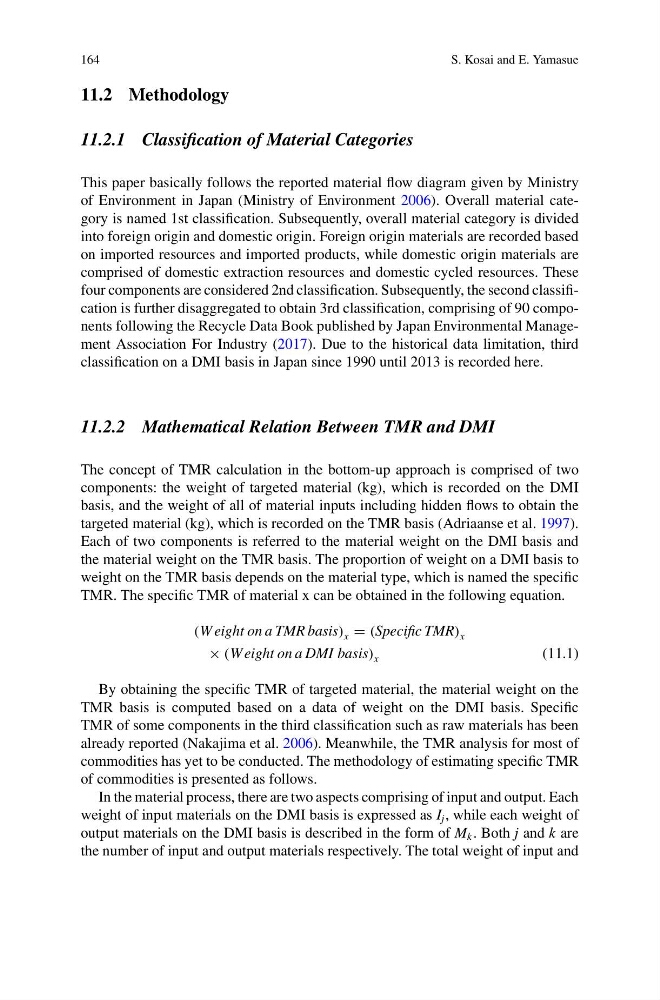
(W eight on a TMR basis) x = (Specific TMR) x
× (W eight on a DMI basis) x
(11.1)
By obtaining the specific TMR of targeted material, the material weight on the
TMR basis is computed based on a data of weight on the DMI basis. Specific
TMR of some components in the third classification such as raw materials has been
already reported (Nakajima et al. 2006). Meanwhile, the TMR analysis for most of
commodities has yet to be conducted. The methodology of estimating specific TMR
of commodities is presented as follows.
In the material process, there are two aspects comprising of input and output. Each
weight of input materials on the DMI basis is expressed as I j , while each weight of
output materials on the DMI basis is described in the form of M k . Both j and k are
the number of input and output materials respectively. The total weight of input and
S. Kosai and E. Yamasue
11.2 Methodology
11.2.1 Classification of Material Categories
This paper basically follows the reported material flow diagram given by Ministry
of Environment in Japan (Ministry of Environment 2006). Overall material category is named 1st classification. Subsequently, overall material category is divided
into foreign origin and domestic origin. Foreign origin materials are recorded based
on imported resources and imported products, while domestic origin materials are
comprised of domestic extraction resources and domestic cycled resources. These
four components are considered 2nd classification. Subsequently, the second classification is further disaggregated to obtain 3rd classification, comprising of 90 components following the Recycle Data Book published by Japan Environmental Management Association For Industry (2017). Due to the historical data limitation, third
classification on a DMI basis in Japan since 1990 until 2013 is recorded here.
11.2.2 Mathematical Relation Between TMR and DMI
The concept of TMR calculation in the bottom-up approach is comprised of two
components: the weight of targeted material (kg), which is recorded on the DMI
basis, and the weight of all of material inputs including hidden flows to obtain the
targeted material (kg), which is recorded on the TMR basis (Adriaanse et al. 1997).
Each of two components is referred to the material weight on the DMI basis and
the material weight on the TMR basis. The proportion of weight on a DMI basis to
weight on the TMR basis depends on the material type, which is named the specific
TMR. The specific TMR of material x can be obtained in the following equation.
(W eight on a TMR basis) x = (Specific TMR) x
× (W eight on a DMI basis) x
(11.1)
By obtaining the specific TMR of targeted material, the material weight on the
TMR basis is computed based on a data of weight on the DMI basis. Specific
TMR of some components in the third classification such as raw materials has been
already reported (Nakajima et al. 2006). Meanwhile, the TMR analysis for most of
commodities has yet to be conducted. The methodology of estimating specific TMR
of commodities is presented as follows.
In the material process, there are two aspects comprising of input and output. Each
weight of input materials on the DMI basis is expressed as I j , while each weight of
output materials on the DMI basis is described in the form of M k . Both j and k are
the number of input and output materials respectively. The total weight of input and