

124
M. Zolfaghari and S. J. Zafarmand
Table 8.4 Items used for formalistic analysis of samples
Elements
Items
Elements
Items
Front silhouette
A1: Vertical lines
Front bumper
F1: Horizontal lines
A2: Corners
Front bumper grille
G1: Fog light shape
A3: Total shape
G2: Size
Front window
B1: Height
G3: Vertical lines
B2: Total shape
Side Window
H1: Vertical angle
B3: Corners
H2: Height
Hood
C1: Horizontal lines
Side Front Fender
I1: Curvature
C2: Vertical lines
I2: Length
C3: Total shape
Side Door
J1: Vertical angle
Front grille
D1: Total shape
J2: Belt line angle
D2: Size
D3: Corners
J3: Corners
Headlight
E1: Size
E2: Horizontal lines
Roof
K1: Curvature
E3: Vertical lines
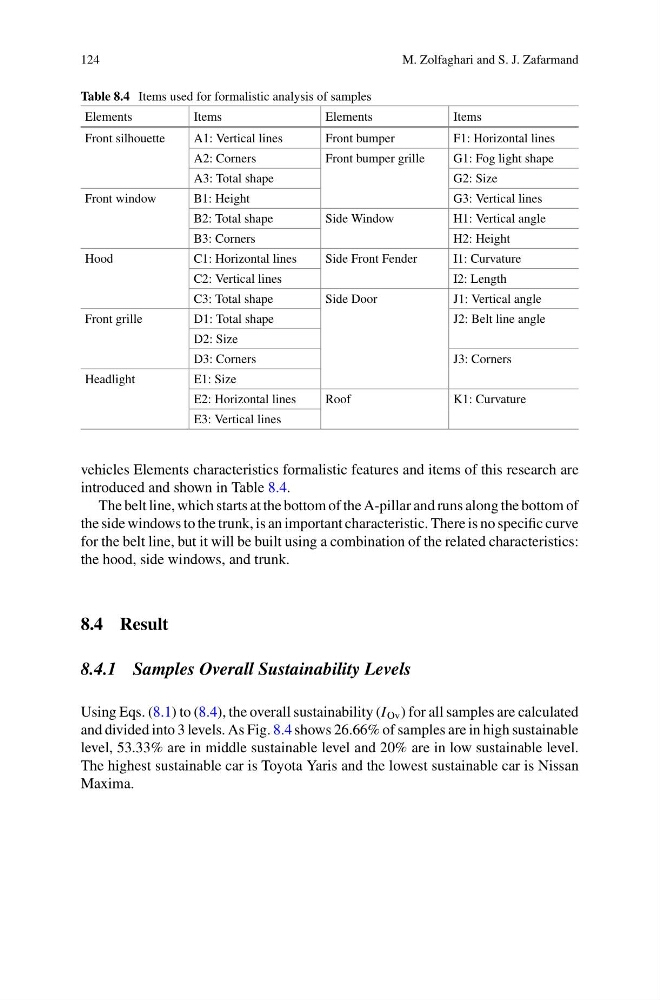
vehicles Elements characteristics formalistic features and items of this research are
introduced and shown in Table 8.4.
The belt line, which starts at the bottom of the A-pillar and runs along the bottom of
the side windows to the trunk, is an important characteristic. There is no specific curve
for the belt line, but it will be built using a combination of the related characteristics:
the hood, side windows, and trunk.
8.4 Result
8.4.1 Samples Overall Sustainability Levels
Using Eqs. (8.1) to (8.4), the overall sustainability (I Ov ) for all samples are calculated
and divided into 3 levels. As Fig. 8.4 shows 26.66% of samples are in high sustainable
level, 53.33% are in middle sustainable level and 20% are in low sustainable level.
The highest sustainable car is Toyota Yaris and the lowest sustainable car is Nissan
Maxima.
M. Zolfaghari and S. J. Zafarmand
Table 8.4 Items used for formalistic analysis of samples
Elements
Items
Elements
Items
Front silhouette
A1: Vertical lines
Front bumper
F1: Horizontal lines
A2: Corners
Front bumper grille
G1: Fog light shape
A3: Total shape
G2: Size
Front window
B1: Height
G3: Vertical lines
B2: Total shape
Side Window
H1: Vertical angle
B3: Corners
H2: Height
Hood
C1: Horizontal lines
Side Front Fender
I1: Curvature
C2: Vertical lines
I2: Length
C3: Total shape
Side Door
J1: Vertical angle
Front grille
D1: Total shape
J2: Belt line angle
D2: Size
D3: Corners
J3: Corners
Headlight
E1: Size
E2: Horizontal lines
Roof
K1: Curvature
E3: Vertical lines
vehicles Elements characteristics formalistic features and items of this research are
introduced and shown in Table 8.4.
The belt line, which starts at the bottom of the A-pillar and runs along the bottom of
the side windows to the trunk, is an important characteristic. There is no specific curve
for the belt line, but it will be built using a combination of the related characteristics:
the hood, side windows, and trunk.
8.4 Result
8.4.1 Samples Overall Sustainability Levels
Using Eqs. (8.1) to (8.4), the overall sustainability (I Ov ) for all samples are calculated
and divided into 3 levels. As Fig. 8.4 shows 26.66% of samples are in high sustainable
level, 53.33% are in middle sustainable level and 20% are in low sustainable level.
The highest sustainable car is Toyota Yaris and the lowest sustainable car is Nissan
Maxima.