

72
2 Observations of Radio and X-ray Pulsars
mirrors aligned for nearly normal incidence. That is, the light waves travel nearly
perpendicular to the reflecting of refracting surface. The lenses for visible light are
made of transparent materials with an index of refraction substantially different
from 1. However, X-rays are different with visible light, and have many properties,
like shorter wavelength, higher frequency, higher energy and stronger penetrability.
As X-rays pass through all known transparent materials, their refractivity is almost
equal to 1. Striking mirror surfaces nearly perpendicular, X-rays are either transmitted or absorbed, but not reflected. Therefore, it is very difficult to focus X-rays by
using conventional optical focus techniques. Alternatively, considering the property
of soft X-rays, they can be focused by using some special focus techniques, such
as Wolter grazing incidence, reflection grating and micro-pore optics. Moreover,
there are many modulated imaging techniques, such as coded-aperture mask, rotated
slab and scanning observation. The Wolter grazing-incidence focus technique and
the coded-aperture mask one will be introduced briefly in this section while other
techniques can be seen further in the related reference [5].
In 1952, a German physicist Hans Wolter (1911–1978) designed an aplanatic
system of grazing-incidence mirrors that satisfied the Abbe sine condition, also
known as Wolter telescope. In geometric optics, the incident angle is an angle
between the incident beam on a surface and the line perpendicular to the surface at
the point of incidence. This line is usually called the normal. Sometimes, dealing
with a beam that is nearly parallel to a surface, it is more useful to refer to the angle
between the beam and the surface, rather than that between the beam and the surface’s
normal. That is to say, the right angle 90 degrees minus the angle of incidence. This
small angle is called a glancing angle or grazing angle, and the incoming way at
grazing angle is called grazing incidence. If soft X-ray photons glance through
polishing metal surface at a smaller grazing angle (typical values between 10 arcminutes and 2 degrees), most of the photons will be reflected to the focal points
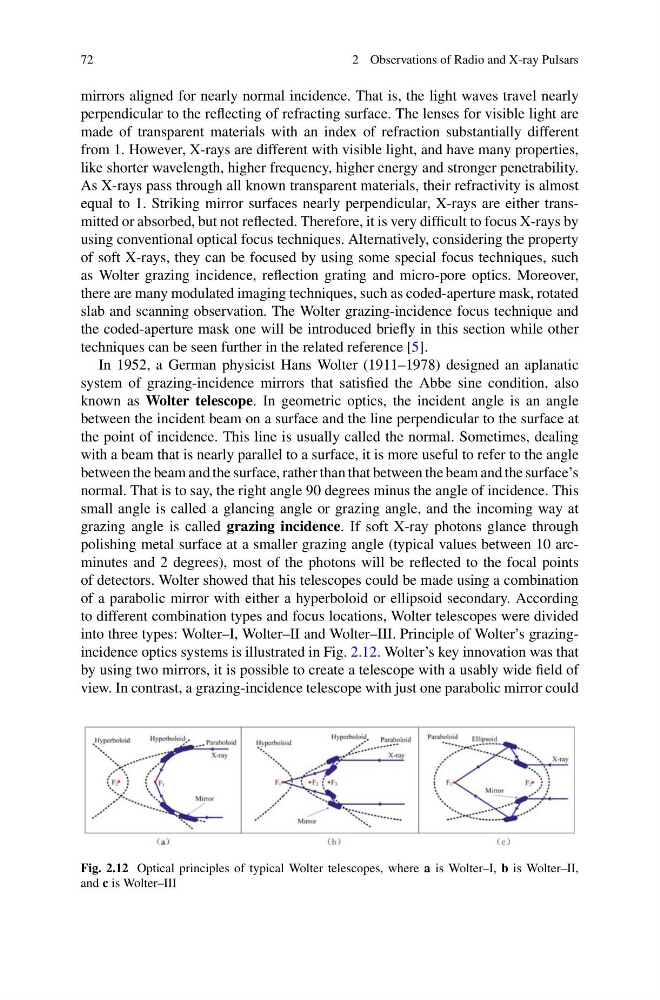
of detectors. Wolter showed that his telescopes could be made using a combination
of a parabolic mirror with either a hyperboloid or ellipsoid secondary. According
to different combination types and focus locations, Wolter telescopes were divided
into three types: Wolter–I, Wolter–II and Wolter–III. Principle of Wolter’s grazingincidence optics systems is illustrated in Fig. 2.12. Wolter’s key innovation was that
by using two mirrors, it is possible to create a telescope with a usably wide field of
view. In contrast, a grazing-incidence telescope with just one parabolic mirror could
Fig. 2.12 Optical principles of typical Wolter telescopes, where a is Wolter–I, b is Wolter–II,
and c is Wolter–III
2 Observations of Radio and X-ray Pulsars
mirrors aligned for nearly normal incidence. That is, the light waves travel nearly
perpendicular to the reflecting of refracting surface. The lenses for visible light are
made of transparent materials with an index of refraction substantially different
from 1. However, X-rays are different with visible light, and have many properties,
like shorter wavelength, higher frequency, higher energy and stronger penetrability.
As X-rays pass through all known transparent materials, their refractivity is almost
equal to 1. Striking mirror surfaces nearly perpendicular, X-rays are either transmitted or absorbed, but not reflected. Therefore, it is very difficult to focus X-rays by
using conventional optical focus techniques. Alternatively, considering the property
of soft X-rays, they can be focused by using some special focus techniques, such
as Wolter grazing incidence, reflection grating and micro-pore optics. Moreover,
there are many modulated imaging techniques, such as coded-aperture mask, rotated
slab and scanning observation. The Wolter grazing-incidence focus technique and
the coded-aperture mask one will be introduced briefly in this section while other
techniques can be seen further in the related reference [5].
In 1952, a German physicist Hans Wolter (1911–1978) designed an aplanatic
system of grazing-incidence mirrors that satisfied the Abbe sine condition, also
known as Wolter telescope. In geometric optics, the incident angle is an angle
between the incident beam on a surface and the line perpendicular to the surface at
the point of incidence. This line is usually called the normal. Sometimes, dealing
with a beam that is nearly parallel to a surface, it is more useful to refer to the angle
between the beam and the surface, rather than that between the beam and the surface’s
normal. That is to say, the right angle 90 degrees minus the angle of incidence. This
small angle is called a glancing angle or grazing angle, and the incoming way at
grazing angle is called grazing incidence. If soft X-ray photons glance through
polishing metal surface at a smaller grazing angle (typical values between 10 arcminutes and 2 degrees), most of the photons will be reflected to the focal points
of detectors. Wolter showed that his telescopes could be made using a combination
of a parabolic mirror with either a hyperboloid or ellipsoid secondary. According
to different combination types and focus locations, Wolter telescopes were divided
into three types: Wolter–I, Wolter–II and Wolter–III. Principle of Wolter’s grazingincidence optics systems is illustrated in Fig. 2.12. Wolter’s key innovation was that
by using two mirrors, it is possible to create a telescope with a usably wide field of
view. In contrast, a grazing-incidence telescope with just one parabolic mirror could
Fig. 2.12 Optical principles of typical Wolter telescopes, where a is Wolter–I, b is Wolter–II,
and c is Wolter–III