

66
2 Observations of Radio and X-ray Pulsars
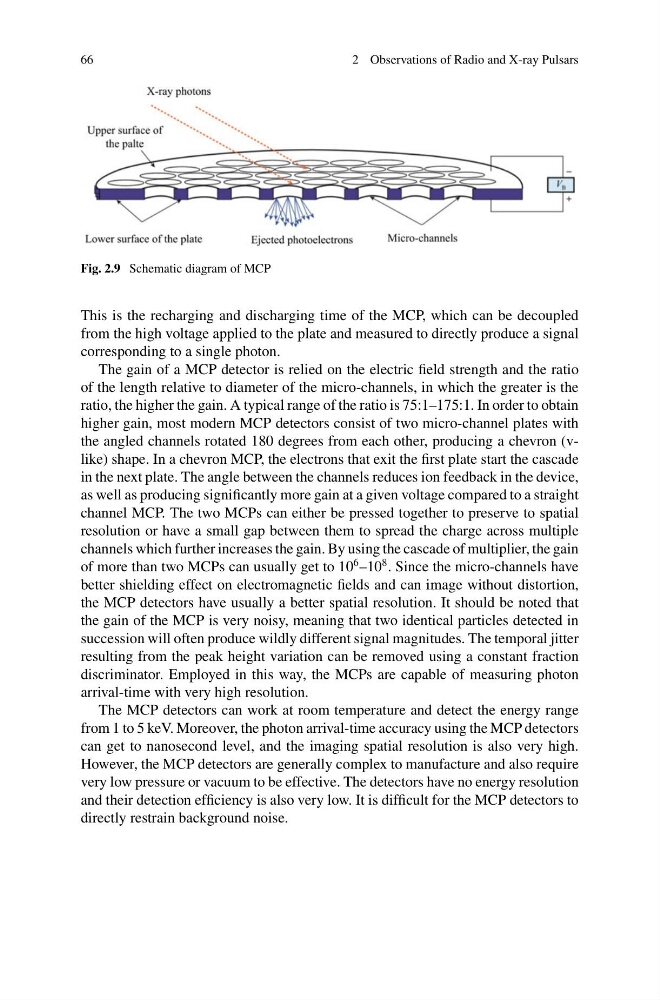
Fig. 2.9 Schematic diagram of MCP
This is the recharging and discharging time of the MCP, which can be decoupled
from the high voltage applied to the plate and measured to directly produce a signal
corresponding to a single photon.
The gain of a MCP detector is relied on the electric field strength and the ratio
of the length relative to diameter of the micro-channels, in which the greater is the
ratio, the higher the gain. A typical range of the ratio is 75:1–175:1. In order to obtain
higher gain, most modern MCP detectors consist of two micro-channel plates with
the angled channels rotated 180 degrees from each other, producing a chevron (vlike) shape. In a chevron MCP, the electrons that exit the first plate start the cascade
in the next plate. The angle between the channels reduces ion feedback in the device,
as well as producing significantly more gain at a given voltage compared to a straight
channel MCP. The two MCPs can either be pressed together to preserve to spatial
resolution or have a small gap between them to spread the charge across multiple
channels which further increases the gain. By using the cascade of multiplier, the gain
of more than two MCPs can usually get to 10
6 –10
8 . Since the micro-channels have
better shielding effect on electromagnetic fields and can image without distortion,
the MCP detectors have usually a better spatial resolution. It should be noted that
the gain of the MCP is very noisy, meaning that two identical particles detected in
succession will often produce wildly different signal magnitudes. The temporal jitter
resulting from the peak height variation can be removed using a constant fraction
discriminator. Employed in this way, the MCPs are capable of measuring photon
arrival-time with very high resolution.
The MCP detectors can work at room temperature and detect the energy range
from 1 to 5 keV. Moreover, the photon arrival-time accuracy using the MCP detectors
can get to nanosecond level, and the imaging spatial resolution is also very high.
However, the MCP detectors are generally complex to manufacture and also require
very low pressure or vacuum to be effective. The detectors have no energy resolution
and their detection efficiency is also very low. It is difficult for the MCP detectors to
directly restrain background noise.
2 Observations of Radio and X-ray Pulsars
Fig. 2.9 Schematic diagram of MCP
This is the recharging and discharging time of the MCP, which can be decoupled
from the high voltage applied to the plate and measured to directly produce a signal
corresponding to a single photon.
The gain of a MCP detector is relied on the electric field strength and the ratio
of the length relative to diameter of the micro-channels, in which the greater is the
ratio, the higher the gain. A typical range of the ratio is 75:1–175:1. In order to obtain
higher gain, most modern MCP detectors consist of two micro-channel plates with
the angled channels rotated 180 degrees from each other, producing a chevron (vlike) shape. In a chevron MCP, the electrons that exit the first plate start the cascade
in the next plate. The angle between the channels reduces ion feedback in the device,
as well as producing significantly more gain at a given voltage compared to a straight
channel MCP. The two MCPs can either be pressed together to preserve to spatial
resolution or have a small gap between them to spread the charge across multiple
channels which further increases the gain. By using the cascade of multiplier, the gain
of more than two MCPs can usually get to 10
6 –10
8 . Since the micro-channels have
better shielding effect on electromagnetic fields and can image without distortion,
the MCP detectors have usually a better spatial resolution. It should be noted that
the gain of the MCP is very noisy, meaning that two identical particles detected in
succession will often produce wildly different signal magnitudes. The temporal jitter
resulting from the peak height variation can be removed using a constant fraction
discriminator. Employed in this way, the MCPs are capable of measuring photon
arrival-time with very high resolution.
The MCP detectors can work at room temperature and detect the energy range
from 1 to 5 keV. Moreover, the photon arrival-time accuracy using the MCP detectors
can get to nanosecond level, and the imaging spatial resolution is also very high.
However, the MCP detectors are generally complex to manufacture and also require
very low pressure or vacuum to be effective. The detectors have no energy resolution
and their detection efficiency is also very low. It is difficult for the MCP detectors to
directly restrain background noise.