

64
2 Observations of Radio and X-ray Pulsars
2.7.1 Typical X-ray Detectors
X-ray detector system is usually composed of three parts: incident X-ray preprocessing, detector’s body and readout electronics. According to the different properties of the materials applied to making the X-ray detector’s bodies, the X-ray
detectors can generally be divided into six basic types: gas proportional counters,
Micro-Channel Plate (MCP) detectors, semiconductor detectors, Charge-Coupled
Device (CCD) detectors, scintillation detectors and calorimeters.
2.7.1.1 Gas Proportional Counter
The X-ray detector developed by taking gas as the main material to absorb photons
and then to collect the ionizing charges is called gas detector. When the X-rays
go through gas, the gas will be ionized to produce positive ions and free electrons.
If there is an electric field in the gas chamber, the ions and electrons will move in
different directions and thus bring up a detectable current. A windowed cylindrical
chamber is filled with an inert gas; a positively-charged thin anode wire is installed
along the center line of the chamber and a high-voltage electric field is also added;
when the incoming X-ray photons interact with the gas matter, the gas molecules are
ionized to produce positive ions and free electrons; since an incoming photon creates
a number of such ion pairs proportional to its energy, and the number of the incoming
photons can be counted according to their energy loss. And thereby, this type of gas
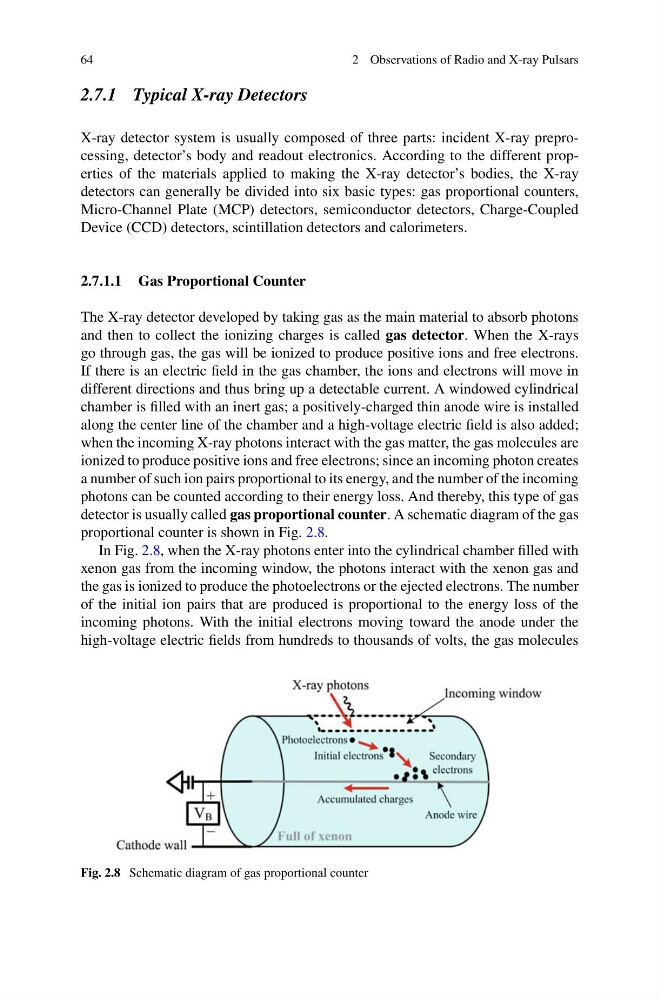
detector is usually called gas proportional counter. A schematic diagram of the gas
proportional counter is shown in Fig. 2.8.
In Fig. 2.8, when the X-ray photons enter into the cylindrical chamber filled with
xenon gas from the incoming window, the photons interact with the xenon gas and
the gas is ionized to produce the photoelectrons or the ejected electrons. The number
of the initial ion pairs that are produced is proportional to the energy loss of the
incoming photons. With the initial electrons moving toward the anode under the
high-voltage electric fields from hundreds to thousands of volts, the gas molecules
Fig. 2.8 Schematic diagram of gas proportional counter
2 Observations of Radio and X-ray Pulsars
2.7.1 Typical X-ray Detectors
X-ray detector system is usually composed of three parts: incident X-ray preprocessing, detector’s body and readout electronics. According to the different properties of the materials applied to making the X-ray detector’s bodies, the X-ray
detectors can generally be divided into six basic types: gas proportional counters,
Micro-Channel Plate (MCP) detectors, semiconductor detectors, Charge-Coupled
Device (CCD) detectors, scintillation detectors and calorimeters.
2.7.1.1 Gas Proportional Counter
The X-ray detector developed by taking gas as the main material to absorb photons
and then to collect the ionizing charges is called gas detector. When the X-rays
go through gas, the gas will be ionized to produce positive ions and free electrons.
If there is an electric field in the gas chamber, the ions and electrons will move in
different directions and thus bring up a detectable current. A windowed cylindrical
chamber is filled with an inert gas; a positively-charged thin anode wire is installed
along the center line of the chamber and a high-voltage electric field is also added;
when the incoming X-ray photons interact with the gas matter, the gas molecules are
ionized to produce positive ions and free electrons; since an incoming photon creates
a number of such ion pairs proportional to its energy, and the number of the incoming
photons can be counted according to their energy loss. And thereby, this type of gas
detector is usually called gas proportional counter. A schematic diagram of the gas
proportional counter is shown in Fig. 2.8.
In Fig. 2.8, when the X-ray photons enter into the cylindrical chamber filled with
xenon gas from the incoming window, the photons interact with the xenon gas and
the gas is ionized to produce the photoelectrons or the ejected electrons. The number
of the initial ion pairs that are produced is proportional to the energy loss of the
incoming photons. With the initial electrons moving toward the anode under the
high-voltage electric fields from hundreds to thousands of volts, the gas molecules
Fig. 2.8 Schematic diagram of gas proportional counter