

38
1 Introduction to the Pulsars
gotten, which is referred to as spatial motions. For the majority of pulsars, the
spatial motions are not obvious.
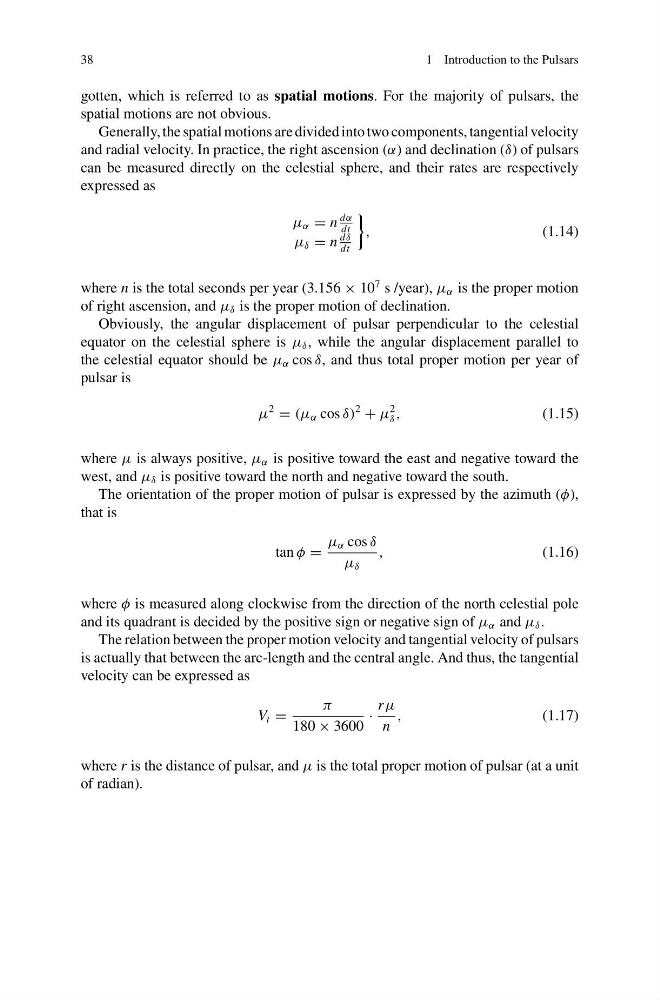
Generally, the spatial motions are divided into two components, tangential velocity
and radial velocity. In practice, the right ascension (α) and declination (δ) of pulsars
can be measured directly on the celestial sphere, and their rates are respectively
expressed as
μ α = n
dα
dt
μ δ = n
dδ
dt
,
(1.14)
where n is the total seconds per year (3.156 × 10
7 s /year), μ α is the proper motion
of right ascension, and μ δ is the proper motion of declination.
Obviously, the angular displacement of pulsar perpendicular to the celestial
equator on the celestial sphere is μ δ , while the angular displacement parallel to
the celestial equator should be μ α cos δ, and thus total proper motion per year of
pulsar is
μ
2
= (μ α cos δ)
2
+ μ
2
δ ,
(1.15)
where μ is always positive, μ α is positive toward the east and negative toward the
west, and μ δ is positive toward the north and negative toward the south.
The orientation of the proper motion of pulsar is expressed by the azimuth (φ),
that is
tan φ =
μ α cos δ
μ δ
,
(1.16)
where φ is measured along clockwise from the direction of the north celestial pole
and its quadrant is decided by the positive sign or negative sign of μ α and μ δ .
The relation between the proper motion velocity and tangential velocity of pulsars
is actually that between the arc-length and the central angle. And thus, the tangential
velocity can be expressed as
V t =
π
180 × 3600
·
r μ
n
,
(1.17)
where r is the distance of pulsar, and μ is the total proper motion of pulsar (at a unit
of radian).
1 Introduction to the Pulsars
gotten, which is referred to as spatial motions. For the majority of pulsars, the
spatial motions are not obvious.
Generally, the spatial motions are divided into two components, tangential velocity
and radial velocity. In practice, the right ascension (α) and declination (δ) of pulsars
can be measured directly on the celestial sphere, and their rates are respectively
expressed as
μ α = n
dα
dt
μ δ = n
dδ
dt
,
(1.14)
where n is the total seconds per year (3.156 × 10
7 s /year), μ α is the proper motion
of right ascension, and μ δ is the proper motion of declination.
Obviously, the angular displacement of pulsar perpendicular to the celestial
equator on the celestial sphere is μ δ , while the angular displacement parallel to
the celestial equator should be μ α cos δ, and thus total proper motion per year of
pulsar is
μ
2
= (μ α cos δ)
2
+ μ
2
δ ,
(1.15)
where μ is always positive, μ α is positive toward the east and negative toward the
west, and μ δ is positive toward the north and negative toward the south.
The orientation of the proper motion of pulsar is expressed by the azimuth (φ),
that is
tan φ =
μ α cos δ
μ δ
,
(1.16)
where φ is measured along clockwise from the direction of the north celestial pole
and its quadrant is decided by the positive sign or negative sign of μ α and μ δ .
The relation between the proper motion velocity and tangential velocity of pulsars
is actually that between the arc-length and the central angle. And thus, the tangential
velocity can be expressed as
V t =
π
180 × 3600
·
r μ
n
,
(1.17)
where r is the distance of pulsar, and μ is the total proper motion of pulsar (at a unit
of radian).