

30
1 Introduction to the Pulsars
from one another, and vary confusedly and disorderly. Nevertheless, an accumulated
pulse profile, which can be obtained by folding hundreds or more of the pulse series
together, is very stable. The folded pulse profile will clearly show an output shape
with one, two or more peaks.
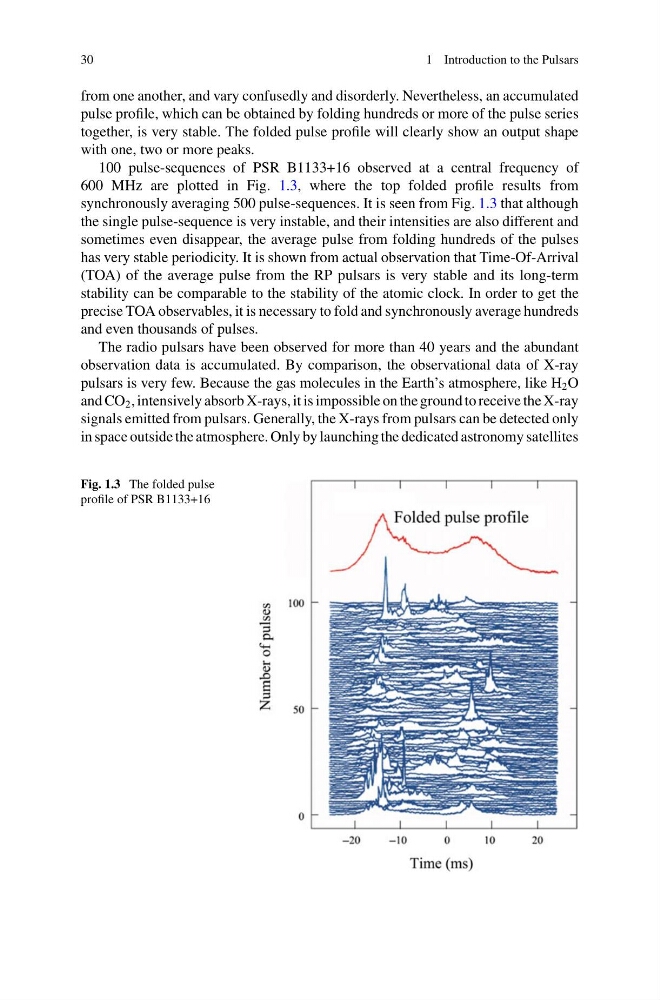
100 pulse-sequences of PSR B1133+16 observed at a central frequency of
600 MHz are plotted in Fig. 1.3, where the top folded profile results from
synchronously averaging 500 pulse-sequences. It is seen from Fig. 1.3 that although
the single pulse-sequence is very instable, and their intensities are also different and
sometimes even disappear, the average pulse from folding hundreds of the pulses
has very stable periodicity. It is shown from actual observation that Time-Of-Arrival
(TOA) of the average pulse from the RP pulsars is very stable and its long-term
stability can be comparable to the stability of the atomic clock. In order to get the
precise TOA observables, it is necessary to fold and synchronously average hundreds
and even thousands of pulses.
The radio pulsars have been observed for more than 40 years and the abundant
observation data is accumulated. By comparison, the observational data of X-ray
pulsars is very few. Because the gas molecules in the Earth’s atmosphere, like H 2 O
and CO 2 , intensively absorb X-rays, it is impossible on the ground to receive the X-ray
signals emitted from pulsars. Generally, the X-rays from pulsars can be detected only
in space outside the atmosphere. Only by launching the dedicated astronomy satellites
Fig. 1.3 The folded pulse
profile of PSR B1133+16
1 Introduction to the Pulsars
from one another, and vary confusedly and disorderly. Nevertheless, an accumulated
pulse profile, which can be obtained by folding hundreds or more of the pulse series
together, is very stable. The folded pulse profile will clearly show an output shape
with one, two or more peaks.
100 pulse-sequences of PSR B1133+16 observed at a central frequency of
600 MHz are plotted in Fig. 1.3, where the top folded profile results from
synchronously averaging 500 pulse-sequences. It is seen from Fig. 1.3 that although
the single pulse-sequence is very instable, and their intensities are also different and
sometimes even disappear, the average pulse from folding hundreds of the pulses
has very stable periodicity. It is shown from actual observation that Time-Of-Arrival
(TOA) of the average pulse from the RP pulsars is very stable and its long-term
stability can be comparable to the stability of the atomic clock. In order to get the
precise TOA observables, it is necessary to fold and synchronously average hundreds
and even thousands of pulses.
The radio pulsars have been observed for more than 40 years and the abundant
observation data is accumulated. By comparison, the observational data of X-ray
pulsars is very few. Because the gas molecules in the Earth’s atmosphere, like H 2 O
and CO 2 , intensively absorb X-rays, it is impossible on the ground to receive the X-ray
signals emitted from pulsars. Generally, the X-rays from pulsars can be detected only
in space outside the atmosphere. Only by launching the dedicated astronomy satellites
Fig. 1.3 The folded pulse
profile of PSR B1133+16