

26
1 Introduction to the Pulsars
around black holes and other astronomical phenomena is an important source of
information about distant magnetic fields.
It should be pointed out that the radiation mechanism of pulsar is still a difficult
research topic. Although a lot of observational data has been obtained, it is not clear
how to determine the actual position of radiation source on the surface of neutron
star and to describe the motion process of charged particles in the magnetic field yet.
So, the theoretical models of pulsar radiations are still being studied intensively.
1.4.3 Internal Structures
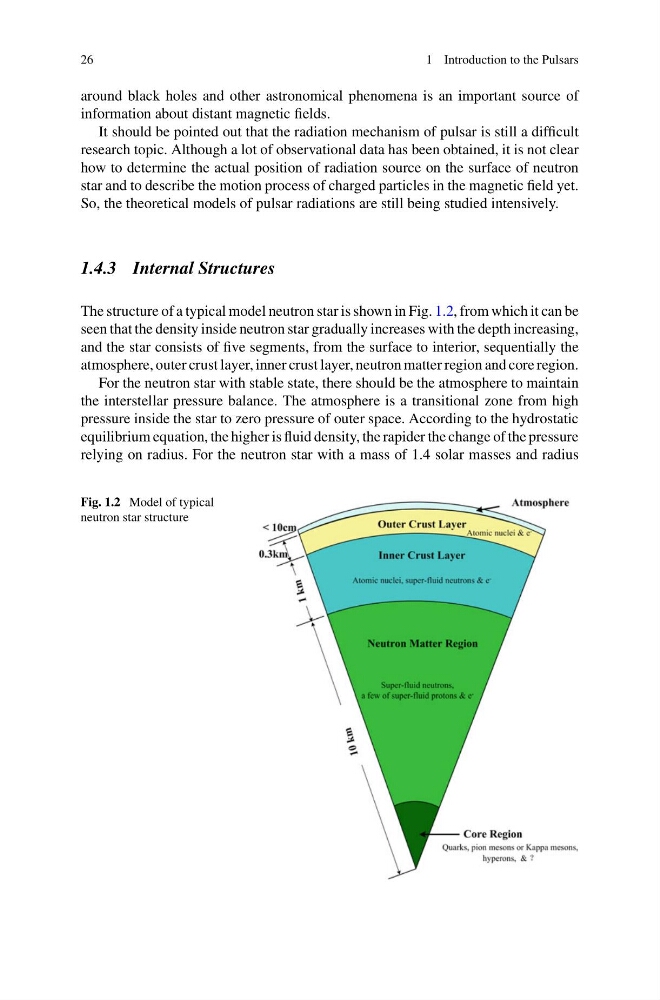
The structure of a typical model neutron star is shown in Fig. 1.2, from which it can be
seen that the density inside neutron star gradually increases with the depth increasing,
and the star consists of five segments, from the surface to interior, sequentially the
atmosphere, outer crust layer, inner crust layer, neutron matter region and core region.
For the neutron star with stable state, there should be the atmosphere to maintain
the interstellar pressure balance. The atmosphere is a transitional zone from high
pressure inside the star to zero pressure of outer space. According to the hydrostatic
equilibrium equation, the higher is fluid density, the rapider the change of the pressure
relying on radius. For the neutron star with a mass of 1.4 solar masses and radius
Fig. 1.2 Model of typical
neutron star structure
1 Introduction to the Pulsars
around black holes and other astronomical phenomena is an important source of
information about distant magnetic fields.
It should be pointed out that the radiation mechanism of pulsar is still a difficult
research topic. Although a lot of observational data has been obtained, it is not clear
how to determine the actual position of radiation source on the surface of neutron
star and to describe the motion process of charged particles in the magnetic field yet.
So, the theoretical models of pulsar radiations are still being studied intensively.
1.4.3 Internal Structures
The structure of a typical model neutron star is shown in Fig. 1.2, from which it can be
seen that the density inside neutron star gradually increases with the depth increasing,
and the star consists of five segments, from the surface to interior, sequentially the
atmosphere, outer crust layer, inner crust layer, neutron matter region and core region.
For the neutron star with stable state, there should be the atmosphere to maintain
the interstellar pressure balance. The atmosphere is a transitional zone from high
pressure inside the star to zero pressure of outer space. According to the hydrostatic
equilibrium equation, the higher is fluid density, the rapider the change of the pressure
relying on radius. For the neutron star with a mass of 1.4 solar masses and radius
Fig. 1.2 Model of typical
neutron star structure