

406
5 X-ray Pulsar-Based Navigation: Theories and Experiments
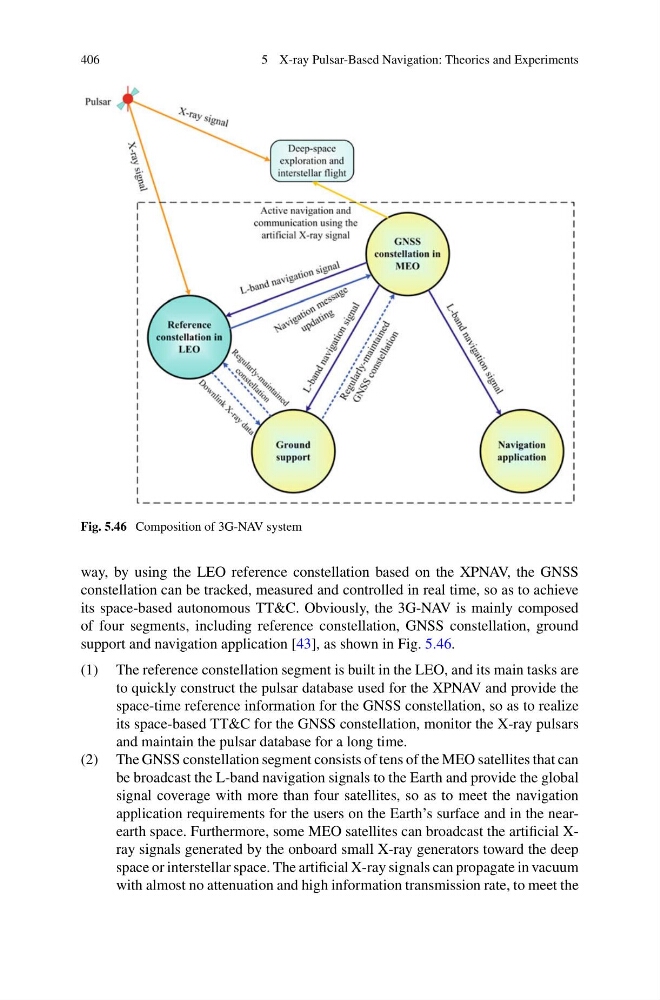
Fig. 5.46 Composition of 3G-NAV system
way, by using the LEO reference constellation based on the XPNAV, the GNSS
constellation can be tracked, measured and controlled in real time, so as to achieve
its space-based autonomous TT&C. Obviously, the 3G-NAV is mainly composed
of four segments, including reference constellation, GNSS constellation, ground
support and navigation application [43], as shown in Fig. 5.46.
(1) The reference constellation segment is built in the LEO, and its main tasks are
to quickly construct the pulsar database used for the XPNAV and provide the
space-time reference information for the GNSS constellation, so as to realize
its space-based TT&C for the GNSS constellation, monitor the X-ray pulsars
and maintain the pulsar database for a long time.
(2) The GNSS constellation segment consists of tens of the MEO satellites that can
be broadcast the L-band navigation signals to the Earth and provide the global
signal coverage with more than four satellites, so as to meet the navigation
application requirements for the users on the Earth’s surface and in the nearearth space. Furthermore, some MEO satellites can broadcast the artificial Xray signals generated by the onboard small X-ray generators toward the deep
space or interstellar space. The artificial X-ray signals can propagate in vacuum
with almost no attenuation and high information transmission rate, to meet the
5 X-ray Pulsar-Based Navigation: Theories and Experiments
Fig. 5.46 Composition of 3G-NAV system
way, by using the LEO reference constellation based on the XPNAV, the GNSS
constellation can be tracked, measured and controlled in real time, so as to achieve
its space-based autonomous TT&C. Obviously, the 3G-NAV is mainly composed
of four segments, including reference constellation, GNSS constellation, ground
support and navigation application [43], as shown in Fig. 5.46.
(1) The reference constellation segment is built in the LEO, and its main tasks are
to quickly construct the pulsar database used for the XPNAV and provide the
space-time reference information for the GNSS constellation, so as to realize
its space-based TT&C for the GNSS constellation, monitor the X-ray pulsars
and maintain the pulsar database for a long time.
(2) The GNSS constellation segment consists of tens of the MEO satellites that can
be broadcast the L-band navigation signals to the Earth and provide the global
signal coverage with more than four satellites, so as to meet the navigation
application requirements for the users on the Earth’s surface and in the nearearth space. Furthermore, some MEO satellites can broadcast the artificial Xray signals generated by the onboard small X-ray generators toward the deep
space or interstellar space. The artificial X-ray signals can propagate in vacuum
with almost no attenuation and high information transmission rate, to meet the