

5.9 Future of Navigation Satellite System
403
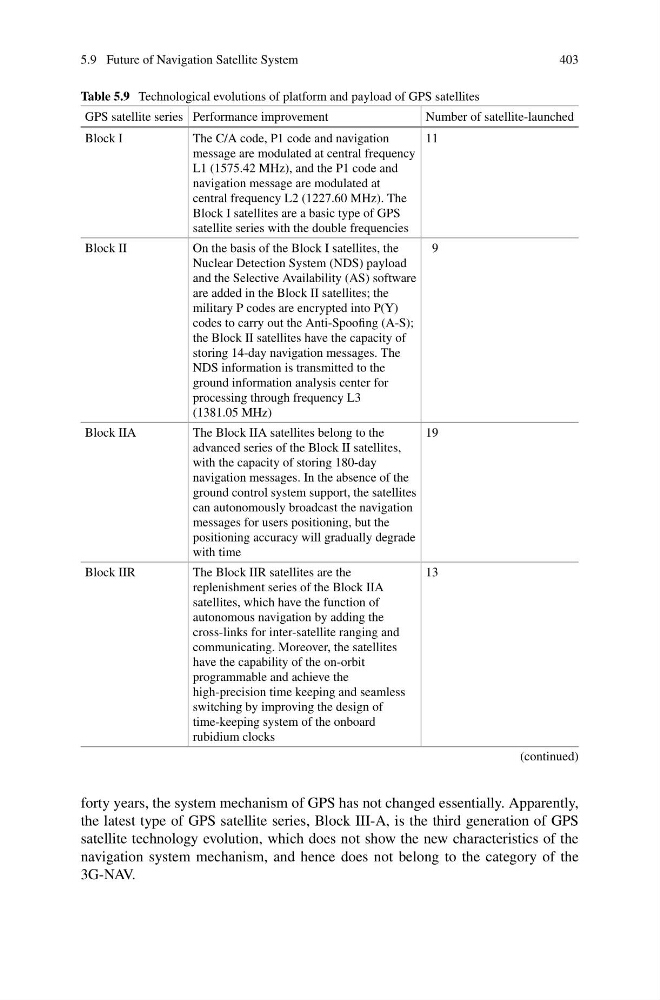
Table 5.9 Technological evolutions of platform and payload of GPS satellites
GPS satellite series Performance improvement
Number of satellite-launched
Block I
The C/A code, P1 code and navigation
message are modulated at central frequency
L1 (1575.42 MHz), and the P1 code and
navigation message are modulated at
central frequency L2 (1227.60 MHz). The
Block I satellites are a basic type of GPS
satellite series with the double frequencies
11
Block II
On the basis of the Block I satellites, the
Nuclear Detection System (NDS) payload
and the Selective Availability (AS) software
are added in the Block II satellites; the
military P codes are encrypted into P(Y)
codes to carry out the Anti-Spoofing (A-S);
the Block II satellites have the capacity of
storing 14-day navigation messages. The
NDS information is transmitted to the
ground information analysis center for
processing through frequency L3
(1381.05 MHz)
9
Block IIA
The Block IIA satellites belong to the
advanced series of the Block II satellites,
with the capacity of storing 180-day
navigation messages. In the absence of the
ground control system support, the satellites
can autonomously broadcast the navigation
messages for users positioning, but the
positioning accuracy will gradually degrade
with time
19
Block IIR
The Block IIR satellites are the
replenishment series of the Block IIA
satellites, which have the function of
autonomous navigation by adding the
cross-links for inter-satellite ranging and
communicating. Moreover, the satellites
have the capability of the on-orbit
programmable and achieve the
high-precision time keeping and seamless
switching by improving the design of
time-keeping system of the onboard
rubidium clocks
13
(continued)
forty years, the system mechanism of GPS has not changed essentially. Apparently,
the latest type of GPS satellite series, Block III-A, is the third generation of GPS
satellite technology evolution, which does not show the new characteristics of the
navigation system mechanism, and hence does not belong to the category of the
3G-NAV.
403
Table 5.9 Technological evolutions of platform and payload of GPS satellites
GPS satellite series Performance improvement
Number of satellite-launched
Block I
The C/A code, P1 code and navigation
message are modulated at central frequency
L1 (1575.42 MHz), and the P1 code and
navigation message are modulated at
central frequency L2 (1227.60 MHz). The
Block I satellites are a basic type of GPS
satellite series with the double frequencies
11
Block II
On the basis of the Block I satellites, the
Nuclear Detection System (NDS) payload
and the Selective Availability (AS) software
are added in the Block II satellites; the
military P codes are encrypted into P(Y)
codes to carry out the Anti-Spoofing (A-S);
the Block II satellites have the capacity of
storing 14-day navigation messages. The
NDS information is transmitted to the
ground information analysis center for
processing through frequency L3
(1381.05 MHz)
9
Block IIA
The Block IIA satellites belong to the
advanced series of the Block II satellites,
with the capacity of storing 180-day
navigation messages. In the absence of the
ground control system support, the satellites
can autonomously broadcast the navigation
messages for users positioning, but the
positioning accuracy will gradually degrade
with time
19
Block IIR
The Block IIR satellites are the
replenishment series of the Block IIA
satellites, which have the function of
autonomous navigation by adding the
cross-links for inter-satellite ranging and
communicating. Moreover, the satellites
have the capability of the on-orbit
programmable and achieve the
high-precision time keeping and seamless
switching by improving the design of
time-keeping system of the onboard
rubidium clocks
13
(continued)
forty years, the system mechanism of GPS has not changed essentially. Apparently,
the latest type of GPS satellite series, Block III-A, is the third generation of GPS
satellite technology evolution, which does not show the new characteristics of the
navigation system mechanism, and hence does not belong to the category of the
3G-NAV.