

388
5 X-ray Pulsar-Based Navigation: Theories and Experiments
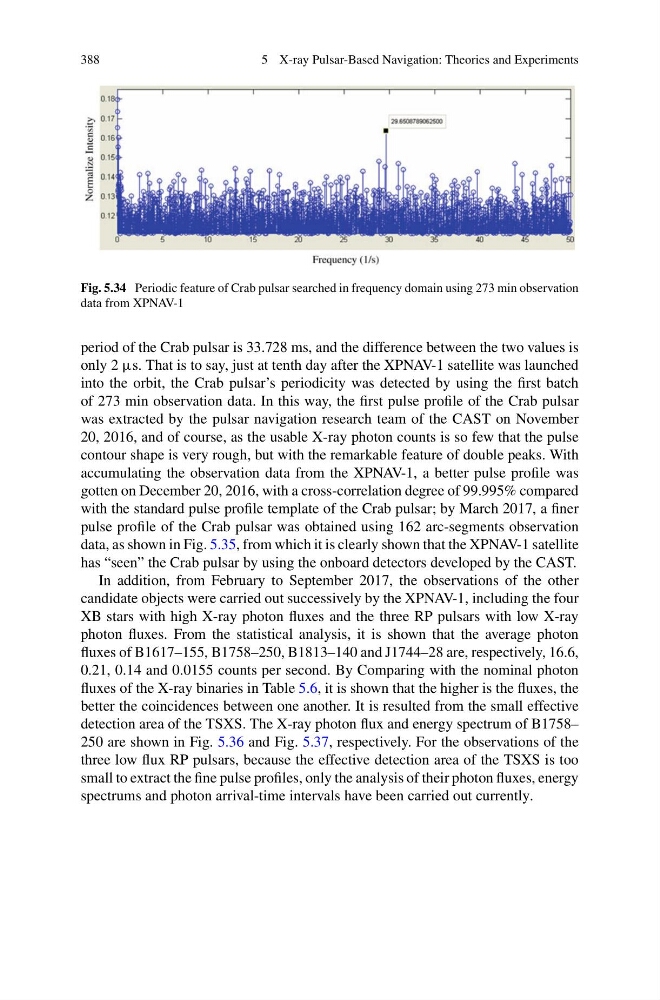
Fig. 5.34 Periodic feature of Crab pulsar searched in frequency domain using 273 min observation
data from XPNAV-1
period of the Crab pulsar is 33.728 ms, and the difference between the two values is
only 2 μs. That is to say, just at tenth day after the XPNAV-1 satellite was launched
into the orbit, the Crab pulsar’s periodicity was detected by using the first batch
of 273 min observation data. In this way, the first pulse profile of the Crab pulsar
was extracted by the pulsar navigation research team of the CAST on November
20, 2016, and of course, as the usable X-ray photon counts is so few that the pulse
contour shape is very rough, but with the remarkable feature of double peaks. With
accumulating the observation data from the XPNAV-1, a better pulse profile was
gotten on December 20, 2016, with a cross-correlation degree of 99.995% compared
with the standard pulse profile template of the Crab pulsar; by March 2017, a finer
pulse profile of the Crab pulsar was obtained using 162 arc-segments observation
data, as shown in Fig. 5.35, from which it is clearly shown that the XPNAV-1 satellite
has “seen” the Crab pulsar by using the onboard detectors developed by the CAST.
In addition, from February to September 2017, the observations of the other
candidate objects were carried out successively by the XPNAV-1, including the four
XB stars with high X-ray photon fluxes and the three RP pulsars with low X-ray
photon fluxes. From the statistical analysis, it is shown that the average photon
fluxes of B1617–155, B1758–250, B1813–140 and J1744–28 are, respectively, 16.6,
0.21, 0.14 and 0.0155 counts per second. By Comparing with the nominal photon
fluxes of the X-ray binaries in Table 5.6, it is shown that the higher is the fluxes, the
better the coincidences between one another. It is resulted from the small effective
detection area of the TSXS. The X-ray photon flux and energy spectrum of B1758–
250 are shown in Fig. 5.36 and Fig. 5.37, respectively. For the observations of the
three low flux RP pulsars, because the effective detection area of the TSXS is too
small to extract the fine pulse profiles, only the analysis of their photon fluxes, energy
spectrums and photon arrival-time intervals have been carried out currently.
5 X-ray Pulsar-Based Navigation: Theories and Experiments
Fig. 5.34 Periodic feature of Crab pulsar searched in frequency domain using 273 min observation
data from XPNAV-1
period of the Crab pulsar is 33.728 ms, and the difference between the two values is
only 2 μs. That is to say, just at tenth day after the XPNAV-1 satellite was launched
into the orbit, the Crab pulsar’s periodicity was detected by using the first batch
of 273 min observation data. In this way, the first pulse profile of the Crab pulsar
was extracted by the pulsar navigation research team of the CAST on November
20, 2016, and of course, as the usable X-ray photon counts is so few that the pulse
contour shape is very rough, but with the remarkable feature of double peaks. With
accumulating the observation data from the XPNAV-1, a better pulse profile was
gotten on December 20, 2016, with a cross-correlation degree of 99.995% compared
with the standard pulse profile template of the Crab pulsar; by March 2017, a finer
pulse profile of the Crab pulsar was obtained using 162 arc-segments observation
data, as shown in Fig. 5.35, from which it is clearly shown that the XPNAV-1 satellite
has “seen” the Crab pulsar by using the onboard detectors developed by the CAST.
In addition, from February to September 2017, the observations of the other
candidate objects were carried out successively by the XPNAV-1, including the four
XB stars with high X-ray photon fluxes and the three RP pulsars with low X-ray
photon fluxes. From the statistical analysis, it is shown that the average photon
fluxes of B1617–155, B1758–250, B1813–140 and J1744–28 are, respectively, 16.6,
0.21, 0.14 and 0.0155 counts per second. By Comparing with the nominal photon
fluxes of the X-ray binaries in Table 5.6, it is shown that the higher is the fluxes, the
better the coincidences between one another. It is resulted from the small effective
detection area of the TSXS. The X-ray photon flux and energy spectrum of B1758–
250 are shown in Fig. 5.36 and Fig. 5.37, respectively. For the observations of the
three low flux RP pulsars, because the effective detection area of the TSXS is too
small to extract the fine pulse profiles, only the analysis of their photon fluxes, energy
spectrums and photon arrival-time intervals have been carried out currently.