

358
5 X-ray Pulsar-Based Navigation: Theories and Experiments
distances from the spacecrafts to the pulsars are unable to be measured accurately.
Using the GNSS to provide navigation service for the spacecrafts, the transmitting
time of the ranging code signals can be gotten from the navigation message, and
the time delay within a ranging code period can be obtained by cross-correlation
processing between the received ranging codes and the local codes, so the distance
from the user spacecrafts to the GNSS satellites can be accurately measured. This is
the natural discrepancy between the XPNAV and GNSS, and it is also the difficulty
of XPNAV. Of course, the observables based on the stable pulse arrival-time have
provided sufficient information for the spacecraft’s orbit determination. Although
the measurement equation of directly using the distance cannot be used for the
spacecraft’s navigation computing, it is helpful to introducing the concepts of the
absolute navigation and relative navigation of the spacecrafts using X-ray pulsars.
5.6.5.2 Measurement Equation of Using Pulse Phase
The spacecrafts can autonomously navigate using the X-ray pulsars, and in fact, is to
utilize the extremely stable periodic rotation characteristics of the pulsars, which are
the most valuable navigation beacons. The stable pulse period signals create favorable
conditions to detect and identify the specified pulse cycles. However, at any given
epoch, it is difficult to detect the pulse peaks or the discernable feature points of a
pulse profile, but only a point on the pulse profile is measured, which is the time of
arrival of a photon, also the phase values within a pulse cycle. If the dimensionless
number [0, 1] is used to represent a pulse cycle, the pulse phase measurement is the
decimal fraction. Thereby, the measurement of pulse arrival-time with the pulse’s
peak as a reference point is actually that of pulse phase. When the number of integer
cycles and the phase of a cycle have been measured, the distance from the pulsar
to spacecraft can be computed easily. In practice, the measurement information for
each pulse feature is not provided in the XPNAV, and hence the number of integer
cycles at any given epoch is unable to be determined. In order to clearly explain the
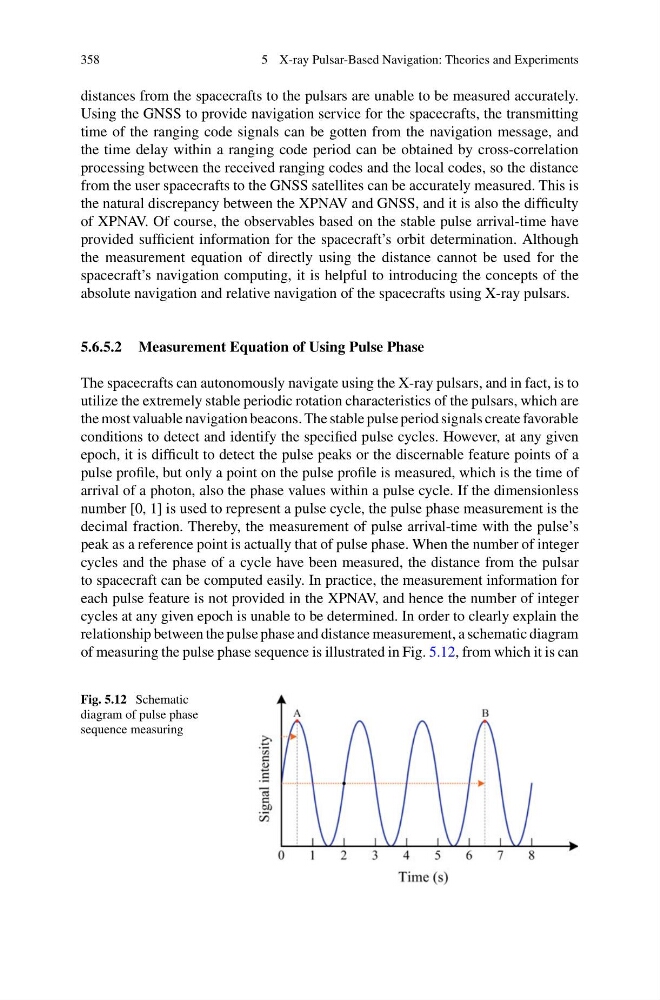
relationship between the pulse phase and distance measurement, a schematic diagram
of measuring the pulse phase sequence is illustrated in Fig. 5.12, from which it is can
Fig. 5.12 Schematic
diagram of pulse phase
sequence measuring
5 X-ray Pulsar-Based Navigation: Theories and Experiments
distances from the spacecrafts to the pulsars are unable to be measured accurately.
Using the GNSS to provide navigation service for the spacecrafts, the transmitting
time of the ranging code signals can be gotten from the navigation message, and
the time delay within a ranging code period can be obtained by cross-correlation
processing between the received ranging codes and the local codes, so the distance
from the user spacecrafts to the GNSS satellites can be accurately measured. This is
the natural discrepancy between the XPNAV and GNSS, and it is also the difficulty
of XPNAV. Of course, the observables based on the stable pulse arrival-time have
provided sufficient information for the spacecraft’s orbit determination. Although
the measurement equation of directly using the distance cannot be used for the
spacecraft’s navigation computing, it is helpful to introducing the concepts of the
absolute navigation and relative navigation of the spacecrafts using X-ray pulsars.
5.6.5.2 Measurement Equation of Using Pulse Phase
The spacecrafts can autonomously navigate using the X-ray pulsars, and in fact, is to
utilize the extremely stable periodic rotation characteristics of the pulsars, which are
the most valuable navigation beacons. The stable pulse period signals create favorable
conditions to detect and identify the specified pulse cycles. However, at any given
epoch, it is difficult to detect the pulse peaks or the discernable feature points of a
pulse profile, but only a point on the pulse profile is measured, which is the time of
arrival of a photon, also the phase values within a pulse cycle. If the dimensionless
number [0, 1] is used to represent a pulse cycle, the pulse phase measurement is the
decimal fraction. Thereby, the measurement of pulse arrival-time with the pulse’s
peak as a reference point is actually that of pulse phase. When the number of integer
cycles and the phase of a cycle have been measured, the distance from the pulsar
to spacecraft can be computed easily. In practice, the measurement information for
each pulse feature is not provided in the XPNAV, and hence the number of integer
cycles at any given epoch is unable to be determined. In order to clearly explain the
relationship between the pulse phase and distance measurement, a schematic diagram
of measuring the pulse phase sequence is illustrated in Fig. 5.12, from which it is can
Fig. 5.12 Schematic
diagram of pulse phase
sequence measuring