

356
5 X-ray Pulsar-Based Navigation: Theories and Experiments
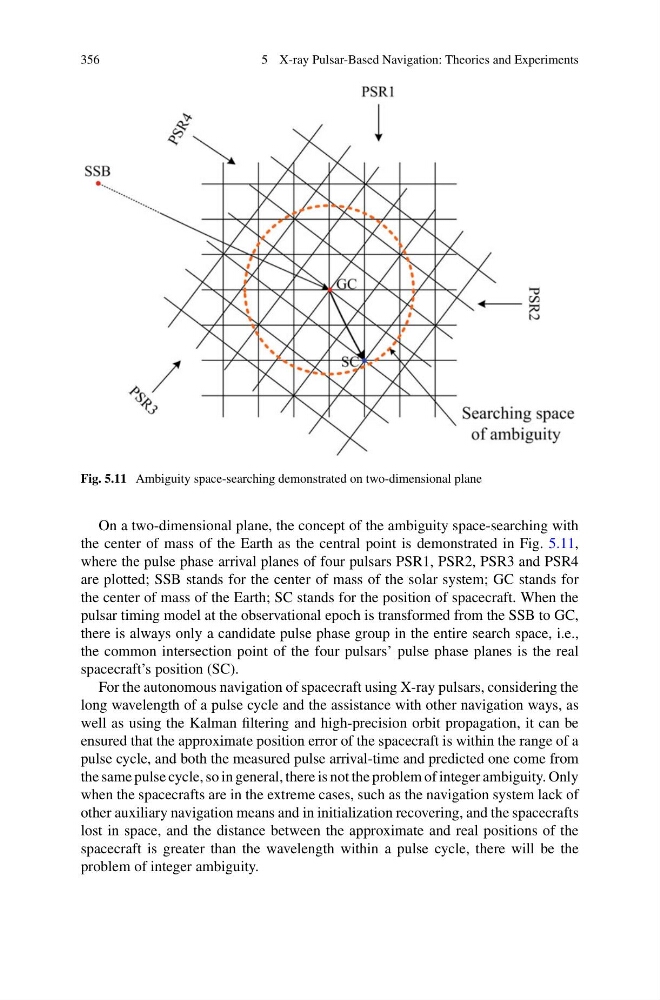
Fig. 5.11 Ambiguity space-searching demonstrated on two-dimensional plane
On a two-dimensional plane, the concept of the ambiguity space-searching with
the center of mass of the Earth as the central point is demonstrated in Fig. 5.11,
where the pulse phase arrival planes of four pulsars PSR1, PSR2, PSR3 and PSR4
are plotted; SSB stands for the center of mass of the solar system; GC stands for
the center of mass of the Earth; SC stands for the position of spacecraft. When the
pulsar timing model at the observational epoch is transformed from the SSB to GC,
there is always only a candidate pulse phase group in the entire search space, i.e.,
the common intersection point of the four pulsars’ pulse phase planes is the real
spacecraft’s position (SC).
For the autonomous navigation of spacecraft using X-ray pulsars, considering the
long wavelength of a pulse cycle and the assistance with other navigation ways, as
well as using the Kalman filtering and high-precision orbit propagation, it can be
ensured that the approximate position error of the spacecraft is within the range of a
pulse cycle, and both the measured pulse arrival-time and predicted one come from
the same pulse cycle, so in general, there is not the problem of integer ambiguity. Only
when the spacecrafts are in the extreme cases, such as the navigation system lack of
other auxiliary navigation means and in initialization recovering, and the spacecrafts
lost in space, and the distance between the approximate and real positions of the
spacecraft is greater than the wavelength within a pulse cycle, there will be the
problem of integer ambiguity.
5 X-ray Pulsar-Based Navigation: Theories and Experiments
Fig. 5.11 Ambiguity space-searching demonstrated on two-dimensional plane
On a two-dimensional plane, the concept of the ambiguity space-searching with
the center of mass of the Earth as the central point is demonstrated in Fig. 5.11,
where the pulse phase arrival planes of four pulsars PSR1, PSR2, PSR3 and PSR4
are plotted; SSB stands for the center of mass of the solar system; GC stands for
the center of mass of the Earth; SC stands for the position of spacecraft. When the
pulsar timing model at the observational epoch is transformed from the SSB to GC,
there is always only a candidate pulse phase group in the entire search space, i.e.,
the common intersection point of the four pulsars’ pulse phase planes is the real
spacecraft’s position (SC).
For the autonomous navigation of spacecraft using X-ray pulsars, considering the
long wavelength of a pulse cycle and the assistance with other navigation ways, as
well as using the Kalman filtering and high-precision orbit propagation, it can be
ensured that the approximate position error of the spacecraft is within the range of a
pulse cycle, and both the measured pulse arrival-time and predicted one come from
the same pulse cycle, so in general, there is not the problem of integer ambiguity. Only
when the spacecrafts are in the extreme cases, such as the navigation system lack of
other auxiliary navigation means and in initialization recovering, and the spacecrafts
lost in space, and the distance between the approximate and real positions of the
spacecraft is greater than the wavelength within a pulse cycle, there will be the
problem of integer ambiguity.