

5.6 Methods of Large-Scale Navigation
345
(1) Transformation from GPST to UTC
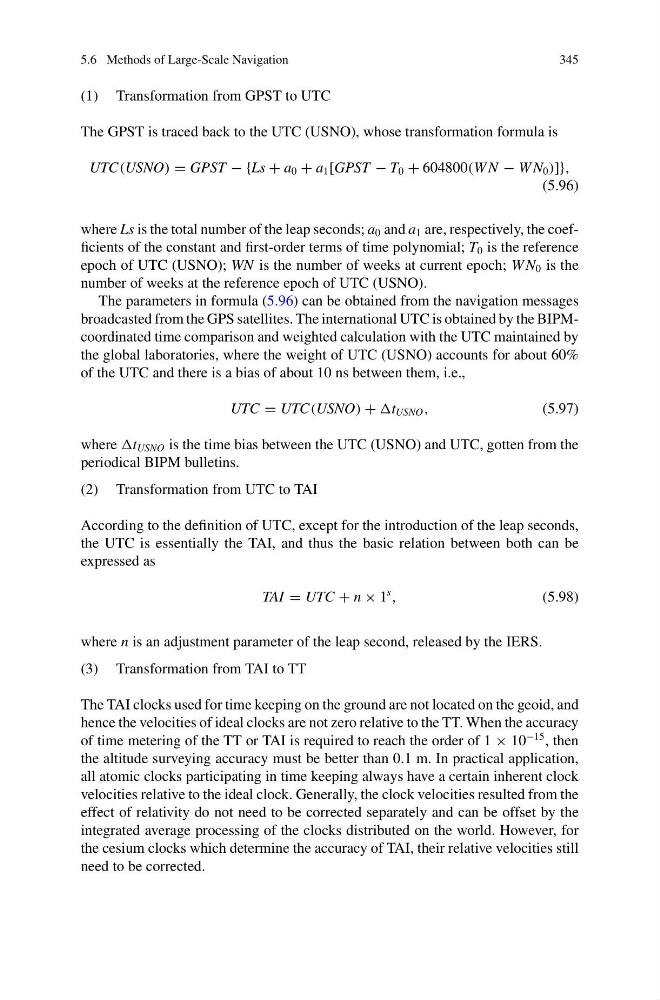
The GPST is traced back to the UTC (USNO), whose transformation formula is
UTC(USNO) = GPST − {Ls + a 0 + a 1 [GPST − T 0 + 604800(W N − W N 0 )]},
(5.96)
where Ls is the total number of the leap seconds; a 0 and a 1 are, respectively, the coefficients of the constant and first-order terms of time polynomial; T 0 is the reference
epoch of UTC (USNO); WN is the number of weeks at current epoch; W N 0 is the
number of weeks at the reference epoch of UTC (USNO).
The parameters in formula (5.96) can be obtained from the navigation messages
broadcasted from the GPS satellites. The international UTC is obtained by the BIPMcoordinated time comparison and weighted calculation with the UTC maintained by
the global laboratories, where the weight of UTC (USNO) accounts for about 60%
of the UTC and there is a bias of about 10 ns between them, i.e.,
UTC = UTC(USNO) + t USNO ,
(5.97)
where t USNO is the time bias between the UTC (USNO) and UTC, gotten from the
periodical BIPM bulletins.
(2) Transformation from UTC to TAI
According to the definition of UTC, except for the introduction of the leap seconds,
the UTC is essentially the TAI, and thus the basic relation between both can be
expressed as
TAI = UTC + n × 1
s
,
(5.98)
where n is an adjustment parameter of the leap second, released by the IERS.
(3) Transformation from TAI to TT
The TAI clocks used for time keeping on the ground are not located on the geoid, and
hence the velocities of ideal clocks are not zero relative to the TT. When the accuracy
of time metering of the TT or TAI is required to reach the order of 1 × 10
−15 , then
the altitude surveying accuracy must be better than 0.1 m. In practical application,
all atomic clocks participating in time keeping always have a certain inherent clock
velocities relative to the ideal clock. Generally, the clock velocities resulted from the
effect of relativity do not need to be corrected separately and can be offset by the
integrated average processing of the clocks distributed on the world. However, for
the cesium clocks which determine the accuracy of TAI, their relative velocities still
need to be corrected.
345
(1) Transformation from GPST to UTC
The GPST is traced back to the UTC (USNO), whose transformation formula is
UTC(USNO) = GPST − {Ls + a 0 + a 1 [GPST − T 0 + 604800(W N − W N 0 )]},
(5.96)
where Ls is the total number of the leap seconds; a 0 and a 1 are, respectively, the coefficients of the constant and first-order terms of time polynomial; T 0 is the reference
epoch of UTC (USNO); WN is the number of weeks at current epoch; W N 0 is the
number of weeks at the reference epoch of UTC (USNO).
The parameters in formula (5.96) can be obtained from the navigation messages
broadcasted from the GPS satellites. The international UTC is obtained by the BIPMcoordinated time comparison and weighted calculation with the UTC maintained by
the global laboratories, where the weight of UTC (USNO) accounts for about 60%
of the UTC and there is a bias of about 10 ns between them, i.e.,
UTC = UTC(USNO) + t USNO ,
(5.97)
where t USNO is the time bias between the UTC (USNO) and UTC, gotten from the
periodical BIPM bulletins.
(2) Transformation from UTC to TAI
According to the definition of UTC, except for the introduction of the leap seconds,
the UTC is essentially the TAI, and thus the basic relation between both can be
expressed as
TAI = UTC + n × 1
s
,
(5.98)
where n is an adjustment parameter of the leap second, released by the IERS.
(3) Transformation from TAI to TT
The TAI clocks used for time keeping on the ground are not located on the geoid, and
hence the velocities of ideal clocks are not zero relative to the TT. When the accuracy
of time metering of the TT or TAI is required to reach the order of 1 × 10
−15 , then
the altitude surveying accuracy must be better than 0.1 m. In practical application,
all atomic clocks participating in time keeping always have a certain inherent clock
velocities relative to the ideal clock. Generally, the clock velocities resulted from the
effect of relativity do not need to be corrected separately and can be offset by the
integrated average processing of the clocks distributed on the world. However, for
the cesium clocks which determine the accuracy of TAI, their relative velocities still
need to be corrected.