

5.5 Theory of Pulsar Timing System
335
At present, the TOA measuring accuracy for the millisecond pulsars is 1 μs, and
that for some pulsars reaches the level of 0.1 μs. For the observation time of more
than one year, the stability of the difference (AT-PT i ) between the atomic time and the
single pulsar time is about 1 × 10
−14 s/s. Besides the radio pulse SNR, measurement
system error, space-time transformation model error and data processing algorithm
error, there are also the atomic timescale error, pulsar radiation mechanism modeling
error, interstellar propagation effect uncertainty, solar system planetary ephemeris
error and gravitational wave effect. These are all the factors affecting the stability
of the time difference (AT-PT i ), and generally they cannot be discriminated only by
using single pulsar timing observations. In theory, the Pulsar Timing Array (PTA)
can be used to discriminate and detect the factors affecting the timing stability, so as
to improve the accuracy of pulsar timing system.
From the point of view of creating a stable timescale and comparing with the
atomic time, the fundamental method of establishing the PTA is: for multiple pulsar
time (PT i ), except for the errors of atomic time system itself, assuming that other
error sources are independent one another, an ensemble-time based on the multiple
pulsar time, denoted as PT en , is obtained by weighted average. Obviously, the noise
level of the PT en is always lower than that of single PT i , and its long-term stability
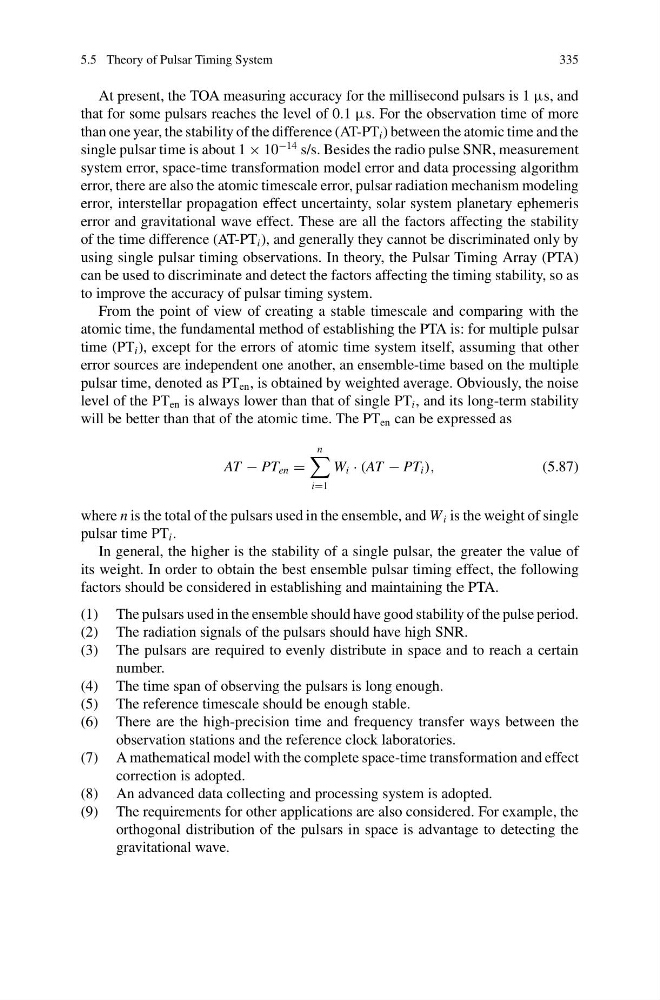
will be better than that of the atomic time. The PT en can be expressed as
AT − PT en =
n
i=1
W i · (AT − PT i ),
(5.87)
where n is the total of the pulsars used in the ensemble, and W i is the weight of single
pulsar time PT i .
In general, the higher is the stability of a single pulsar, the greater the value of
its weight. In order to obtain the best ensemble pulsar timing effect, the following
factors should be considered in establishing and maintaining the PTA.
(1) The pulsars used in the ensemble should have good stability of the pulse period.
(2) The radiation signals of the pulsars should have high SNR.
(3) The pulsars are required to evenly distribute in space and to reach a certain
number.
(4) The time span of observing the pulsars is long enough.
(5) The reference timescale should be enough stable.
(6) There are the high-precision time and frequency transfer ways between the
observation stations and the reference clock laboratories.
(7) A mathematical model with the complete space-time transformation and effect
correction is adopted.
(8) An advanced data collecting and processing system is adopted.
(9) The requirements for other applications are also considered. For example, the
orthogonal distribution of the pulsars in space is advantage to detecting the
gravitational wave.
335
At present, the TOA measuring accuracy for the millisecond pulsars is 1 μs, and
that for some pulsars reaches the level of 0.1 μs. For the observation time of more
than one year, the stability of the difference (AT-PT i ) between the atomic time and the
single pulsar time is about 1 × 10
−14 s/s. Besides the radio pulse SNR, measurement
system error, space-time transformation model error and data processing algorithm
error, there are also the atomic timescale error, pulsar radiation mechanism modeling
error, interstellar propagation effect uncertainty, solar system planetary ephemeris
error and gravitational wave effect. These are all the factors affecting the stability
of the time difference (AT-PT i ), and generally they cannot be discriminated only by
using single pulsar timing observations. In theory, the Pulsar Timing Array (PTA)
can be used to discriminate and detect the factors affecting the timing stability, so as
to improve the accuracy of pulsar timing system.
From the point of view of creating a stable timescale and comparing with the
atomic time, the fundamental method of establishing the PTA is: for multiple pulsar
time (PT i ), except for the errors of atomic time system itself, assuming that other
error sources are independent one another, an ensemble-time based on the multiple
pulsar time, denoted as PT en , is obtained by weighted average. Obviously, the noise
level of the PT en is always lower than that of single PT i , and its long-term stability
will be better than that of the atomic time. The PT en can be expressed as
AT − PT en =
n
i=1
W i · (AT − PT i ),
(5.87)
where n is the total of the pulsars used in the ensemble, and W i is the weight of single
pulsar time PT i .
In general, the higher is the stability of a single pulsar, the greater the value of
its weight. In order to obtain the best ensemble pulsar timing effect, the following
factors should be considered in establishing and maintaining the PTA.
(1) The pulsars used in the ensemble should have good stability of the pulse period.
(2) The radiation signals of the pulsars should have high SNR.
(3) The pulsars are required to evenly distribute in space and to reach a certain
number.
(4) The time span of observing the pulsars is long enough.
(5) The reference timescale should be enough stable.
(6) There are the high-precision time and frequency transfer ways between the
observation stations and the reference clock laboratories.
(7) A mathematical model with the complete space-time transformation and effect
correction is adopted.
(8) An advanced data collecting and processing system is adopted.
(9) The requirements for other applications are also considered. For example, the
orthogonal distribution of the pulsars in space is advantage to detecting the
gravitational wave.