

324
5 X-ray Pulsar-Based Navigation: Theories and Experiments
5.4.5 International Celestial Reference System and Its
Realization
5.4.5.1 Celestial Sphere Reference System and Its Frame
An ideal celestial reference system is a three-dimensional inertial reference system
established under the Newtonian mechanics. It is a coordinate system which describes
the corresponding relationship between the actual space point and three-dimensional
array, defined by the origin, orientation and scale of coordinate axis. In order to
establish the celestial reference system, some basic elements such as reference points,
lines, planes and circles and their relationships must be defined at the first. A celestial
coordinate system is defined by coordinate origin, datum point and datum plane. In
this coordinate system, the position of any celestial body can be expressed in the
form of rectangular or spherical coordinates.
The Earth is an approximately rotating ellipsoid with the equatorial bulge. Under
the gravitational action of the Sun, Moon and other celestial bodies on the equatorial
bulge, when the Earth moves around the Sun, the spatial orientation of its rotational
axis will change, thus resulting in the vernal equinox to drift to the West slowly on
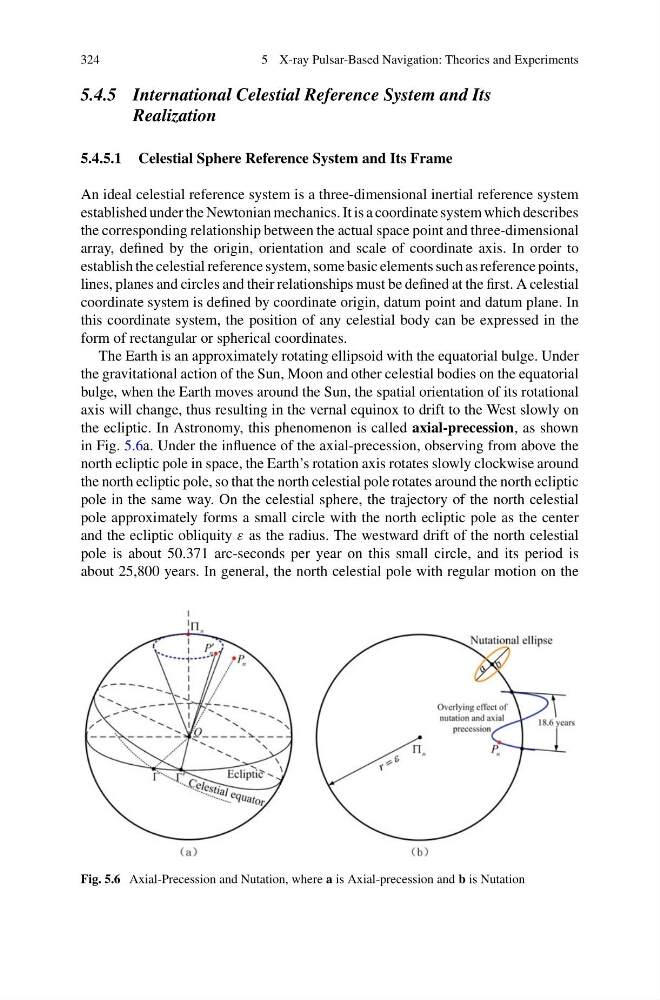
the ecliptic. In Astronomy, this phenomenon is called axial-precession, as shown
in Fig. 5.6a. Under the influence of the axial-precession, observing from above the
north ecliptic pole in space, the Earth’s rotation axis rotates slowly clockwise around
the north ecliptic pole, so that the north celestial pole rotates around the north ecliptic
pole in the same way. On the celestial sphere, the trajectory of the north celestial
pole approximately forms a small circle with the north ecliptic pole as the center
and the ecliptic obliquity ε as the radius. The westward drift of the north celestial
pole is about 50.371 arc-seconds per year on this small circle, and its period is
about 25,800 years. In general, the north celestial pole with regular motion on the
Fig. 5.6 Axial-Precession and Nutation, where a is Axial-precession and b is Nutation
5 X-ray Pulsar-Based Navigation: Theories and Experiments
5.4.5 International Celestial Reference System and Its
Realization
5.4.5.1 Celestial Sphere Reference System and Its Frame
An ideal celestial reference system is a three-dimensional inertial reference system
established under the Newtonian mechanics. It is a coordinate system which describes
the corresponding relationship between the actual space point and three-dimensional
array, defined by the origin, orientation and scale of coordinate axis. In order to
establish the celestial reference system, some basic elements such as reference points,
lines, planes and circles and their relationships must be defined at the first. A celestial
coordinate system is defined by coordinate origin, datum point and datum plane. In
this coordinate system, the position of any celestial body can be expressed in the
form of rectangular or spherical coordinates.
The Earth is an approximately rotating ellipsoid with the equatorial bulge. Under
the gravitational action of the Sun, Moon and other celestial bodies on the equatorial
bulge, when the Earth moves around the Sun, the spatial orientation of its rotational
axis will change, thus resulting in the vernal equinox to drift to the West slowly on
the ecliptic. In Astronomy, this phenomenon is called axial-precession, as shown
in Fig. 5.6a. Under the influence of the axial-precession, observing from above the
north ecliptic pole in space, the Earth’s rotation axis rotates slowly clockwise around
the north ecliptic pole, so that the north celestial pole rotates around the north ecliptic
pole in the same way. On the celestial sphere, the trajectory of the north celestial
pole approximately forms a small circle with the north ecliptic pole as the center
and the ecliptic obliquity ε as the radius. The westward drift of the north celestial
pole is about 50.371 arc-seconds per year on this small circle, and its period is
about 25,800 years. In general, the north celestial pole with regular motion on the
Fig. 5.6 Axial-Precession and Nutation, where a is Axial-precession and b is Nutation