

322
5 X-ray Pulsar-Based Navigation: Theories and Experiments
Strictly speaking, the observer must be in the neighborhood of the clock and
remain at rest relative to the clock. Due to the difference of gravitational field, there
may be a slight difference between two actual lengths of a second in the SI units, and
hence the relativistic effect should be considered in the realization of second of the
atomic time. In 1980, the TAI was defined by the International Advisory Committee
on the definition of “seconds”. The TAI is the coordinate timescale in the geocentric
coordinate system, taking the second of the SI units on the rotating geoid as the unit.
In fact, the TT is measured along the world-line by using the clock carried with the
observer, who is at rest relative to the GCRS on the geoid.
Therefore, there are four astronomical timescales in the general relativity, where
the TDB and TCB belong to the BCRS, and the TT and TCG belong to the
GCRS. Since 1984, the dynamical time has been used in the compilation of celestial
ephemeris in the solar system. However, in order to maintain the continuity of the
ephemeris catalogue, it is necessary to use an astronomical timescale to succeed the
previous ET, and finally the TDT (later renamed the TT) is introduced to replace the
ET as the time variable in the ephemeris catalogue.
The trajectory curve of any observer and his local reference system is a world-line,
and the line element between two adjacent points on the world-line can be expressed
as
ds
2
= −c
2 d τ
2
,
(5.80)
where τ is the proper time measured by using the ideal clock carried by the observer.
The proper time is connected with the coordinate time through the space-time
metric, i.e.,
d τ
2
= (1 − 2K)dt
2
,
(5.81)
where K =
1
2
1 + g 00 + g 0i
v
i
c
+ g ij
v
i v
j
c 2
; v
i
=
dx
i
dt
, the three-dimensional velocity of
the observer.
Because the coordinate time is not a physical quantity, it can only be realized
indirectly by the proper time for the celestial bodies. It is not difficult to understand
that for any physical clock used to measure the proper time, only if its frequency is
adjusted or its time corrected, it can be changed into a coordinate clock.
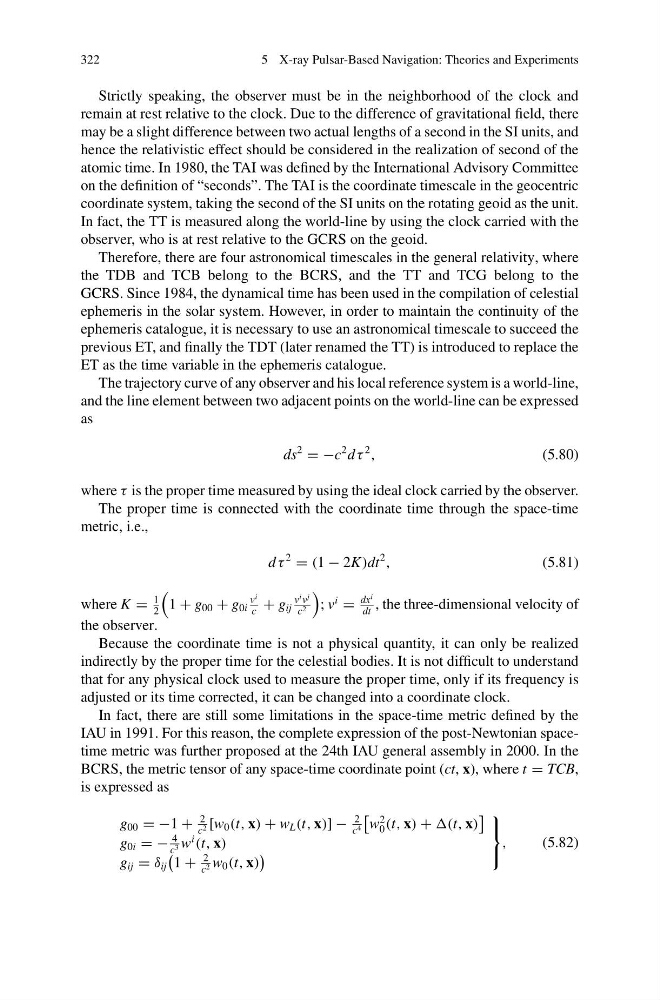
In fact, there are still some limitations in the space-time metric defined by the
IAU in 1991. For this reason, the complete expression of the post-Newtonian spacetime metric was further proposed at the 24th IAU general assembly in 2000. In the
BCRS, the metric tensor of any space-time coordinate point (ct, x), where t = TCB,
is expressed as
g 00 = −1 +
2
c 2 [w 0 (t, x) + w L (t, x)] −
2
c 4
w
2
0 (t, x) + (t, x)
g 0i = −
4
c 3 w
i
(t, x)
g ij = δ ij
1 +
2
c 2 w 0 (t, x)
⎫
⎬
⎭
,
(5.82)
5 X-ray Pulsar-Based Navigation: Theories and Experiments
Strictly speaking, the observer must be in the neighborhood of the clock and
remain at rest relative to the clock. Due to the difference of gravitational field, there
may be a slight difference between two actual lengths of a second in the SI units, and
hence the relativistic effect should be considered in the realization of second of the
atomic time. In 1980, the TAI was defined by the International Advisory Committee
on the definition of “seconds”. The TAI is the coordinate timescale in the geocentric
coordinate system, taking the second of the SI units on the rotating geoid as the unit.
In fact, the TT is measured along the world-line by using the clock carried with the
observer, who is at rest relative to the GCRS on the geoid.
Therefore, there are four astronomical timescales in the general relativity, where
the TDB and TCB belong to the BCRS, and the TT and TCG belong to the
GCRS. Since 1984, the dynamical time has been used in the compilation of celestial
ephemeris in the solar system. However, in order to maintain the continuity of the
ephemeris catalogue, it is necessary to use an astronomical timescale to succeed the
previous ET, and finally the TDT (later renamed the TT) is introduced to replace the
ET as the time variable in the ephemeris catalogue.
The trajectory curve of any observer and his local reference system is a world-line,
and the line element between two adjacent points on the world-line can be expressed
as
ds
2
= −c
2 d τ
2
,
(5.80)
where τ is the proper time measured by using the ideal clock carried by the observer.
The proper time is connected with the coordinate time through the space-time
metric, i.e.,
d τ
2
= (1 − 2K)dt
2
,
(5.81)
where K =
1
2
1 + g 00 + g 0i
v
i
c
+ g ij
v
i v
j
c 2
; v
i
=
dx
i
dt
, the three-dimensional velocity of
the observer.
Because the coordinate time is not a physical quantity, it can only be realized
indirectly by the proper time for the celestial bodies. It is not difficult to understand
that for any physical clock used to measure the proper time, only if its frequency is
adjusted or its time corrected, it can be changed into a coordinate clock.
In fact, there are still some limitations in the space-time metric defined by the
IAU in 1991. For this reason, the complete expression of the post-Newtonian spacetime metric was further proposed at the 24th IAU general assembly in 2000. In the
BCRS, the metric tensor of any space-time coordinate point (ct, x), where t = TCB,
is expressed as
g 00 = −1 +
2
c 2 [w 0 (t, x) + w L (t, x)] −
2
c 4
w
2
0 (t, x) + (t, x)
g 0i = −
4
c 3 w
i
(t, x)
g ij = δ ij
1 +
2
c 2 w 0 (t, x)
⎫
⎬
⎭
,
(5.82)