

306
5 X-ray Pulsar-Based Navigation: Theories and Experiments
the general relativity principle, but it is uncertain that the general relativity principle
is derived from the equivalence principle. Both are independent of each other and
constitute together the fundamental theoretical system of the general relativity.
The equivalence principle extends the concept of gravity and implies that the
space-time of gravitational field is a curved Riemannian space. The physical effect
of gravitational field can be reflected by the metric tensor of the Riemannian space.
Similar to Newton’s gravitational theory, the distribution of gravitational potential
depends on that of the density of static matter, so the metric field should depend on
the energy-momentum tensor of matter. By the tensor analysis of Riemannian space,
Einstein derived that the differential equation of metric field is as follows:
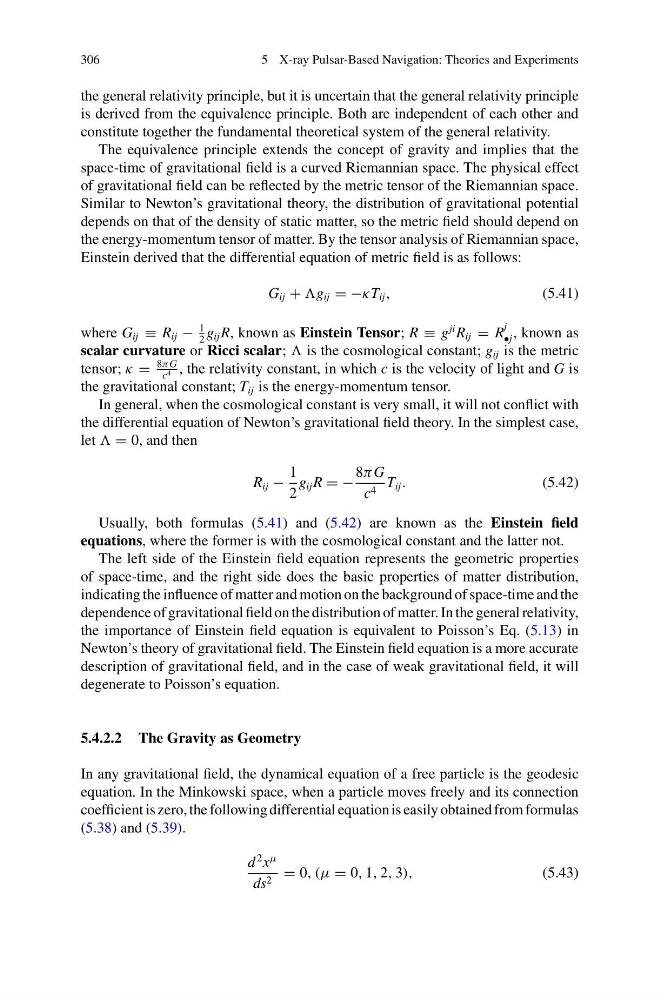
G ij + g ij = −κT ij ,
(5.41)
where G ij ≡ R ij −
1
2
g ij R, known as Einstein Tensor; R ≡ g
ji R ij = R
j
•j , known as
scalar curvature or Ricci scalar; is the cosmological constant; g ij is the metric
tensor; κ =
8πG
c 4 , the relativity constant, in which c is the velocity of light and G is
the gravitational constant; T ij is the energy-momentum tensor.
In general, when the cosmological constant is very small, it will not conflict with
the differential equation of Newton’s gravitational field theory. In the simplest case,
let = 0, and then
R ij −
1
2
g ij R = −
8π G
c 4 T ij .
(5.42)
Usually, both formulas (5.41) and (5.42) are known as the Einstein field
equations, where the former is with the cosmological constant and the latter not.
The left side of the Einstein field equation represents the geometric properties
of space-time, and the right side does the basic properties of matter distribution,
indicating the influence of matter and motion on the background of space-time and the
dependence of gravitational field on the distribution of matter. In the general relativity,
the importance of Einstein field equation is equivalent to Poisson’s Eq. (5.13) in
Newton’s theory of gravitational field. The Einstein field equation is a more accurate
description of gravitational field, and in the case of weak gravitational field, it will
degenerate to Poisson’s equation.
5.4.2.2 The Gravity as Geometry
In any gravitational field, the dynamical equation of a free particle is the geodesic
equation. In the Minkowski space, when a particle moves freely and its connection
coefficient is zero, the following differential equation is easily obtained from formulas
(5.38) and (5.39).
d
2 x
μ
ds 2 = 0, (μ = 0, 1, 2, 3),
(5.43)
5 X-ray Pulsar-Based Navigation: Theories and Experiments
the general relativity principle, but it is uncertain that the general relativity principle
is derived from the equivalence principle. Both are independent of each other and
constitute together the fundamental theoretical system of the general relativity.
The equivalence principle extends the concept of gravity and implies that the
space-time of gravitational field is a curved Riemannian space. The physical effect
of gravitational field can be reflected by the metric tensor of the Riemannian space.
Similar to Newton’s gravitational theory, the distribution of gravitational potential
depends on that of the density of static matter, so the metric field should depend on
the energy-momentum tensor of matter. By the tensor analysis of Riemannian space,
Einstein derived that the differential equation of metric field is as follows:
G ij + g ij = −κT ij ,
(5.41)
where G ij ≡ R ij −
1
2
g ij R, known as Einstein Tensor; R ≡ g
ji R ij = R
j
•j , known as
scalar curvature or Ricci scalar; is the cosmological constant; g ij is the metric
tensor; κ =
8πG
c 4 , the relativity constant, in which c is the velocity of light and G is
the gravitational constant; T ij is the energy-momentum tensor.
In general, when the cosmological constant is very small, it will not conflict with
the differential equation of Newton’s gravitational field theory. In the simplest case,
let = 0, and then
R ij −
1
2
g ij R = −
8π G
c 4 T ij .
(5.42)
Usually, both formulas (5.41) and (5.42) are known as the Einstein field
equations, where the former is with the cosmological constant and the latter not.
The left side of the Einstein field equation represents the geometric properties
of space-time, and the right side does the basic properties of matter distribution,
indicating the influence of matter and motion on the background of space-time and the
dependence of gravitational field on the distribution of matter. In the general relativity,
the importance of Einstein field equation is equivalent to Poisson’s Eq. (5.13) in
Newton’s theory of gravitational field. The Einstein field equation is a more accurate
description of gravitational field, and in the case of weak gravitational field, it will
degenerate to Poisson’s equation.
5.4.2.2 The Gravity as Geometry
In any gravitational field, the dynamical equation of a free particle is the geodesic
equation. In the Minkowski space, when a particle moves freely and its connection
coefficient is zero, the following differential equation is easily obtained from formulas
(5.38) and (5.39).
d
2 x
μ
ds 2 = 0, (μ = 0, 1, 2, 3),
(5.43)