

296
5 X-ray Pulsar-Based Navigation: Theories and Experiments
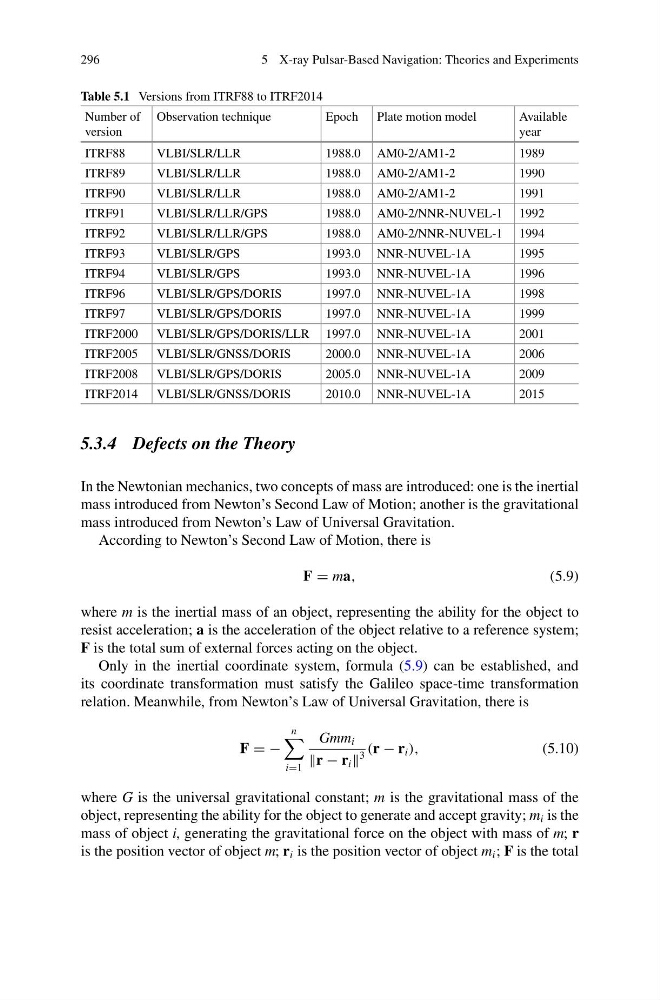
Table 5.1 Versions from ITRF88 to ITRF2014
Number of
version
Observation technique
Epoch Plate motion model
Available
year
ITRF88
VLBI/SLR/LLR
1988.0 AM0-2/AM1-2
1989
ITRF89
VLBI/SLR/LLR
1988.0 AM0-2/AM1-2
1990
ITRF90
VLBI/SLR/LLR
1988.0 AM0-2/AM1-2
1991
ITRF91
VLBI/SLR/LLR/GPS
1988.0 AM0-2/NNR-NUVEL-1 1992
ITRF92
VLBI/SLR/LLR/GPS
1988.0 AM0-2/NNR-NUVEL-1 1994
ITRF93
VLBI/SLR/GPS
1993.0 NNR-NUVEL-1A
1995
ITRF94
VLBI/SLR/GPS
1993.0 NNR-NUVEL-1A
1996
ITRF96
VLBI/SLR/GPS/DORIS
1997.0 NNR-NUVEL-1A
1998
ITRF97
VLBI/SLR/GPS/DORIS
1997.0 NNR-NUVEL-1A
1999
ITRF2000 VLBI/SLR/GPS/DORIS/LLR 1997.0 NNR-NUVEL-1A
2001
ITRF2005 VLBI/SLR/GNSS/DORIS
2000.0 NNR-NUVEL-1A
2006
ITRF2008 VLBI/SLR/GPS/DORIS
2005.0 NNR-NUVEL-1A
2009
ITRF2014 VLBI/SLR/GNSS/DORIS
2010.0 NNR-NUVEL-1A
2015
5.3.4 Defects on the Theory
In the Newtonian mechanics, two concepts of mass are introduced: one is the inertial
mass introduced from Newton’s Second Law of Motion; another is the gravitational
mass introduced from Newton’s Law of Universal Gravitation.
According to Newton’s Second Law of Motion, there is
F = ma,
(5.9)
where m is the inertial mass of an object, representing the ability for the object to
resist acceleration; a is the acceleration of the object relative to a reference system;
F is the total sum of external forces acting on the object.
Only in the inertial coordinate system, formula (5.9) can be established, and
its coordinate transformation must satisfy the Galileo space-time transformation
relation. Meanwhile, from Newton’s Law of Universal Gravitation, there is
F = −
n
i=1
Gmm i
r − r i
3
(r − r i ),
(5.10)
where G is the universal gravitational constant; m is the gravitational mass of the
object, representing the ability for the object to generate and accept gravity; m i is the
mass of object i, generating the gravitational force on the object with mass of m; r
is the position vector of object m; r i is the position vector of object m i ; F is the total
5 X-ray Pulsar-Based Navigation: Theories and Experiments
Table 5.1 Versions from ITRF88 to ITRF2014
Number of
version
Observation technique
Epoch Plate motion model
Available
year
ITRF88
VLBI/SLR/LLR
1988.0 AM0-2/AM1-2
1989
ITRF89
VLBI/SLR/LLR
1988.0 AM0-2/AM1-2
1990
ITRF90
VLBI/SLR/LLR
1988.0 AM0-2/AM1-2
1991
ITRF91
VLBI/SLR/LLR/GPS
1988.0 AM0-2/NNR-NUVEL-1 1992
ITRF92
VLBI/SLR/LLR/GPS
1988.0 AM0-2/NNR-NUVEL-1 1994
ITRF93
VLBI/SLR/GPS
1993.0 NNR-NUVEL-1A
1995
ITRF94
VLBI/SLR/GPS
1993.0 NNR-NUVEL-1A
1996
ITRF96
VLBI/SLR/GPS/DORIS
1997.0 NNR-NUVEL-1A
1998
ITRF97
VLBI/SLR/GPS/DORIS
1997.0 NNR-NUVEL-1A
1999
ITRF2000 VLBI/SLR/GPS/DORIS/LLR 1997.0 NNR-NUVEL-1A
2001
ITRF2005 VLBI/SLR/GNSS/DORIS
2000.0 NNR-NUVEL-1A
2006
ITRF2008 VLBI/SLR/GPS/DORIS
2005.0 NNR-NUVEL-1A
2009
ITRF2014 VLBI/SLR/GNSS/DORIS
2010.0 NNR-NUVEL-1A
2015
5.3.4 Defects on the Theory
In the Newtonian mechanics, two concepts of mass are introduced: one is the inertial
mass introduced from Newton’s Second Law of Motion; another is the gravitational
mass introduced from Newton’s Law of Universal Gravitation.
According to Newton’s Second Law of Motion, there is
F = ma,
(5.9)
where m is the inertial mass of an object, representing the ability for the object to
resist acceleration; a is the acceleration of the object relative to a reference system;
F is the total sum of external forces acting on the object.
Only in the inertial coordinate system, formula (5.9) can be established, and
its coordinate transformation must satisfy the Galileo space-time transformation
relation. Meanwhile, from Newton’s Law of Universal Gravitation, there is
F = −
n
i=1
Gmm i
r − r i
3
(r − r i ),
(5.10)
where G is the universal gravitational constant; m is the gravitational mass of the
object, representing the ability for the object to generate and accept gravity; m i is the
mass of object i, generating the gravitational force on the object with mass of m; r
is the position vector of object m; r i is the position vector of object m i ; F is the total